





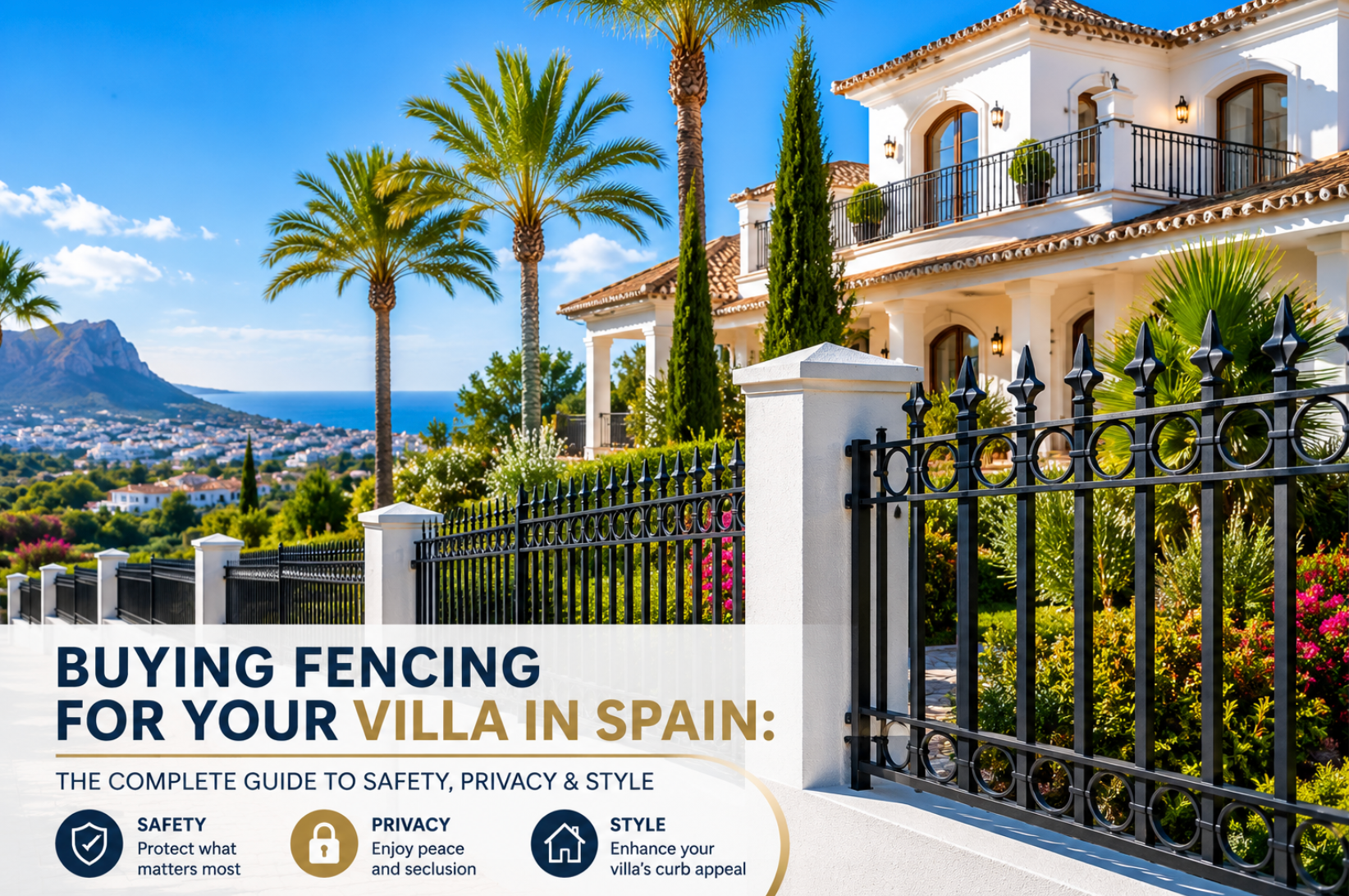
Why your villa’s fencing in Spain matters more than you think
In Spain, a villa’s perimeter is never merely a line on the ground. It is the quiet guardian of your privacy, the first layer of your family’s security, a punctuation of style that introduces your home to the street and frames your garden’s ambience. The right fencing choice does all of this while complying with local planning rules, withstanding Mediterranean sun and coastal breezes, and complementing the architectural character that drew you to your villa in the first place. Done well, fencing elevates not only the look and feel of your property but also its liveability, safety, and long-term value.
Yet, selecting and buying fencing in Spain is not simply a matter of finding a design you like. The country’s legal and planning environment is distinct; municipal rules can be highly localised; property boundaries can hold surprises; and microclimates—from the salt-laden air of the Balearics to the dry heat of inland Andalusia and the gusty conditions on parts of the Costa Brava—demand deliberate material choices. A well-planned fence is a synthesis of regulation, engineering, design, and lifestyle. This guide offers a complete, practical pathway from first considerations to flawless execution, with a focus on safety, privacy, and style tailored to Spanish villas.
Whether you are creating a tranquil sanctuary in a bustling urbanisation, enclosing a rural finca with traditional stonework, or articulating a crisp, modern line around a contemporary coastal home, the following sections will help you navigate regulations, choose the best materials, detail a secure and elegant design, manage costs, and ensure enduring performance. The result should not just be “a fence,” but a crafted edge to your life at home—robust, beautiful, and perfectly attuned to its setting.
Understanding Spain’s legal and planning framework for fencing
Before you select a panel, commission a gate, or book a contractor, invest time in understanding the regulatory context that governs fencing in Spain. Requirements vary between autonomous communities and municipalities, and often between urban and rustic land classifications within the same municipality. While the following guidance is comprehensive, always confirm particulars with your local Ayuntamiento (town hall) and, where relevant, your community of owners (comunidad de propietarios).
Urban versus rustic land: why classification matters
In Spain, land is commonly classified as urban (suelo urbano) or rustic/non-developable (suelo rústico/no urbanizable). This classification influences what kind of enclosure you can build, its maximum height, how solid it may be, and whether you need a minor works licence (licencia de obra menor) or a more formal permit.
- Urban plots: Typically fall under detailed municipal planning ordinances (ordenanzas). Common rules include a maximum fence height of around 1.5–2.0 metres along front boundaries, sometimes requiring lower, more transparent designs towards the public street (for example, 1.0 metre solid base plus openwork above). Side and rear boundaries may allow greater height or solidity, but rules differ per street and zone.
- Rustic plots: Enclosures are often permitted only if they remain visually permeable and rural in character (e.g., post-and-wire or dry-stone techniques). In protected areas, scenic corridors, or agricultural zones, you may be limited to specific materials or prohibited from building solid walls.
Consult your property’s ficha urbanística (urban planning sheet), which your architect or technical advisor can typically obtain. This document details parameters like allowable heights, setbacks, and materials guidance.
Heights, openness, and the “visibility triangle” at corners
In many Spanish municipalities, fences bordering roads must preserve drivers’ sightlines—especially at corners and driveway exits. Regulations may impose a “visibility triangle” where heights are restricted to a low wall or transparent fencing for a set distance from a junction. It is common for solid front walls to be limited to a lower base (for example, 0.6–1.0 metre) topped by railings or openwork elements that allow airflow and visibility.
When placing hedges or dense shrubs near corners or driveways, similar visibility requirements can apply. Even if your fence is compliant, a tall hedge that obstructs visibility can trigger neighbour complaints or municipal notices. Plan planting with sightlines in mind.
Licences, notifications, and community approvals
Most fencing works on an existing villa require a licencia de obra menor (minor works licence). More substantial works—like tall masonry walls, retaining walls, or structural elements—can trigger a licencia de obra mayor (major works licence) and require technical drawings stamped by an architect or technical architect. The application typically includes a basic plan, description of works, and, if applicable, details on materials and heights. Fees (tasa urbanística) and works taxes (ICIO) are usually calculated as a percentage of the declared budget.
- Community of owners: If your villa sits within an urbanisation or managed development, the statutes (estatutos) or internal rules may specify allowed designs, colours, or heights. Secure written approval where required before seeking a municipal licence, to avoid costly rework.
- Heritage and protected areas: Certain zones (historic centres, near listed buildings, coastal protection areas, or natural parks) require extra permissions, stricter aesthetics, or outright prohibitions on specific materials.
Allow time for approvals. Minor works licences can be swift in some municipalities yet take several weeks in others. Do not commence construction without the licence in hand; fines and stop-work orders are far costlier than a short wait.
Boundaries, party fences, and neighbour relations
Spain’s cadastral map (Catastro) and property deeds (escritura) may not always align perfectly with physical fences on the ground—especially on older properties. If there is any doubt about the precise line of ownership, commission a topographic survey. A clear, surveyed boundary prevents disputes and allows your contractor to set out accurately.
Party fences and walls—those that sit on the boundary line and are shared—are governed by the Civil Code’s principles of co-ownership and rights to enclosures. In practice:
- If a wall is already shared, both neighbours typically contribute to maintenance proportionally.
- If a new fence is to be placed exactly on the boundary line, formal neighbour consent helps avoid future conflict. Alternatively, situating the fence entirely within your plot (a small setback) establishes sole ownership, but slightly reduces your usable land.
- Raising the height of an existing shared fence can require neighbour agreement unless clearly permitted by local ordinance and you assume costs on your side without affecting the other.
Open, courteous communication with neighbours saves enormous time and stress. Share your design intentions early, explain how you will manage dust and noise, and address practicalities like access to install along the boundary. Document agreements in writing when feasible.
Coastal and environmental restrictions
Near Spain’s maritime public domain and in certain protected corridors, enclosures may be restricted or required to be visually permeable. If your villa is within a designated coastal influence zone or adjacent to public paths, check with your local authority or coastal department office about fencing limitations. Environmental protections can also affect rustic plots, especially where wildlife corridors or fire-risk management applies.
Pool safety and tourist rental considerations
Spain does not impose a single, nationwide rule mandating pool fencing for private homes. However, safety measures are increasingly encouraged, and rules vary by municipality and autonomous community. If the villa is or may be used for tourist rentals, local regulations or licensing conditions can require specific safety devices, which might include a compliant barrier, self-closing gates, alarms, or certified covers. Always confirm requirements with your local authority to avoid licence issues or liability exposure.
CCTV, lighting, and privacy law
If your fencing plan includes cameras or powerful lighting, ensure compliance with Spanish data protection and privacy norms. As a general principle, private CCTV should not film public thoroughfares or a neighbour’s property beyond what is strictly necessary for security, and signage may be required. Choose lighting that provides effective security while avoiding glare or light trespass. Thoughtful, downward-directed fixtures on timers or motion sensors enhance safety without undermining neighbourhood goodwill.
Defining your objectives: safety, privacy, and style in balance
The best fencing projects begin with a short, pointed brief that captures the “why” behind every decision. Use the following dimensions to articulate a clear goal set for your villa. Clarity here avoids future compromises and helps your designer, contractor, or supplier propose targeted solutions.
Safety and security
- Deterrence versus defence: Do you need a fence that simply signals a clear boundary and discourages opportunistic access, or are you seeking robust resistance to forced entry?
- Gate control: Will you rely on manual gates, or do you need automated access, intercoms, or number-plate recognition for effortless, secure entry?
- Child and pet containment: Are there dogs that jump or dig, or young children needing secure garden boundaries and, possibly, pool protection measures?
- Visibility and monitoring: Do you prefer see-through fencing for natural surveillance from the house, or increased privacy around sensitive areas with strategic screening?
Privacy and comfort
- Screening level: Decide where you need full opacity (e.g., pool terraces, bedroom patios) versus partial screening (e.g., front garden where you still want a friendly connection to the street).
- Noise and wind moderation: Is there road noise to mitigate or coastal wind to temper? Materials and layouts can meaningfully affect microclimate and sound levels.
- Light management: Consider how fence height and planting interplays with sun paths. Aim to preserve winter light while providing summer shade, particularly on south- and west-facing edges.
Style and architectural character
- Regional cues: Embrace or respectfully reinterpret local vernacular—white rendered walls with timber gates in Ibiza, honey-toned stone in the Balearics, hand-wrought iron in Andalusia, crisp slatted aluminium on Costa Blanca modern villas.
- Continuity: Tie fence materials and colours to façades, paving, and garden elements. Repetition and rhythm make a boundary feel integrated rather than tacked-on.
- Entry statement: Gates and pedestrian portals are focal points. Consider bespoke ironwork, timber craftsmanship, or minimalist aluminium frames with concealed hinges for refinement.
Longevity, maintenance, and budget
- Durability expectations: Coastal environments require high corrosion resistance. Mountain microclimates demand resilience against temperature swings. Choose accordingly to reduce future maintenance.
- Maintenance appetite: Honest assessment is key. Timber can be exquisite, yet demands periodic finishing. Powder-coated aluminium or rendered masonry may better fit a lock-and-leave lifestyle.
- Lifecycle cost: Consider initial outlay plus upkeep. A slightly higher upfront investment often pays back in fewer interventions and longer service life.
Materials: pros, cons, and best uses around Spanish villas
Your choice of materials sets the tone for both performance and aesthetics. Spain’s climate zones, coastal salinity, and regional styles reward careful selection. Below is a comprehensive overview to help you match materials to your objectives.
Masonry walls: rendered block, brick, and stone
Rendered blockwork (concrete masonry units finished with render) is ubiquitous in many Spanish municipalities. It delivers solidity, privacy, and excellent noise reduction. Render can be smooth, textured, or trowelled for artisan character, and painted in colours that harmonise with local palettes. For a refined look, finish with a coping stone featuring a drip edge to throw water clear of the face and reduce staining.
- Advantages: Robust, durable, strong privacy and security, good acoustic attenuation, broad aesthetic range.
- Considerations: Requires good foundations; improper detailing can lead to cracking or damp issues (efflorescence). Solid walls can be wind sails; height and reinforcement must reflect local wind loads. Permissions are more stringent than for lighter fences.
- Best for: Side and rear boundaries needing privacy, street walls with solid base plus openwork above, terraced plots where you can combine retaining and enclosure.
Brickwork brings warmth and texture. In some regions, traditional brick bonds are celebrated features. Brick resists UV and, with proper detailing, can be very low maintenance.
- Advantages: Timeless aesthetic, robust, minimal upkeep.
- Considerations: Skilled craftsmanship is essential to avoid uneven coursing or moisture traps. Costs vary based on brick type and labour.
Natural stone is an elegant option, often reflecting local geology: marés in the Balearics, limestone and sandstone across the peninsula, granite in the north, or dry-stone techniques (mampostería en seco) in rustic settings. Stone walls can be mortared or dry-stacked, the latter prized in rural zones for its breathability and traditional character.
- Advantages: Exceptional longevity, sense of place, high-end appeal, excellent thermal mass, acoustic performance.
- Considerations: Highest initial cost for quality stone and craftsmanship; weight demands substantial foundations; permissions may prefer or require dry-stone in rural contexts.
Gabions (wire baskets filled with stones) offer a contemporary-meets-rustic look, ideal where you want mass and texture with good drainage. They can be faced with local rock for visual integration.
- Advantages: Permeable to water, excellent for slope stabilisation, quick to install on prepared bases, modern aesthetic.
- Considerations: Use high-grade, corrosion-resistant mesh near the coast; prevent vegetation and debris build-up; precision in alignment is crucial for a crisp result.
Metals: wrought iron, steel mesh, aluminium, and corten
Wrought iron and decorative steel railings are hallmarks of Andalusian and Mediterranean design. When galvanised and powder-coated, they offer long service life and strong security. From classic scrollwork to geometric modern patterns, ironwork provides elegance without full visual closure—perfect for front boundaries that need openness.
- Advantages: Refined aesthetics, strong, customisable, pairs beautifully with masonry plinths and pillars.
- Considerations: Requires quality coatings to prevent corrosion; intricate designs can add cost; offers limited privacy without added screening.
Welded mesh panels and steel bar systems are excellent for secure, contemporary enclosures. They resist cutting and climbing when specified with small apertures and robust framing. Galvanised and powder-coated finishes perform well, though coastal installations benefit from enhanced anti-corrosion treatments and maintenance schedules.
- Advantages: High security-to-weight ratio, clean lines, consistent modules, quick installation.
- Considerations: Limited privacy unless combined with slats or planting; quality of fixings and anchorage determines long-term stability.
Aluminium slat fencing is a standout for modern villas: lightweight, corrosion-resistant, and available in a wide range of powder-coated colours and timber-look finishes. Slats can be angled (louvred) for controlled privacy and airflow.
- Advantages: Low maintenance, coastal-friendly, adjustable privacy via slat spacing and angle, sleek aesthetic.
- Considerations: Higher upfront cost than basic steel mesh; cheaper, thin-gauge systems can rattle in wind—choose robust profiles and quality fixings.
Corten steel develops a protective rust patina, bringing warmth and artistry to garden edges and feature screens. It is best used as an accent, in combination with masonry or planting, to avoid an overly industrial look.
- Advantages: Sculptural presence, virtually no painting needed once patinated, stunning with Mediterranean planting palettes.
- Considerations: Initial run-off can stain adjacent paving or render; not ideal in marine spray zones; thoughtful detailing for drainage and isolation from sensitive surfaces is essential.
Stainless steel (preferably marine-grade 316 in coastal environments) is resilient but more often used in fixings, hinges, tensioned cables, and gate hardware than in full fencing. It is a premium choice where longevity and precision detailing are priorities.
Timber and composites
Softwoods (such as pine) can be pressure-treated for outdoor use. For ground contact, ensure Use Class 4 treatment; for above-ground, Use Class 3 may suffice. Timber brings natural warmth and softness to a boundary, with vertical or horizontal slatting providing varying privacy levels.
- Advantages: Tactile, adaptable, can be DIY-friendly, pairs beautifully with white render and stone.
- Considerations: Requires periodic maintenance (staining/oiling/painting). Watch for UV greying, checking, and movement. Avoid direct ground contact where possible.
Hardwoods (such as iroko or teak alternatives) offer superior stability and longevity but come at a premium. Always ensure responsible sourcing. Hardwoods are excellent for gates and select feature sections where tactile quality is most appreciated.
Wood–plastic composites (WPC) provide a timber-like appearance with reduced maintenance. Quality varies significantly; superior systems offer UV stability, hidden fixings, and sound structural elements.
- Advantages: Low maintenance, consistent appearance, good for coastal and lock-and-leave homes.
- Considerations: Can heat up in strong sun; aesthetic is less organic than real timber; ensure colourfastness warranties and robust substructure.
PVC and vinyl fencing
Modern PVC/vinyl systems can be attractive and durable, offering clean lines and a broad palette. They are particularly useful for privacy panels in consistent modular runs and can integrate well with masonry pillars.
- Advantages: Low maintenance, colourfast options, easy to clean.
- Considerations: Look for UV-stabilised, high-quality systems; cheaper products can brittle under sun exposure; choose reinforced profiles for wind-prone sites.
Glass and acrylic
Frameless or minimally framed toughened glass delivers a crisp, contemporary boundary—common around pools and terraces where preserving views is essential. For pool areas, use appropriate safety glass and hardware. Clear glass offers no privacy, but etched or fluted glass can diffuse views while retaining light.
- Advantages: Minimal visual impact, wind-moderation without visual bulk, perfect for view corridors.
- Considerations: Requires meticulous installation; regular cleaning of water spots/salt spray; not ideal for complete privacy; specify thickness for wind load and safety.
Living fences: hedges, bamboo, and climbers
Hedges provide beautiful, biophilic boundaries that soften masonry or metal and create habitats for birds and pollinators. Mediterranean favourites include oleander, viburnum, pittosporum, photinia, and privet; drought-tolerant and salt-tolerant options exist for coastal sites. In wildfire-prone areas, consider species with lower flammability and maintain defensible space in line with local guidance.
- Advantages: Seasonal interest, cooling through evapotranspiration, acoustic softening.
- Considerations: Require irrigation in the establishment phase (and often beyond), pruning, and pest management. Some species are allergen-prone or messy near pools.
Bamboo and reed screens can provide quick, natural-looking privacy but are best used as secondary cladding to a stable structure (e.g., fixed to a metal or timber fence). Avoid running varieties of live bamboo without proper containment, as it can spread aggressively.
Climbers like bougainvillea, jasmine, and wisteria can transform a simple trellis into living art. Ensure supports are strong, consider thorns near walkways, and protect rendered walls with stand-off trellises to allow airflow and reduce damp staining.
Hybrid solutions
Many of the most successful fences mix materials: a rendered base for solidity, aluminium slats for privacy and airflow, stone pillars for gravitas, and a green tapestry of planting for softness. Hybrids balance performance with aesthetics—precisely the alchemy that makes Spanish villas shine.
Designing for safety and security
Good security is layered: psychological deterrence, physical resistance, and intelligent detection. Your fence and gates are the most visible layer. Design them to prevent easy access while complementing the home’s style and day-to-day usability.
Heights, profiles, and anti-climb strategies
- Height: For general deterrence, 1.8–2.2 metres is a common target where permitted. In urban zones, front boundaries often must be lower or more open; use increased height along side and rear boundaries for stronger protection.
- Profiles: Vertical slats with minimal horizontal footholds reduce climbability. Where slatted fences are used, avoid wide rails at climbable intervals.
- Toppings: In higher-risk settings, discreet angled capping, dense planting, or security mesh extensions can improve resistance without resorting to aggressive features that neighbours or regulators may object to.
Anti-cut and tamper-resistant details
- Materials: Choose welded steel mesh panels with small apertures and substantial wire diameter for cut resistance. For aluminium slats, use robust wall thicknesses and reinforced posts.
- Fixings: Use tamper-resistant fasteners and conceal brackets where possible. Rivets and coach bolts can outperform standard screws for security. Stainless or coated fasteners prevent corrosion-related weakening.
- Posts and footings: Deep, well-anchored posts with concrete footings deter uplifting or ramming. On sloping ground, step footings rather than raking posts for strength and aesthetics.
Gates: the nerve centres of security
Gates require special attention because they concentrate traffic and strain. Design them as integrated systems, not mere afterthoughts.
- Driveway gates: Sliding gates save space on tight plots and are wind-resilient. Swing gates suit traditional aesthetics; specify robust hinges, stops, and closers. Either can be automated with motors sized for gate weight and wind exposure.
- Automation and controls: Choose EU-compliant systems with safety edges, photocells, and obstruction detection. Integrate video intercoms, keypad entry, remote fobs, and smartphone controls. Battery back-up and manual release ensure access during power outages.
- Pedestrian gates: Prioritise self-closing hinges, quality latches, and closers that do not slam in wind. For pool-adjacent gates, use child-resistant latches mounted high and outward-opening leafs where appropriate.
- Foundations and frames: Gates concentrate loads at hinge posts. Oversize posts and footings, use steel reinforcement in masonry pillars, and specify durable, greasable hinges suited to local wind conditions.
Lighting and integrated detection
Layer in smart security without turning the home into a fortress. Low-glare, downward-facing LED lighting along entry points and dark corners improves deterrence while keeping the garden inviting at night. Pair with discreet perimeter sensors, gate status alerts, and, where permitted, cameras angled to monitor only your property. Position electrics in weatherproof enclosures, run conduit within walls or underground, and label runs for future maintenance.
Pets and family safety
- Dogs: Reduce gaps at the base with gravel boards or concrete toe beams. For dig-prone breeds, bury a mesh apron or install a low wall. Choose heights commensurate with jumping ability.
- Children: Avoid ladder-like fencing profiles; choose self-closing gates with child-resistant latches; ensure no entrapment hazards in rails or balustrade gaps.
- Pools: Where you add barriers, maintain clear zones free of climbable furniture or planters near the fence line.
Designing for privacy and comfort
Privacy is not merely about blocking views; it is about crafting calmness and comfort. In Spain, outdoor living is a way of life, so the best fences create microclimates that extend your usable seasons while screening precisely where needed.
Mapping sightlines and choreographing views
Walk your property at various times of day. Identify where neighbours can see in, where the street overlooks your garden, and which views you wish to protect or frame. Use higher opacity around pools, terraces, and bedroom patios. For frontages, pair lower or openwork elements with strategic planting that screens eye level while keeping the façade welcoming.
Balancing airflow and seclusion
Complete opacity can trap hot air on still summer days. Louvred aluminium slats, widely spaced timber battens, or perforated metal panels maintain privacy while encouraging breezes. Planting adds evaporative cooling and a sensory layer—fragrance, movement, shade—that pure hardscape cannot provide.
Acoustic comfort
Solid, heavy fences like masonry and gabions block sound via mass—the “mass law” principle. A rendered wall of sufficient thickness can deliver meaningful reductions in road noise. For greater performance, consider double-skin solutions with an absorptive inner lining to reduce reflections into your garden. If noise is sporadic, strategic earthen berms or densely planted hedges near the source can complement fencing without overwhelming your design.
Wind, shade, and microclimate
Spain’s coastal and inland winds shape daily comfort. On wind-exposed plots, introduce angled slats or porous windbreak panels that reduce gust velocities without creating dangerous suction forces. Add pergolas and trellises near fence lines for dappled shade and intimacy. Consider deciduous climbers on the south or west sides to allow winter sun and provide summer cooling.
Style and regional aesthetics: harmonising with Spanish vernacular
Use your fence to express and enhance the spirit of place. Spain’s regions each offer cues to guide material, colour, and detail choices.
Balearic poetry: stone and light
In the Balearic Islands, honeyed marés stone and limewashed walls sit naturally among pines and olive trees. Pair low dry-stone walls with taller sections of white-rendered masonry topped by slim, sand-toned aluminium slats for privacy. Timber gates in oiled hardwood or timber-look aluminium nod to tradition while suiting coastal maintenance needs. Keep hardware discreet and marine-grade.
Ibizan minimalism: white, wood, and shadow lines
Ibiza’s refined minimalism thrives on simple geometry, bright whites, and tactile natural accents. Rendered walls with soft radiused corners, pale composite or hardwood slats, and frameless glass wind-screens around terraces achieve an ethereal look. Use integrated lighting to create gentle washes of light on smooth plaster at night.
Andalusian character: ironwork and courtyards
Andalusia celebrates wrought ironwork, patterned tiles, and earthy tones. Low, solid walls in textured render or brickwork—capped with terracotta tiles—support elegant iron railings and artisan gates, possibly incorporating geometric motifs or subtle scrolls. Climbers like jasmine and bougainvillea soften and scent the boundary, evoking courtyard intimacy.
Costa Blanca and Valencia modernism: crisp lines and contrast
Along the Costa Blanca and in much of the Valencian Community, contemporary villas favour sharp lines, white façades, and contrasting dark or timber-accent details. Aluminium slat fencing in charcoal, bronze, or timber-effect tones paired with white-rendered bases delivers privacy and a coherent language. Slim, linear mailboxes and flush-fitting pedestrian gates keep the composition sleek.
Catalan and northern solidity: stone, brick, and greenery
In Catalonia and the greener northern regions, heavier materials feel at home. Stone or brick walls with metal infill panels, lush hedging, and climbers capture a sense of permanence. Where rainfall is higher, incorporate generous copings and drip edges to protect vertical surfaces and reduce moss growth.
Performance in coastal, inland, and mountain environments
Spain’s varied climates ask different questions of your fence. Materials and detailing should respond accordingly.
Coastal resilience
- Corrosion resistance: Salt-laden air accelerates metal corrosion. Favour hot-dip galvanised steel with high-quality powder coating, marine-grade stainless fixings, or aluminium systems designed for coastal exposure.
- Glass care: Specify marine-grade fittings. Plan for regular rinsing to remove salt spray and prevent spotting.
- Timber and composites: Use durable species or composites with UV stability. Keep timber off the ground and ensure proper drainage at all junctions.
- Wind loads: Account for strong gusts and channelled winds. Opt for slatted fences over large solid planes where allowed, and upsize posts and footings.
Inland heat and UV
- Colour and heat: Dark colours absorb heat; choose lighter finishes or materials with thermal stability to avoid warping.
- UV stability: Prioritise UV-stabilised coatings, paints, and composite systems with proven performance. Timber finishes should include high-quality UV blockers.
- Irrigation and planting: Drought-tolerant hedging and drip irrigation protect living screens through hot summers.
Mountain and cooler microclimates
- Thermal movement: Detail joints and fixings to accommodate expansion and contraction. Avoid long, uninterrupted runs without expansion breaks in masonry.
- Moisture management: Generous copings, breathable renders, and weep holes for retaining walls help prevent damp and frost damage.
- Snow and wind: Consider load paths for occasional snow and more frequent winds; ensure gates and hinges are sized for gust conditions.
Engineering and construction: details that ensure longevity
Even the best design fails without sound engineering and quality construction. Insist on details and workmanship that respect Spain’s climate and your municipality’s structural expectations.
Foundations and posts
- Post footings: For panel fences, typical post centres range from 1.8 to 2.5 metres. Footings must extend below topsoil into competent strata; in much of Spain, frost depth is modest, but local conditions vary. A common rule is footing depth equal to one-third of post height above ground, widened and reinforced for high winds.
- Masonry foundations: Continuous strip footings with reinforcing steel are common for walls. Dimensioning depends on soil bearing capacity, wall height, and any surcharge from level changes behind the wall.
- Anchorage: Chemical anchors and base plates can fix posts to existing concrete, but embedded posts in new concrete footings often offer superior rigidity. Protect embedded steel with coatings and caps to reduce corrosion.
Retaining walls and stepped fences
On terraced or sloping plots, retaining elements must be properly engineered to handle lateral earth pressure and water. Combine drainage layers, perforated pipe (with outlets), and weep holes. Step fences in discrete increments to maintain level panel tops while following the ground; avoid raking panels unless the design specifically calls for it and wind performance is addressed.
Drainage, damp, and efflorescence
Water is masonry’s adversary. Specify capillary breaks, damp-proof courses where needed, breathable renders or paints, and copings with drip edges. Keep soil and planting back from wall faces to allow airflow. If efflorescence appears (white salts), it often indicates trapped moisture—address causes, not just symptoms, by improving drainage and protective detailing.
Fasteners and fixings: the smallest parts with the biggest consequences
Mismatched metals can cause galvanic corrosion. In coastal settings, pair aluminium with stainless fixings designed to avoid direct contact where possible (use isolation gaskets). Hot-dip galvanising outperforms simple electroplating for steel components. Hidden fixings create clean aesthetics and reduce tampering but must remain serviceable.
Quality control and tolerances
Insist on plumb posts, level caps, consistent panel spacing, and clean terminations at corners and gates. A well-built fence shows its quality in the shadows it casts: straight lines, even rhythms, refined junctions. Create a snagging list at handover, addressing minor touch-ups, movement tolerances, and gate alignment after initial settling.
Procurement and cost planning: investing wisely
Budgeting for fencing in Spain benefits from a lifecycle perspective—consider both initial outlay and long-term care. Costs vary by region, site complexity, and finish quality. While precise figures require site-specific quotes, the following guidance helps frame your planning.
Indicative cost ranges (materials and installation)
- Chain-link or basic mesh fencing: Typically at the lower end per linear metre; best for rustic plots or temporary demarcation where visual quality is secondary.
- Welded mesh panels and steel bar systems: Mid-range; robust, secure, modern appearance. Costs increase with panel height, wire thickness, and coating quality.
- Aluminium slat systems: Mid-to-upper range; pays back through low maintenance and coastal resilience, with premium profiles and bespoke colours at the higher end.
- Rendered blockwork walls: Mid-to-upper range depending on height, reinforcement, and finish quality; includes foundation and coping detailing.
- Natural stone walls: Upper range; reflects material selection and artisan labour; dry-stone techniques can require significant craftsmanship.
- Gabions: Mid-to-upper range; sensitive to stone choice and mesh specification.
- Composite fencing: Mid-to-upper range; quality systems with concealed fixings and UV warranties are worth the premium.
- Glass panels: Upper range; safety glass thickness, hardware quality, and wind exposure dictate cost.
- Hedges: Initial outlay ranges widely due to plant sizes and species; factor in irrigation installation and ongoing maintenance.
Gate automation, intercoms, lighting, and premium hardware add to the envelope but significantly improve daily convenience and security. Always collect itemised quotes (presupuesto desglosado), including foundations, waste disposal, finishes, electrics, and VAT (IVA).
Budget management strategies
- Prioritise zones: Invest in high-spec frontages and outdoor living areas; economise with simpler boundaries where aesthetics matter less.
- Hybridise: Combine a solid base with cost-effective infill to reduce material and labour while meeting privacy goals.
- Lifecycle thinking: Choose low-maintenance materials in hard-to-reach or wind-exposed areas; reserve higher-maintenance timber for sheltered, feature moments.
- Phasing: If budget is tight, install robust posts and bases first; add premium infill or cladding later without redoing foundations.
Choosing contractors and managing risk
- Credentials and references: Seek contractors accustomed to local regulations and climates. Review completed projects similar to yours.
- Clear scope: Define materials, finishes, heights, gate operations, electrics, and cleanup. A well-drafted scope avoids misunderstandings and extras.
- Programme and access: Agree timelines, site working hours, and access routes. Plan for material deliveries and storage in tight urbanisations.
- Warranties: Request warranties on materials and labour. Clarify maintenance responsibilities that keep warranties valid (e.g., periodic washing of coastal metalwork).
- Permits and compliance: Confirm who secures licences and arranges inspections. Require adherence to safety regulations on-site.
Installation: a clear, step-by-step process
Great construction is choreography: preparation, precision, and protection of the site and neighbours. Here is a typical sequence for a premium fencing project.
1) Survey and set-out
Confirm property boundaries with a topographic survey if needed. Mark fence lines, post centres, gate locations, and changes in level. Identify and mark underground services to prevent damage. Review the plan with your contractor and, where applicable, your neighbour.
2) Site preparation
Clear vegetation where necessary, preserving valuable trees and roots. Establish temporary barriers if you are modifying an existing fence for security during works. Protect paving, façades, and planting with coverings and corner guards.
3) Foundations and posts
Excavate footings to the specified depth and width. Place reinforcement where required and ensure proper cover from soil. For posts, align and level meticulously; use string lines and laser levels to guarantee straight runs. Pour concrete and allow adequate curing time, especially for load-bearing gate posts.
4) Walls and infill
Build masonry in measured lifts, allowing mortar to set and avoiding excessive height gains in a single day. Keep perp joints staggered, maintain level courses, and protect fresh work from rapid drying in hot weather. For panel systems, install rails and panels after posts have fully set, adjusting for even gaps and consistent alignment.
5) Gates and automation
Install gate frames square and true. Set motors on foundations resistant to vibration and water ingress. Configure safety devices—photocells, safety edges—and test thoroughly. Programme remote controls and intercoms; label controls discreetly for future reference.
6) Finishes and detailing
Apply render coats per manufacturer guidance, observing curing times and weather conditions. Paint with high-quality exterior systems suitable for UV and salt exposure as relevant. Fit copings with drip edges, seal sensitive junctions, and install isolation pads between dissimilar metals.
7) Landscaping and clean-up
Reinstate planting beds, mulch to retain moisture, and adjust irrigation to support new hedging or climbers. Clean all surfaces of mortar smears, dust, and fingerprints—particularly glass and stainless steel. Walk through with your contractor to compile a snagging list for final touch-ups.
Maintenance and longevity: protecting your investment
A thoughtful maintenance plan keeps your fencing elegant and effective for years. Schedule light, regular care rather than deferring to infrequent major interventions.
Metalwork
- Cleaning: Rinse with fresh water in coastal zones monthly or quarterly, depending on exposure; wash with mild detergent periodically to remove grime and salts.
- Inspection: Check for coating breaches, rust spots, or loose fixings annually. Touch up minor chips promptly to prevent underfilm corrosion.
- Hardware: Lubricate hinges, locks, and rollers; replace worn nylon guides; check gate alignment after heavy winds.
Masonry
- Surfaces: Inspect render for hairline cracks; seal where needed to prevent water ingress. Clean efflorescence with appropriate cleaners after addressing moisture sources.
- Copings and sealants: Ensure copings remain secure and sealed; renew sealants exposed to UV and movement as needed.
- Retaining walls: Keep drainage outlets clear; monitor for bulging or new cracks and consult an engineer if you observe movement.
Timber and composites
- Timber: Recoat oils or stains on schedule; sand lightly to refresh appearance. Keep sprinklers off timber to reduce staining.
- Composites: Clean with manufacturer-approved agents to prevent staining; avoid harsh abrasives.
Glass
- Cleaning: Use soft water where possible to avoid spotting; apply protective coatings to ease maintenance in marine areas.
- Hardware: Inspect clamps and fixings for tightness and corrosion; clean drain paths at base channels.
Hedges and climbers
- Pruning: Prune for density and shape at species-appropriate times. Avoid heavy cuts during heatwaves.
- Irrigation: Maintain drip systems; adjust seasonally. Mulch to conserve moisture and moderate root-zone temperatures.
- Clearance: Maintain a small gap between dense growth and walls or metalwork to allow airflow and reduce damp problems.
Sustainable and biophilic fencing choices
Enhance your villa’s sustainability footprint by choosing materials and layouts that respect resources and foster biodiversity.
Responsible materials
- Timber: Select responsibly sourced wood and specify treatment levels appropriate to exposure to extend service life and reduce replacements.
- Recycled metals: Aluminium and steel often contain recycled content; powder-coat finishes are low-maintenance and durable.
- Local stone: Using regionally sourced stone reduces transport impact and anchors your design in local character.
Design for durability
- Detailing: Drips, caps, and isolation layers protect materials and limit premature failure.
- Repairability: Choose systems with replaceable panels or slats; keep a small stock of matching components.
Living boundaries and biodiversity
- Hedgerows: Native or climate-adapted mixed hedges support pollinators and birds. Layer species for seasonal interest and ecological resilience.
- Green screens: Pair trellises with climbers to green hard boundaries quickly. Ensure irrigation supports establishment but remains efficient.
Special cases and tailored solutions
Some boundary contexts in Spain require heightened attention to specific functional or regulatory factors. Plan proactively to meet these with elegance.
Pool fencing and terraces
Where pool barriers are chosen or required, aim for an elegant solution that protects without dominating. Frameless glass preserves views; aluminium or composite slats with child-resistant gates offer privacy and airflow. Confirm local safety specifications where applicable, including gate self-closing and latch heights.
Historic or listed contexts
In heritage zones, you may be limited to traditional materials and forms. Lime renders, dry-stone walls, and wrought ironwork can meet both regulatory and aesthetic expectations. Seek early guidance from local heritage authorities and maintain scrupulous craftsmanship.
Sloping, terraced, or retaining conditions
Combine retaining and fencing in a coherent structural solution. Where height is functionally necessary, modulate it with planting terraces, material mixes (e.g., stone base with lighter upper infill), and stepped profiles. Ensure drainage is integral, not retrospective.
Sports courts and enclosures
For tennis or padel courts, specify high-tensile mesh or glass with robust posts and foundations. Consider acoustic buffers if near neighbours—strategic planting and mass walls reduce ball impact noise. Integrate ball-stop netting discreetly at the top for playability without visual clutter.
Equestrian or agricultural edges on rustic land
On rustic plots, traditional post-and-rail or wire fencing maintains rural character and fulfils functional needs. Check local restrictions to retain visual permeability. Use treated or naturally durable posts and consider wildlife-friendly designs that allow small fauna passage where appropriate.
Shared driveways and service access
Where access is shared, formalise rights and responsibilities in writing. Specify gates with access control that honours all users; include fail-safe mechanisms for emergency services. Maintain clear dimensions for delivery vehicles and waste collection.
Common mistakes—and how to avoid them
Learn from others’ missteps to ensure your project is smooth, compliant, and beautiful.
- Ignoring local rules: Building a tall, solid front wall in a zone that mandates openness can trigger fines and forced alterations. Confirm ordinances before committing.
- Under-engineering in windy areas: Slender posts and shallow footings lead to rattling and premature failure. Upsize structures for exposed coastlines and hilltops.
- Mismatched metals: Aluminium panels fixed with low-grade steel screws in marine air will corrode at the fixings first. Use compatible, corrosion-resistant fasteners and isolation pads.
- Poor drainage detailing: Walls without copings or with soil piled against render invite damp, algae, and efflorescence. Use copings with drips and maintain airflow.
- Overly solid boundaries where breezes are needed: A blank wall that achieves privacy but traps heat reduces outdoor comfort. Use louvres or planting to balance seclusion and ventilation.
- Overlooking gates: Under-specifying hinge posts, hardware, or automation creates daily frustrations. Treat gates as priority elements.
- Planting too close: Dense hedges planted tight to walls hinder maintenance and promote damp. Allow breathing room and access.
- Neglecting neighbour communication: Surprising neighbours with boundary works courts conflict. Share intentions early and manage site impacts thoughtfully.
A practical checklist and timeline
Use this as a working tool to steer your project from idea to immaculate completion.
- Define objectives: Security, privacy, style, maintenance appetite, and budget bands.
- Gather documents: Deeds, cadastral plan, community statutes, urban planning sheet (ficha urbanística).
- Survey boundary: Commission topographic survey if there is any doubt.
- Concept design: Choose materials, heights, gate types, and aesthetic direction aligned with local vernacular.
- Neighbour engagement: Discuss shared boundaries, access for works, and any height changes.
- Permissions: Secure community approval if required; apply for municipal licence (obra menor/obra mayor as applicable).
- Detailed specification: Finalise drawings, structural details for posts and walls, fixings, coatings, colours, and electrics.
- Quotations: Obtain itemised quotes from qualified contractors; verify references.
- Contract and programme: Agree schedule, payment plan, responsibilities for permits, waste removal, and site protection.
- Pre-start meeting: Confirm set-out, materials, gate automation plan, power supplies, and temporary security during works.
- Construction: Foundations, posts/walls, panels, gates, finishes, electrics, landscaping restoration.
- Commissioning: Test gates and safety systems; adjust alignments and latches; set lighting timers or sensors.
- Snagging and handover: Walk-through, document items, complete touch-ups, and receive warranties and maintenance guidance.
- Maintenance plan: Calendar cleaning, inspections, and seasonal plant care.
Frequently asked questions about buying fencing for a villa in Spain
Do I always need a licence to build a fence?
Most fencing works require a minor works licence at minimum. Structural walls, retaining elements, and major alterations can require a major works licence and technical documentation. Requirements vary; check with your Ayuntamiento before starting.
How tall can my fence be?
Typical maximum heights along public frontages range from around 1.5 to 2.0 metres, often with restrictions on solid portions. Side and rear boundaries may allow more height. Local ordinances control specifics, and corner plots often have visibility rules.
Can I build my fence directly on the boundary line?
You can, but if the fence is to be shared (party fence), neighbour consent and co-ownership principles apply. Many owners opt for a small setback within their property to avoid co-ownership complexity. Where modifying a shared fence, agreement is best practice.
What is the best fence for a coastal villa?
Aluminium slats with marine-grade coatings, hot-dip galvanised and powder-coated steel mesh with stainless fixings, and thoughtfully detailed masonry perform well. Avoid systems prone to corrosion or with low-quality hardware. Glass works beautifully with regular maintenance and proper fittings.
How do I reduce road noise with fencing?
Use mass: rendered masonry or stone provide the most immediate improvement. Enhance performance by eliminating gaps, adding height within the legal limit, and combining with dense hedging. For significant noise, consult an acoustic specialist for double-skin or absorptive solutions.
Are hedges considered a fence in planning terms?
Planting is generally more flexible, but high hedges that obstruct visibility at corners or exceed community rules can prompt enforcement or neighbour complaints. Hedge height disputes fall under specific local frameworks—avoid issues by designing responsibly and discussing plans with neighbours.
What gate is best for windy sites?
Sliding gates are often more stable in strong winds. If you prefer swing gates, specify perforated or slatted designs to reduce wind loading, and size hinge posts and hardware accordingly.
Do I need a pool fence at my private villa?
Spain does not mandate pool fencing nationwide for private residences, but local rules and tourist rental licensing conditions may require safety barriers or other devices. Regardless, many owners choose barriers as a prudent safety measure. Confirm local specifics with your Ayuntamiento.
How long will an aluminium fence last?
With quality powder coating, marine-grade fixings, and proper installation, aluminium fences can provide decades of service, particularly in coastal regions where they outperform many alternatives with minimal maintenance.
How can I ensure the fence won’t crack or fail over time?
Invest in proper foundations, drainage, compatible materials, and experienced installers. For masonry, include movement joints and protective copings. For panels, anchor posts deeply and select robust sections fit for local wind loads.
Case-led design guidance by scenario
Front boundary with style and welcome
Objective: create a gracious threshold while preserving local openness rules. Solution: a 0.8–1.0 metre rendered wall topped with refined ironwork or slim aluminium slats. Add a bespoke pedestrian gate with a concealed closer, integrated letterbox, and house number backlit at night. Flank the entry with sculptural planting and low, warm landscape lighting.
Secluded pool courtyard
Objective: secure privacy without oppressive mass. Solution: U-shaped perimeter of 1.8–2.0 metre aluminium louvres angled for sightline control, combined with tall ornamental grasses and perfumed shrubs. A frameless glass windscreen preserves a view axis from the terrace. The pedestrian gate is self-closing with a child-resistant latch at compliant height.
Coastal cliffside villa
Objective: resist salt spray and strong gusts while maintaining views. Solution: aluminium slats with marine-grade coatings on reinforced posts and foundations, arranged for airflow. Gate: sliding with brushless motor and surge protection. Lighting: low-glare marine-grade luminaires. Regular rinse-down maintenance scheduled.
Rural finca boundary
Objective: define boundaries in a visually permeable, traditional manner. Solution: low dry-stone wall base with chestnut or acacia post-and-rail, backed by stock-proof mesh where needed. Plant a mixed native hedge set back inside the fence line for habitat and seasonal interest.
Integrating technology elegantly
Smart features can elevate convenience and security without compromising aesthetics.
- Access control: Combine keypad or RFID entry with a sleek video intercom. For frequent guests or deliveries, temporary access codes provide flexibility without spare keys.
- Automation intelligence: Smartphone control lets you open gates for trades or couriers remotely. Battery back-up and solar-assisted motors enhance resilience in outages.
- Perimeter sensors: Discreet vibration or magnetic sensors on gates, paired with lighting scenes, create intelligent responses to after-hours approach.
Legal and practical cautions
This guide provides comprehensive, practical information, yet local rules and site conditions vary. Treat the following as best-practice cautions:
- Verify before you dig: Locate underground services to avoid dangerous and costly strikes.
- Document agreements: Record neighbour consents for shared fences and access. Keep licence approvals and stamped drawings on file.
- Respect public space: Ensure gates do not swing into pavements; avoid planting or fixtures that encroach on public land.
- Privacy compliance: Angle cameras inward and use masking where devices support it. Ensure lighting does not cause nuisance.
- Fire-wise design: In high-risk areas, maintain defensible space, avoid resinous or highly flammable species near structures, and keep boundaries clear of debris.
From vision to reality: curated material pairings
For inspiration, consider these proven pairings that delight in Spanish contexts:
- White render + aluminium timber-look slats + limestone coping: A Costa Blanca classic that brings warmth without timber upkeep.
- Dry-stone base + black powder-coated mesh + native hedge: Rural elegance with ecological value and subtle security.
- Marés stone pillars + minimal ironwork + jasmine trellis: Balearic charm grounded in stone and scented with tradition.
- Textured render + corten feature panels + Mediterranean grasses: Modern artistry softened by movement and rust’s warm glow.
- Brick plinth + vertical hardwood battens + stainless hardware: Northern solidity and tactile refinement.
Gates as signature pieces
Think of your gate as jewellery for the home—functional yet expressive. Explore:
- Artisan ironwork: Commission local craftsmen for patterns echoing balcony railings or interior motifs.
- Flush aluminium panels: Seamless modernity with hidden frames, integrated handles, and soft-close mechanisms.
- Timber statement gates: Oiled hardwood planks with minimal stainless fixings and a concealed steel subframe for stability.
Ensure gates sit comfortably with pillar proportions, approach sightlines, and driveway gradients. Integrate house numbers, intercoms, and mailboxes into the design for a consolidated, clutter-free entry.
Acoustic, privacy, and wind performance: fine-tuning details
Small design decisions have outsized impacts on comfort:
- Acoustics: Avoid creating a “sound mirror” that reflects noise back into your terrace. Add absorptive planting or break up long, solid runs with shallow pilasters or climbing frames to diffuse reflections.
- Privacy gradients: Use layered privacy—denser at seated eye level, lighter above—to avoid feeling boxed in while still achieving seclusion where it counts.
- Wind tuning: Vary louvre angles across a run to temper prevailing gusts near seating while allowing breezes near pool terraces for cooling.
Life safety and accessibility considerations
Elegance and safety can and should coexist:
- Emergency access: Ensure manual gate release is intuitive and documented; provide key safes or codes where appropriate.
- Driveway geometry: Confirm widths and turning radii for your vehicles; account for delivery vans and occasional service trucks.
- Steps and thresholds: Keep pedestrian gates step-free where possible; choose latches and handles that are ergonomic and secure.
Insurance, value, and documentation
High-quality fencing can positively influence insurance and valuation perceptions:
- Insurer notifications: Inform your insurer of significant security upgrades; some policies consider perimeter enhancements in evaluating risk.
- Valuation optics: A refined, coherent boundary elevates curb appeal and signals meticulous property care—elements that support strong valuations.
- Records: Keep permits, warranties, material specifications, colour codes, and maintenance logs. These documents simplify future works and reassure prospective buyers.
Seasonal rhythms: owning a villa and its boundary year-round
Synchronise maintenance with Spain’s seasons for optimal results:
- Spring: Inspect after winter winds and rains—tighten, touch up, prune hedges before heat rises.
- Summer: Monitor irrigation, shade delicate plantings near walls, rinse coastal metalwork more frequently.
- Autumn: Recoat timber, deep-clean render, clear drains and weep holes, plan any structural works before winter storms.
- Winter: Check for pooling water, stabilise loose gravel or soils near foundations, schedule quotes for spring works.
Bringing it all together: a model process for excellence
To achieve a boundary that is compliant, secure, private, and beautiful:
- Start with rules and realities: Know your classification, ordinances, and boundary lines.
- Write a tight brief: Define security, privacy, style, and maintenance targets explicitly.
- Design holistically: Integrate materials, planting, lighting, and technology; treat gates as centrepieces.
- Engineer for the site: Size posts, footings, and walls for wind, soil, and exposure; detail for drainage and corrosion.
- Build with care: Choose experienced installers, demand precise alignment, and protect finishes during works.
- Maintain lightly, regularly: Small, timely interventions preserve beauty and performance for decades.
Conclusion: crafting a boundary worthy of your Spanish villa
The most successful fencing projects in Spain are not driven by a single priority—security, privacy, or style—but by an artful synthesis of all three, grounded in local rules and real-world performance. A well-conceived boundary safeguards your family and pets, calms noise and views, moderates wind and heat, and frames your home with enduring elegance. It respects neighbours and the street, enhances biodiversity where possible, and feels unmistakably at home in its region.
From the choice of a simple louvre angle to the decision to embrace local stone, every detail contributes to the lived experience of your villa. Invest the time to plan deeply, the care to build precisely, and the light but steady attention to maintain gracefully. Your reward will be a fence that quietly does everything you need—every hour of every day—while making your home more welcoming, more secure, and more itself.
If you would like tailored guidance—from interpreting local rules to curating materials and coordinating installation—reach out to IMMO ABROAD for expert support aligned with your property, preferences, and region. With the right approach, your fencing project will not just draw a line; it will define a lifestyle.