




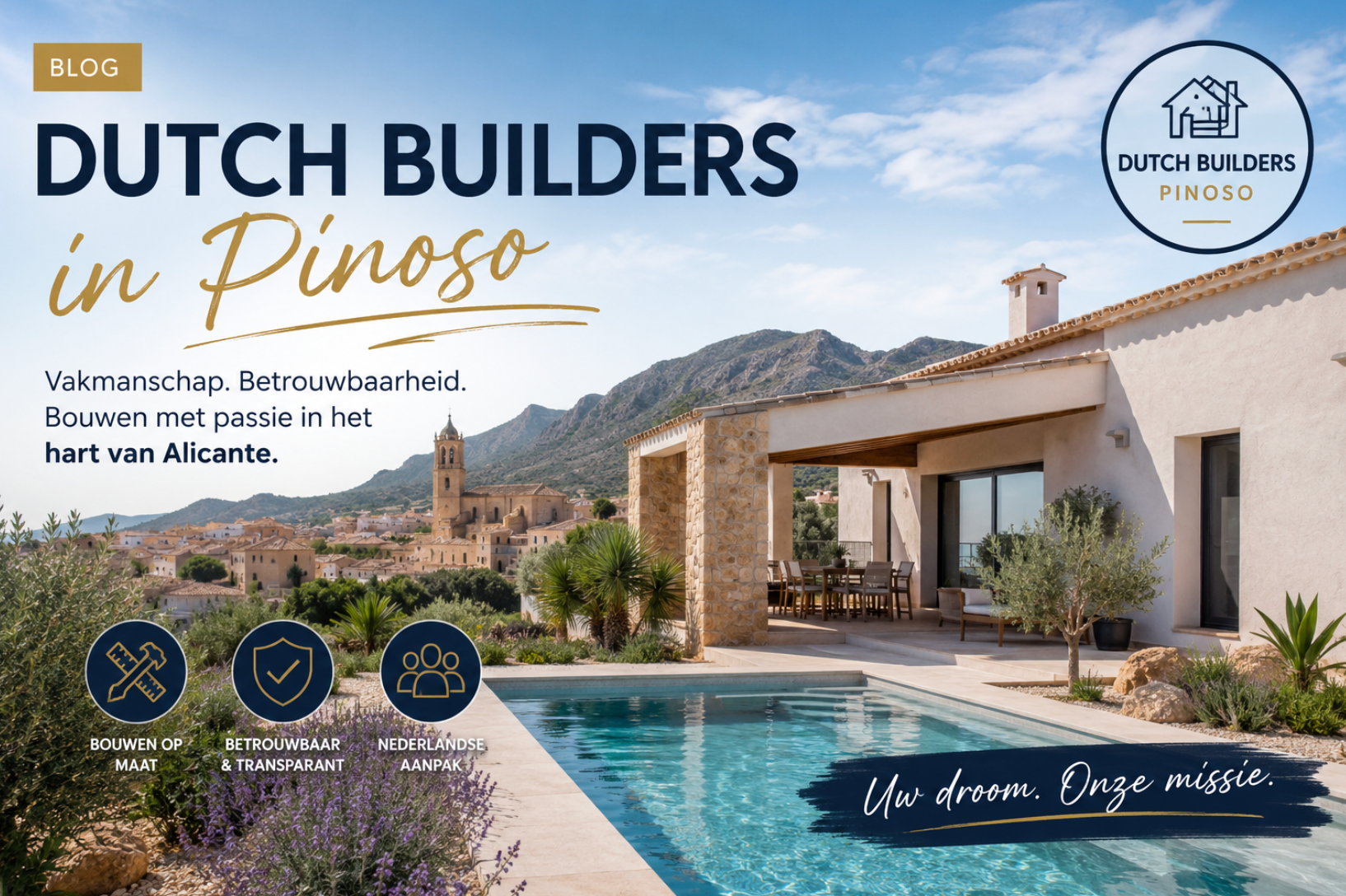
Dutch Builders in Pinoso: Craftsmanship, Clarity, and Confidence for Your Spanish Home
Pinoso, known locally as El Pinós, sits amid almond groves, vineyards, and gently rolling hills inland from Alicante. It is a place where life unfolds at a measured pace, where village traditions meet modern comforts, and where international homebuyers discover an inviting canvas for their Spanish property plans. For many, the journey from idea to impeccably finished home is most rewarding when guided by professionals who combine technical precision with clear communication. That is precisely why Dutch builders in Pinoso have become synonymous with trust, quality, and a beautifully managed building experience.
From new-build villas on expansive country plots to sensitive renovations of authentic village houses, Dutch building teams operating in and around Pinoso are known for their structured approach, attention to detail, and European sensibility. They bring both design fluency and a project methodology that demystifies the Spanish planning and construction environment, ensuring that every stage—from land acquisition and concept drawings to licensing, construction, and handover—is handled with diligence. When this is coordinated alongside a seasoned real estate partner such as IMMO ABROAD, clients benefit from a seamless blend of property expertise and construction excellence tailored to the Pinoso area.
This in-depth guide explores what to expect from Dutch builders in Pinoso, how the process works, the legal and technical frameworks that govern building in the Valencian Community, and the many design and lifestyle choices available. It is crafted for discerning buyers who want a knowledgeable, reliable, and refined path to a home that is genuinely personal and profoundly well made.
Why Pinoso Appeals to Discerning Homeowners
There is a particular quality to Pinoso that continues to attract international residents: an authentic Spanish town with a friendly, open character and a surrounding countryside that is both peaceful and picturesque. The backdrop includes vineyards (notably Monastrell), olive and almond groves, and famed local stone, while the town centre offers cafés, restaurants, shops, sports facilities, and a strong sense of community. The climate delivers hot summers, mild winters, and abundant sunshine; the location provides easy access to Alicante and its beaches, yet feels worlds apart from crowded coastal strips.
For buyers considering a bespoke home, the area around Pinoso offers generous plot sizes, outstanding views, and a planning framework that, while rigorous, is navigable with the right guidance. Rural settings allow for privacy and space, while village houses in and around Pinoso’s historic core appeal to those who wish to preserve and refresh traditional architecture. Across both scenarios, a carefully led design-and-build process will bring efficiency, clarity, and long-term value.
The Distinctive Value Dutch Builders Bring to Pinoso Projects
Dutch builders in Pinoso understand the expectations of international buyers who prioritise transparency, robust scheduling, sound budgeting, and an exceptional finish. Their reputation rests on several pillars:
- Clear communication: Seamless bilingual or multilingual communication eliminates guesswork, aligns expectations, and speeds decision-making.
- Methodical project management: Structured workflows, milestone planning, and detailed documentation keep timelines and budgets on track.
- Technical rigour: Adherence to the Spanish Technical Building Code (Código Técnico de la Edificación) and regional standards is integral, not optional.
- Design sensitivity: Aesthetic fluency that complements Pinoso’s landscapes—modern minimalism, contemporary Mediterranean, or softened rustic—executed with restraint and quality materials.
- Quality workmanship: Skilled tradespeople who take pride in precise detailing, durable finishes, and clean lines.
- Energy performance: A strong bias for insulation, orientation, airtightness strategies, and modern systems such as heat pumps and solar PV.
Combined with the local property knowledge and client advocacy of IMMO ABROAD, you benefit from a coherent, accountable team focused on delivering your goals with clarity and care.
Plot Selection and Due Diligence: Foundations for Success
Whether you are purchasing a rustic parcel with sweeping countryside views or a village plot within walking distance of amenities, success starts with careful, systematic due diligence. The Pinoso area offers a range of possibilities, but each parcel has a unique legal and technical profile that needs expert review before you commit. IMMO ABROAD supports this crucial first phase to protect your investment and set a realistic course for the build.
Key Considerations When Choosing a Plot
- Land classification: In the Valencian Community, land is generally classified as urban, developable, or non-developable (rustic). The category determines minimum plot size, permitted use, and what you can build. Rustic parcels often require larger minimum areas to allow a detached house, with specific build and occupation limits set by local planning regulations.
- Minimum plot size and build parameters: Local planning documents (PGOU or equivalent) define metrics such as minimum plot size, permitted footprint, maximum height, and setback distances from plot boundaries, roads, and neighbouring properties. These vary by zone and municipality. Confirming them at the outset will prevent costly redesigns.
- Topography and soil conditions: A geotechnical study (estudio geotécnico) informs foundation design, drainage solutions, and earthworks. Slopes, rock, or expansive clays can influence costs and structure.
- Access and infrastructure: Assess the condition of existing tracks, steepness, and turning areas for delivery trucks. Check availability and viability of connections to electricity, potable water, and sewerage. In rural areas, solutions often include off-grid or hybrid solar systems, water deposits or boreholes, and septic treatment plants.
- Boundaries and cadastral accuracy: Ensuring that registered boundaries match on-site reality is essential. Georeferenced plans help confirm that fences, walls, or natural features align with the title description. If there is a discrepancy, a rectification process may be necessary before planning moves forward.
- Environmental and easement issues: Confirm there are no protected habitats, rights of way, or infrastructure easements (for example, water channels or utility lines) that could affect the buildable area.
A well-chosen plot pays dividends throughout the project. It will support the home you want, streamline licensing, reduce unforeseen costs, and secure resale value, all while fitting your aesthetic and lifestyle ambitions for Pinoso.
Understanding Planning and Permissions in the Valencian Community
Every build or significant renovation in Pinoso must comply with national and regional building regulations and obtain the correct municipal licences. Dutch builders familiar with the area work closely with local architects, technical architects (aparejadores), and town hall departments to clarify requirements and timelines early on.
Primary Project Roles
- Architect: Leads design, produces the basic and execution projects, ensures compliance with the Technical Building Code, and obtains the necessary licences. Also coordinates site supervision.
- Technical architect (aparejador): Oversees day-to-day technical supervision, cost control, and quality assurance, liaising between the architect and builder.
- Builder (contractor): Delivers the works in accordance with the approved project and licence, managing trades, suppliers, and on-site safety.
- Health and safety coordinator: Ensures compliance with occupational safety standards during construction.
- Client representative: IMMO ABROAD can serve as your advocate, coordinating documentation, scheduling site meetings, providing progress reports, and helping manage decisions, changes, and budgets.
Licences and Related Documentation
- Licencia de obra mayor: Required for new-builds, structural works, extensions, and major renovations. The application includes the architect’s project documents and supporting technical reports.
- Licencia de obra menor or responsible declaration (declaración responsable): Used for minor non-structural works, subject to municipal criteria.
- ICIO and municipal fees: The Impuesto sobre Construcciones, Instalaciones y Obras (ICIO) is a construction tax based on declared build costs. Expect additional municipal fees for licence processing and waste management.
- Waste management plan: Compliance with construction waste regulations, including disposal via authorised handlers, is mandatory.
- End of works certificates: Upon completion, the architect and technical architect issue certificates, followed by the Licencia de Primera Ocupación (first occupancy licence) from the town hall.
- Energy performance certificate (EPC): Delivered at completion and required for utility contracts and future sales.
Timelines for licences vary with municipal workload and the complexity of your project. Well-prepared applications, accurate drawings, and thorough technical data lead to smoother approvals. Dutch building teams in Pinoso are accustomed to sequencing design and submissions so that the project progresses without administrative bottlenecks.
Contract Types, Cost Control, and Payment Schedules
Clarity on budget, risk allocation, and deliverables is non-negotiable for a successful build. You will typically choose between two broad contracting structures, each with strengths to match your preferences and project profile.
Common Contract Structures
- Lump-sum (fixed-price) contract: The builder agrees to deliver the project for a defined sum based on a detailed specification and set of drawings. This offers budget certainty but requires comprehensive design definition before signing, plus change-control procedures for any later variations.
- Cost-plus contract: You pay actual construction costs plus a pre-agreed fee or percentage for the contractor. This can be useful if design is evolving, but it requires rigorous transparency, itemised invoicing, and vigilant oversight to keep budgets aligned with expectations.
Payment Schedules and Financial Safeguards
- Staged payments: Commonly aligned with milestones (e.g., foundations, structure, enclosure, first fix, finishes, completion). Each stage ideally follows a joint valuation by the technical team.
- Retention: Holding a small percentage until snagging is completed incentivises timely resolution of minor defects.
- Guarantees and insurances: For many builds, especially where a developer sells to a third party, a ten-year structural insurance (seguro decenal) is standard practice. For self-promoters, it may be optional but is often required by mortgage lenders and is strongly recommended for future marketability.
- Bank guarantees: In certain structures—particularly off-plan purchases—buyers may seek bank guarantees for staged payments. The applicability depends on whether the project is structured as a development sale or a custom build on your own land. Speak with IMMO ABROAD for a suitable framework.
From the outset, IMMO ABROAD advocates for detailed cost plans, documented specifications, and itemised allowances (for example, tiles, sanitaryware, kitchens, and landscaping), so expectations are clear and controllable. Dutch builders’ data-driven approach supports this transparency, helping you make informed choices without unpleasant surprises later.
What Does a New-Build Villa in Pinoso Typically Include?
New-build homes in Pinoso reflect a spectrum of styles and specifications. A well-conceived brief and honest budget planning will define which features are included and at what quality level. Dutch builders known in the area commonly deliver the following core elements with a standard of execution that feels precise and thoughtfully considered.
Structure and Envelope
- Foundations and structure: Engineered to suit the geotechnical report, often reinforced concrete with slab or strip footings as appropriate to soil conditions.
- External walls and insulation: High-performance cavity or SATE (external insulation) systems to minimise thermal bridging and improve energy efficiency.
- Roofing: Flat roofs with excellent waterproofing and thermal insulation or traditional pitched roofs with ventilated build-ups; careful detailing at parapets and openings.
- Windows and glazing: Aluminium or high-spec PVC frames with thermal breaks, double or triple glazing, and solar control coatings where exposure demands it.
Building Services and Comfort
- Heating and cooling: Aerothermal heat pumps with underfloor heating for winter comfort and ducted air conditioning for summer cooling; smart zoning enhances efficiency.
- Hot water: Efficient production via heat pump technology or solar thermal contributions.
- Ventilation: Demand-controlled or mechanical ventilation strategies to maintain air quality; filtered air is especially valued by allergy-sensitive occupants.
- Photovoltaics: Roof-integrated or discrete PV arrays with inverters sized for daily loads; potential battery storage for energy autonomy.
Interior Fit-Out
- Flooring: Large-format porcelain tiles or natural stone internally and externally for visual continuity; microcement in select bathrooms or feature zones.
- Kitchens: Bespoke joinery with integrated appliances, composite stone or sintered tops, and efficient storage solutions; island configurations popular for open living.
- Bathrooms: Quality sanitaryware, thermostatic mixers, recessed niches, and frameless screens; careful fall management to ensure excellent drainage.
- Lighting and controls: Layered lighting schemes (ambient, task, accent) with dimming and scene control; pre-wiring for home automation, AV, and security.
Outdoor Living
- Porches and pergolas: Deep overhangs and adjustable shading for solar control; timber or aluminium pergolas for dining and lounge zones.
- Swimming pool: Typically tiled and salt-chlorinated, with steps or beach entry; optional covers, heat pumps, and automatic safety solutions.
- Summer kitchen: Integrated BBQs, sinks, refrigeration, and storage; stone or porcelain worktops; weather-proof cabinetry.
- Landscaping: Xeriscaped schemes using Mediterranean species, irrigation systems, low-glare lighting, and drought-resilient ground covers.
The end result is a cohesive indoor-outdoor lifestyle experience that maximises comfort, reduces running costs, and celebrates the Pinoso climate and views.
Renovating and Extending in Pinoso: Respecting Heritage, Elevating Performance
The historic fabric of Pinoso’s townhouses and village homes offers delightful possibilities for revitalisation: high ceilings, thick walls, attractive façades, and intimate courtyards. Dutch builders with local experience excel at marrying the character of older properties with modern comfort and building science.
Typical Renovation Priorities
- Structural assessments: Verifying load-bearing walls, roof integrity, and timber condition to inform safe interventions and modern layouts.
- Moisture management: Addressing rising damp and lateral ingress with breathable materials, capillary breaks, and drainage solutions.
- Thermal upgrades: Insulating roofs and selected walls, improving airtightness around openings, and installing efficient heating/cooling systems.
- Electrical and plumbing renewals: Rewiring to current standards, replacing legacy pipes, and integrating modern water-heating solutions.
- Kitchen and bathroom modernisation: Bespoke joinery, efficient layouts, and premium fixtures within the context of existing structures.
- Façade and roof works: Careful repair using compatible mortars and tiles; sensitive window replacements that respect proportions and rhythm.
Licensing for renovations depends on scope, with major structural changes requiring a full building licence. An architect’s measured survey and a coherent plan for phasing are the cornerstones of smooth execution. With meticulous sequencing and temporary protections, you can live nearby while works progress, relying on regular updates and site meetings facilitated by IMMO ABROAD.
Design Languages: From Modern Mediterranean to Contemporary Rustic
Pinoso’s landscape encourages designs that are serene, ordered, and tactile. Dutch builders are adept at translating client briefs into architecture that is at once timeless and practical—pared-back forms, framed views, and natural materials that age gracefully.
Modern Mediterranean
Flat-roof volumes with crisp white render, generous glass, and shaded terraces. The emphasis is on simplicity, sight lines, and strong inside-outside connections. Materials often include porcelain floors that continue outdoors, integrated pergolas, and minimalist kitchens. Hidden gutters and careful parapet detailing maintain a clean silhouette.
Contemporary Rustic
Traditional silhouettes updated with improved proportions, sleek joinery, and select use of local stone. Timber beams (real or engineered), earthy finishes, and soft lime plasters bring depth. With enhanced insulation and modern services hidden behind crafted surfaces, the home exudes character without compromising performance.
Hybrid Villas
Modern plans with nods to vernacular features: deep porches, tiled pitches, stone base courses, and chimney volumes punctuating clean façades. These hybrids offer excellent solar control and acclimatisation while delivering a contemporary living experience.
Energy Strategy and Sustainability: Building for Comfort and Longevity
High-end buyers are increasingly focused on comfort, resilience, and low running costs. In Pinoso’s sun-drenched climate, smart passive measures and efficient systems make a profound difference. Dutch builders, influenced by northern European performance traditions, tend to favour robust energy strategies that pay back over the building’s life.
Passive Measures
- Orientation: Positioning key living spaces to enjoy winter sun and views, while controlling summer heat through overhangs, pergolas, and vegetation.
- Insulation and thermal bridges: Continuity of insulation at junctions, high-performance window frames, and carefully detailed thresholds.
- Shading and glazing ratios: Balanced glass areas, solar-control glazing, and external shading to limit peak summer gains.
- Airtightness: Better seals at openings and penetrations reduce drafts and boost HVAC efficiency; combined with controlled ventilation for healthy air.
Active Systems
- Aerothermal heat pumps: Efficient year-round comfort with underfloor heating and ducted cooling, integrated with smart thermostats.
- Photovoltaics (PV): Offset daytime loads and support electric vehicle charging; battery integration provides resilience during grid interruptions.
- Hot water optimisation: Hybrid solutions leveraging heat pumps and solar inputs, sized to occupancy patterns.
Water and Landscape
- Water harvesting: Roof drainage to underground tanks for irrigation; filtration protects irrigation circuits and reduces mains usage.
- Xeriscaping: Drought-tolerant palettes reduce water demand and maintenance; micro-irrigation with moisture sensors improves efficiency.
- Pool efficiency: High-efficiency pumps, variable-speed filtration, and covers that limit evaporation and heat loss.
These strategies complement regional regulations and often exceed minimum requirements, providing a comfortable living environment in all seasons while preserving the calm, uncluttered character of the home.
Rural Building Specifics: Services, Access, and Practical Details
Building on rustic land around Pinoso offers space, privacy, and outlook, but it also entails specific practical considerations. A capable team will anticipate them, integrating robust solutions into your design and budget.
Utilities and Off-Grid Options
- Electricity: Where grid connection is not feasible or desirable, PV with battery storage can offer near-autonomy, supported by efficient appliances and smart controls.
- Water: Options include mains connections, agricultural water for irrigation, boreholes (subject to permits), and storage tanks fed from tanker deliveries or rainwater capture.
- Sewerage: Approved septic treatment plants with appropriate dispersal fields, sized to occupancy and soil percolation rates, installed to meet regulations.
- Internet and communications: Rural broadband solutions range from fibre where available to 4G/5G routers and satellite, planned early to suit your work-from-home needs.
Site Access, Fire Safety, and Boundaries
- Track upgrades: Ensure all-weather access and turning radii for delivery vehicles; stabilised bases for parking areas and driveways.
- Fire defensible space: Strategic vegetation management and non-combustible zones around the home; metal mesh soffits and fire-resistant exterior materials where appropriate.
- Fencing and walls: Compliance with municipal height and setback rules; gates sized for construction traffic and future maintenance access.
Early planning and honest dialogue about these rural realities lead to a finished home that functions beautifully and is easy to live with year-round.
Workflows and Timelines: From First Sketch to Turnkey Handover
A structured approach saves time and avoids missteps. Below is a typical sequence that Dutch builders in Pinoso will follow, adapted to your project’s scale and complexity. IMMO ABROAD coordinates at each stage to keep decisions on time and information complete.
Phase 1: Discovery and Feasibility
- Client brief: Lifestyle goals, room counts, style preferences, energy targets, and budget range.
- Site review: Visits to shortlisted plots or existing properties; initial zoning checks; utilities reconnaissance.
- Concept sketches: Massing, orientation, rough floor plans; preliminary cost guidance to validate direction.
Phase 2: Design Development and Cost Plan
- Measured surveys and geotechnical studies: Topographic plans and soil reports support structural design.
- Architectural drawings: Refined plans, elevations, and sections; 3D visuals to communicate volume and light.
- Engineering inputs: Structural and MEP systems integrated; energy modelling for performance targets.
- Cost plan: Detailed budget with allowances for finishes; value-engineering options presented.
Phase 3: Permitting and Procurement
- Licence submissions: Complete documentation lodged with the town hall, including technical reports.
- Tender or contractor confirmation: If not already engaged under a design-build model, pricing is sought from the preferred contractor. Contract terms and programme agreed.
- Long-lead items: Windows, bespoke joinery, and special finishes reserved to maintain timeline integrity.
Phase 4: Construction
- Groundworks and structure: Foundations placed per geotechnical recommendations; structure erected; roof formation.
- Enclosure and services: External walls insulated and sealed; first-fix electrical and plumbing; HVAC infrastructure.
- Internal finishes: Plastering, tiling, joinery, kitchens, bathrooms; second-fix and commissioning of systems.
- External works: Terraces, pool, pergolas, landscaping, driveways, gates, and lighting.
- Site meetings and reports: Regular updates with photos, cost-to-complete summaries, and risk registers. IMMO ABROAD facilitates transparent communication and timely decisions.
Phase 5: Handover and Aftercare
- Snagging: Thorough walk-through and documented snag list; rectifications scheduled and confirmed.
- Certificates and licences: End-of-works sign-offs, Licencia de Primera Ocupación, EPC, and utility setups.
- Owner orientation: Systems handbooks, maintenance schedules, and warranties provided; aftercare programme discussed.
Every build is unique, but well-managed projects around Pinoso typically span several months for permitting and 10 to 16 months for construction depending on size, complexity, and seasonality. Material lead times and design complexity are the main variables; proactive planning smooths both.
Cost Guidance and Value Engineering
Budgets must reflect your priorities for size, specification, and performance. While exact costs depend on design and market conditions at the time of contracting, the following guidance helps frame decisions. All figures are indicative; IMMO ABROAD will align your budget with current quotations and real-world site conditions.
Budget Drivers
- Area and complexity: Larger footprints and intricate geometries impact structural and envelope costs. Double-height spaces and extensive glazing increase spend.
- Ground conditions: Rock excavation, retaining structures, or poor soils require additional engineering and materials.
- Specification level: Premium windows, natural stone, bespoke joinery, and high-end appliances contribute materially to cost.
- Energy systems: Heat pumps, PV with batteries, and advanced controls add to upfront cost but reduce running expenses and improve comfort.
- External works: Pools, terraces, landscaping, driveways, and boundary treatments can represent a significant portion of the total project value.
Value Engineering Without Compromise
- Focus on envelope performance: Prioritise insulation, airtightness, and quality windows; they pay dividends in comfort and cost of ownership.
- Rationalise structure and form: Simple, elegant geometries are economical to build and timeless in appearance.
- Phase non-essential extras: Plan cabling and infrastructure now; add solar batteries, pergola enclosures, or outdoor kitchens later if needed.
- Select durable finishes: Choose materials that age gracefully and are easy to maintain in the Pinoso climate.
With disciplined specification management and clear allowances, you retain creative control while keeping a firm grip on the budget. Dutch builders provide the documentation and transparency to make that possible; IMMO ABROAD ensures the commercial terms match your comfort level.
Legal Protections, Insurance, and Quality Assurance
Any high-value construction deserves robust legal safeguards and quality controls. Experienced teams operate within a tested framework that protects your interests at each stage.
Key Protections
- Ten-year structural insurance (seguro decenal): Protects against major structural defects. Often mandatory where a home is built for sale or required by lenders even for self-promoted builds; advisable for future resale.
- Third-party liability insurance: Covers accidental damage or injury arising from construction activities.
- Contractual warranties: Builders typically provide warranties for workmanship and specific systems; durations vary by component.
- Quality control testing: Concrete and steel testing, waterproofing checks, pressure tests on plumbing, and commissioning of HVAC and electrical systems.
- Documentation and compliance: At completion, you should receive as-built drawings, user manuals, and the building’s dossier (Libro del Edificio) where applicable.
These measures provide confidence that your investment is protected, that the building performs as designed, and that future maintenance is straightforward.
Pools, Terraces, and Outdoor Kitchens: Elevating the Mediterranean Lifestyle
The outdoor realm is central to life in Pinoso. Thoughtful design transforms terraces, pools, and summer kitchens into an extension of the home. The difference lies in considered proportions, shade, and robust details that stand up to intense sunshine and occasional winter rains.
Swimming Pool Design
- Form and finish: Rectilinear pools with simple steps and long swim lanes; porcelain or glass mosaic finishes for durability and understated elegance.
- Plant and filtration: Energy-efficient variable-speed pumps, salt electrolysis systems, and automation for maintenance ease.
- Heating and covers: Air-to-water heat pumps extend the season; slatted or thermal covers retain heat and enhance safety.
- Terraces: Non-slip porcelain slabs with integrated drainage slopes; shadow lines and clean detailing elevate the aesthetic.
Outdoor Kitchens and Dining
- Placement: Leeward of prevailing winds, conveniently close to indoor kitchen and dining; pergolas or louvred roofs for all-weather usability.
- Equipment: Built-in BBQs, gas or induction hobs, sinks, refrigeration, and storage sized to your entertaining style.
- Materials: UV- and weather-resistant finishes, stone or sintered worktops, and concealed services for a refined look.
- Lighting: Warm, layered lighting with glare control; pathway lighting to guide guests safely.
Detailed planning yields spaces that feel natural and gracefully proportioned—perfect for long lunches, family gatherings, and quiet evenings beneath the Pinoso sky.
Interior Architecture: Calm, Craft, and Considered Detail
Inside, the most elegant homes in Pinoso share a quiet confidence. They favour proportion, comfort, and craftsmanship over clutter. Dutch builders and their design partners focus on the kind of details that you sense more than you see: a door that closes with hushed assurance, a shadow gap that emphasises a wall’s purity, a kitchen island tailored to how you cook and live.
Key Interior Themes
- Flow and zoning: Open-plan living balanced with intimate corners, studies, or snug TV rooms; ensuite privacy and well-located storage.
- Acoustics: Soft materials, strategic partitions, and ceiling treatments for comfortable sound levels in open spaces.
- Joinery and storage: Built-in wardrobes, utility rooms, and pantries that keep surfaces calm and functional.
- Lighting: Natural light maximised; artificial lighting layered to suit tasks, ambience, and artwork.
- Finishes palette: A restrained base of stone or porcelain, offset by timber accents and textured plasters for warmth.
The result is a home that quietly enhances daily life, rewarding close inspection without shouting for attention.
Case Studies: Exemplary Dutch-Built Homes in the Pinoso Area
The following anonymised case studies illustrate how different briefs, sites, and budgets translate into tailor-made outcomes in and around Pinoso. They highlight the breadth of what is possible and the decision-making that underpins great results.
Case Study 1: A Contemporary 220 m² Villa on a Gentle Slope
Brief: A light-filled home for year-round living with two guest suites and a dedicated work-from-home studio; low running costs; clean contemporary lines.
Site: 12,000 m² rustic parcel with panoramic views, moderate slope, and good access.
Solution: Two intersecting volumes around a sheltered courtyard, extensive glazing shaded by deep overhangs. Insulated flat roofs with solar PV, aerothermal heating with underfloor circuits, and ducted cooling. A 12 x 3.5 m lap pool aligns with the horizon. Materials include white rendered walls, aluminium-framed windows, and large-format porcelain inside and out. The studio is acoustically isolated for calls and recording.
Outcome: An elegant, high-performance home with exceptional daylight and tempered summer solar gain. Commissioning and handover were accompanied by a maintenance manual tailored to the client’s routine.
Case Study 2: Traditional Village House, Modern Comfort
Brief: Preserve the façade and original staircase; reconfigure interiors to add a principal suite and an internal patio bringing light deep into the plan. Discreet contemporary updates throughout.
Site: Narrow plot in Pinoso’s historic core with neighbouring party walls and limited rear access.
Solution: Structural assessment informed selective steel reinforcements. Lime-based plasters, breathable paint, and a new ventilated roof assembly resolved moisture issues. A compact heat-pump system with radiators and dehumidification delivered year-round comfort. Kitchen and bathrooms were completely renewed with minimal disruption to historic features.
Outcome: A dignified, warm home that respects its heritage while meeting modern expectations for comfort and efficiency. Permitting and logistics were carefully managed to minimise street disruption.
Case Study 3: Off-Grid Country Retreat
Brief: A tranquil holiday home capable of off-grid autonomy for extended stays; easy maintenance, durable finishes, and a strong connection to the land.
Site: 15,000 m² parcel with no immediate utility connections; gently rolling terrain and mature almond trees.
Solution: PV with battery storage, water storage tanks, advanced septic treatment, and a low-energy HVAC plan. Compact forms minimise envelope area, and SATE insulation curbs heat flow. Shaded terraces on east and west facades provide day-long usability. Landscaping uses native plantings with minimal irrigation demand.
Outcome: A serene hideaway that runs quietly and efficiently off-grid, with systems designed for easy monitoring and seasonal use.
Avoiding Common Pitfalls: What Successful Clients Do Differently
Even the best projects falter if planning and decisions are rushed. Successful clients tend to share a handful of habits that keep everything on track and enjoyable.
- Establish priorities early: Decide what matters most—size, finishes, energy performance, outdoor features—and allocate budget accordingly.
- Confirm the brief before contracting: Fewer late changes mean less disruption, fewer delays, and better pricing.
- Respect the sequence: Allow time for geotechnical studies, structural design, and procurement of long-lead items before breaking ground.
- Plan utilities in detail: Especially in rural builds, ensure electricity, water, sewerage, and communications strategies are resolved, costed, and permitted.
- Attend scheduled reviews: Regular site or video meetings keep decisions prompt and clear; recorded minutes avoid misunderstandings.
- Protect contingencies: Maintain a sensible contingency reserve to cover discoveries or improvements you decide to add.
Working with organised, communicative professionals is the single largest predictor of satisfaction and long-term value. With IMMO ABROAD coordinating and Dutch builders executing, the framework is already in place.
Pinoso Materials and Craft: Local Stone, Artisan Touches, and Modern Techniques
Part of the pleasure of building around Pinoso is the region’s material culture. Local stone, hand-finished plasters, and crafted metalwork lend depth and authenticity. Dutch builders relish combining these with modern methods and crisp detailing.
Material Highlights
- Natural stone: Used as base courses, accent walls, or landscape elements; sealers chosen to preserve texture while resisting staining.
- Porcelain slabs: Indoors and out, these deliver low maintenance and consistent tone; rectified edges facilitate narrow, elegant joints.
- Timber: Engineered beams, ribbed ceilings, and bespoke joinery add warmth; external timber elements are detailed to shed water and resist UV.
- Microcement and lime plasters: Tactile finishes for bathrooms and feature walls; breathable where moisture control is needed.
- Metals: Powder-coated aluminium for pergolas and railings; corten steel as a sculptural landscape accent.
From a maintenance perspective, material selection should consider Pinoso’s sun, occasional dust, and seasonal winds. The best choices look as good in ten years as they do at handover, with cleaning and resealing regimes that are simple and infrequent.
Integrating Technology: Smart Homes That Stay Simple
A refined home quietly supports your life without intruding. The technology that achieves this is increasingly straightforward and reliable when specified with restraint and installed by experienced professionals.
Recommended Smart Integrations
- Climate controls: Zonal heating and cooling via intuitive wall controls and app access; temperature schedules adapt to occupancy.
- Lighting scenes: Pre-set scenes for dining, entertaining, movie nights, and bedtime simplify daily routines.
- Security: Discreet exterior cameras, gate controls, and alarm monitoring with local storage and secure remote access.
- Energy monitoring: Track PV generation and consumption to refine habits; battery management integrated into dashboards.
- Networking: Robust Wi-Fi coverage with hardwired backbones ensures reliability; outdoor access points for terraces and pool areas.
The guiding principle is always user-friendliness. Systems are chosen for stability and supportability, not novelty. Dutch builders and their MEP partners in Pinoso calibrate specifications to your appetite for automation so that technology enhances, rather than complicates, daily living.
Financing, Mortgages, and Appraisals
Many buyers fund their Pinoso home with a combination of equity and Spanish or international financing. The nuances of mortgages for self-builds and renovations require early planning to align cash flow with construction stages.
Key Financial Considerations
- Mortgage structure: New-builds on owned land often involve staged drawdowns against certified progress. Lenders may require a detailed project, licences, and cost plans before releasing funds.
- Appraisals (tasación): Conducted by licensed appraisers, these inform maximum lending and may be updated at key milestones.
- Insurance requirements: Some lenders insist on ten-year structural insurance even for self-promoted builds; budget accordingly.
- Currency planning: For buyers funding from multiple jurisdictions, currency strategies can protect against exchange-rate volatility during construction.
- Tax and fees: Plan for ICIO, municipal licence fees, notary and registry costs, and professional fees (architect, technical architect, project management).
IMMO ABROAD can coordinate the documentation and milestone certifications lenders expect, ensuring your financial plan and build programme remain in lockstep.
Working with IMMO ABROAD: Coordination, Advocacy, and Peace of Mind
Building abroad should be exciting, not exhausting. With IMMO ABROAD as your dedicated partner in Pinoso, you benefit from property intelligence, construction acumen, and steadfast advocacy from first viewing to final handover.
How IMMO ABROAD Supports Your Build
- Plot and property sourcing: Matching you with land or a renovation target that truly fits your brief and budget.
- Due diligence: Coordinating title checks, boundary verification, planning parameters, and utilities assessments before commitment.
- Team selection: Introducing proven Dutch builders whose methods, communication style, and craftsmanship align with your expectations.
- Specification and pricing: Helping you develop a clear, itemised specification and negotiate transparent, balanced contract terms.
- Programme management: Setting milestones, arranging site meetings, and issuing progress reports with photos and cost-to-complete snapshots.
- Quality and handover: Coordinating snagging, documentation, licences, and post-completion support so you step into a home that is fully ready.
The objective is straightforward: a property journey in Pinoso that feels curated, precise, and enjoyable, culminating in a home whose value endures—in use, in experience, and in the market.
Frequently Asked Questions: Dutch Builders in Pinoso
How long does a typical new-build take?
Allow several months for design and licensing, followed by 10 to 16 months of construction depending on size, complexity, and material lead times. Early planning and prompt decisions compress overall duration.
What are the main advantages of working with Dutch builders?
Clear communication, structured project management, rigorous quality control, and a strong energy-performance mindset. Clients value the transparency and reliability that underpin budget and timeline certainty.
Can I build on rustic land?
In many cases yes, provided the plot meets minimum area and zoning rules and the project respects build parameters set by local regulations. Verification is essential on a plot-by-plot basis. IMMO ABROAD will coordinate these checks with architects and the town hall.
What warranties come with a new-build?
Beyond statutory responsibilities, reputable builders provide workmanship and system warranties. Ten-year structural insurance is often required by lenders and is advisable for long-term protection and marketability.
Are off-grid solutions common?
Yes, particularly on remote rustic plots. Solar PV with storage, water tanks, advanced septic treatment, and efficient HVAC systems can deliver reliable autonomy with modest maintenance.
How is cost managed and reported?
Through documented specifications, stage valuations, and change-control logs. Dutch builders provide itemised updates; IMMO ABROAD consolidates reporting so you always know status and spend.
Can I live nearby during a renovation?
Often yes. With careful phasing, dust protection, and temporary services, many clients live locally and visit the site regularly for reviews. Safety and logistics are coordinated in advance.
What interior styles work best in Pinoso?
Modern Mediterranean and contemporary rustic dominate—both prioritise proportion, texture, and shade. Neutral palettes with natural materials look refined year-round and suit the light.
Will my home meet energy standards?
Yes. Dutch builders align with the Technical Building Code and typically exceed minimums, optimising insulation, glazing, airtightness, and systems for comfort and low running costs.
How do I start?
Begin with a conversation to define your brief and priorities, then tour suitable plots or renovation candidates. From there, the architect and builder develop concept designs and a preliminary cost plan, and the journey begins. IMMO ABROAD will guide every step.
Your Next Step: A Pinoso Home Built with Confidence
The decision to create a home in Pinoso is both practical and deeply personal. You are choosing a climate, a landscape, and a rhythm of life—and a team to translate your vision into enduring architecture. Dutch builders in the Pinoso area have earned their standing by delivering what discerning clients value most: reliability, clarity, and fine workmanship. With IMMO ABROAD orchestrating the process—from astute plot selection and clear budgeting to decisive project management and refined finishing—you can look forward to a Spanish homebuilding experience that is calm, transparent, and genuinely enjoyable.
Whether you imagine a minimalist villa framed by almond blossoms, a contemporary home that gathers family around sunlit terraces, or a sensitively updated townhouse in the heart of Pinoso, the path is well lit. It begins with the right conversation, continues with expert guidance and skilful hands, and concludes with a key turned in a door that feels, unmistakably, like yours.