





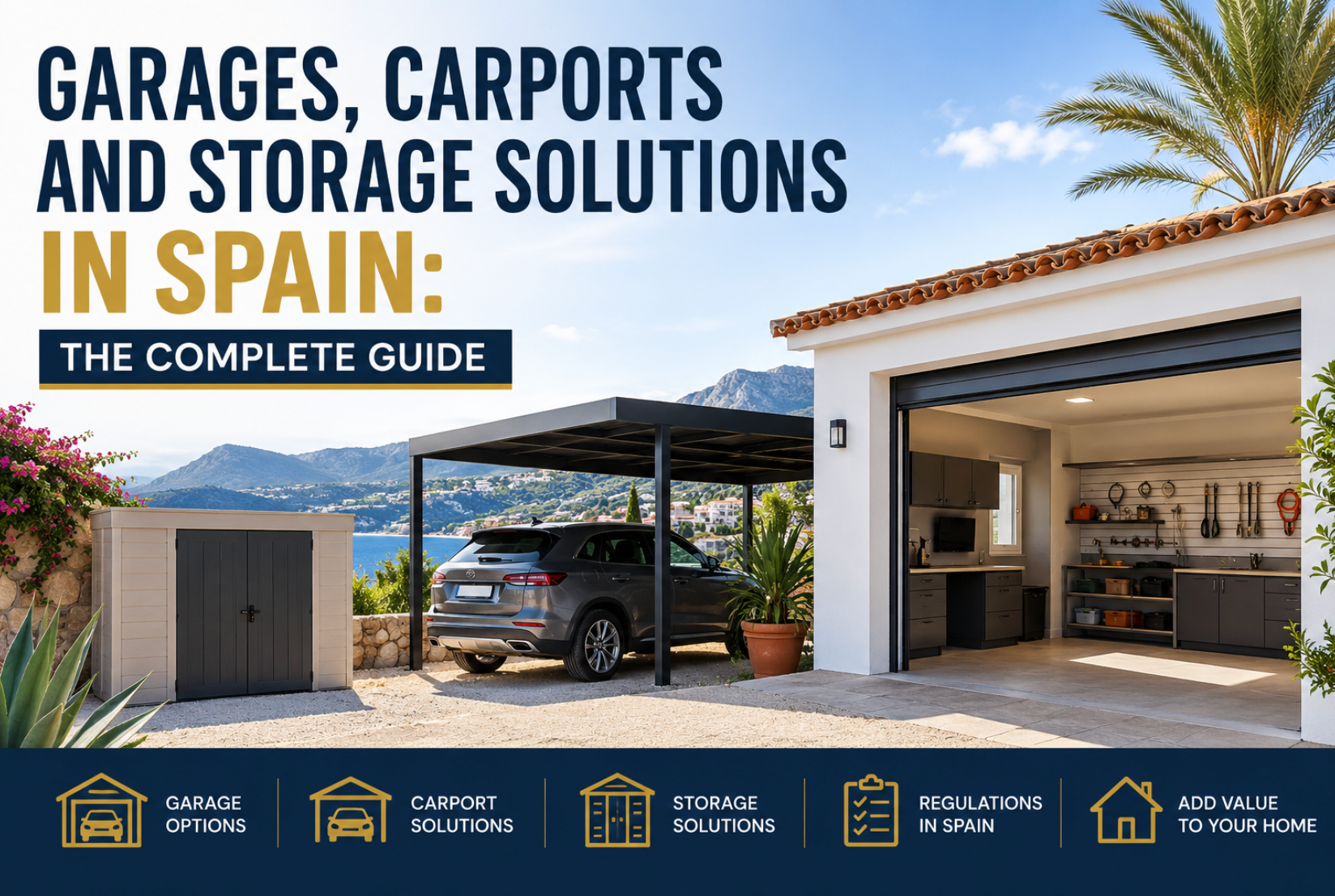
Why Garages, Carports and Storage Matter in Spain
From the Costa del Sol to the Balearic Islands, a home in Spain is as much about lifestyle as it is about square metres. Sunshine, sea breezes, and long summers shape how we live day to day — and they should shape how we protect our cars, boats, bicycles, sports gear, and seasonal belongings. In practice, that means making intentional choices about garages, carports and storage spaces that stand up to Spain’s climate, local planning rules, and your long‑term needs.
Beyond convenience, sheltered parking and well‑planned storage can enhance your home’s value, improve energy efficiency, and protect your investments from sun, salt and storms. Whether you are designing a new villa, upgrading a townhouse, adapting a countryside finca, or optimising an urban apartment with a “plaza de garaje” and “trastero”, the right solution will balance architecture, regulation, and daily practicality.
This complete guide distils the Spanish context — legal, climatic, technical and aesthetic — into clear, actionable insight. You will learn how to evaluate options ranging from enclosed garages to open carports and modular outbuildings, how to navigate municipal permits, how to incorporate EV charging and solar generation, how to choose durable materials for coastal locations, what costs and taxes to anticipate, and how to integrate storage that keeps clutter out of sight while making everyday life easier. Along the way, we will highlight best practices for safety, sustainability and value preservation, so you can plan with confidence.
Understanding Property Types in Spain and Where Garages Fit
Spain’s housing stock is diverse, and the property type you own or plan to purchase determines what is feasible — and what will require extra permissions or design care. Knowing the constraints and opportunities of each context is the first step to a smart parking and storage strategy.
Detached villas and chalets
Detached villas, chalets and country houses offer the most flexibility for car storage and outbuildings. With private plots, you can consider:
- Attached garages that tie into the home’s façade and utilities.
- Detached garages or workshops sited to optimise access and views.
- Open carports integrated into landscape design to provide shade and ease of use.
- Modular outbuildings for garden equipment, paddle boards, bicycles or wine storage.
- Underground or semi‑basement parking for sloping plots, keeping the massing low and views open.
Each option intersects differently with local planning rules, setback distances, maximum buildable area, and plot coverage. On larger urban plots and many coastal municipalities, both attached and detached solutions are possible, but external appearance, height, and materials may be regulated to protect streetscapes.
Townhouses and terraced homes
In historic town centres and many residential developments, terraced homes often have limited frontage and shared walls. Common approaches include:
- Ground‑floor garages opening to the street, frequently forming part of the original design.
- Rear carports or canopies in private patios, subject to community rules and privacy considerations.
- Compact “trasteros” (storage rooms) under stairs, in courtyards or roof terraces, designed to minimise visual impact.
In older barrios, converting a ground‑floor room to a garage may be possible but typically requires structural review, community consent under the Horizontal Property Law, and careful adherence to façade regulations. Many municipalities protect historical aesthetics and limit new garage openings to maintain street character.
Urban apartments and communities
In apartment buildings and urban residential complexes, parking is usually provided as:
- Underground communal garages with deeded spaces (“plazas de garaje”) and shared access ramps and ventilation.
- Surface parking within a gated community, sometimes with shade sails or lightweight carports installed by the developer.
- Deeded “trasteros” (storage rooms) in basement levels, rooftop areas, or separate annex buildings.
In these settings, your ability to add, enclose or modify structures is governed by the building’s statutes and internal rules (reglamento de régimen interior), as well as the Spanish Horizontal Property Law. Individual owners must obtain approval before installing charging stations, enclosing open spaces, or altering communal elements. Fortunately, Spanish regulations also streamline the installation of EV charging in communal garages, provided appropriate notice and technical compliance are observed.
Country fincas and rustic land
On rural plots (“suelo rústico” or “no urbanizable”), agricultural or landscape character is typically prioritised. While agricultural sheds and tool stores may be feasible, the installation of a garage or carport for strictly residential use can be limited or prohibited depending on the region, zoning, and existing building rights. Where permitted, design often needs to be discreet, low in height, and in materials sympathetic to the rural setting. Always verify the planning framework for the parcel, including any protected classifications, before committing to construction.
Climate and Environmental Considerations Across Spain
Spain’s climate is wonderfully varied, and your locale will inform material selections, structural design, and maintenance planning for garages and carports. The key drivers are sun (UV), salt air, wind, rainfall intensity, humidity, and temperature swings.
Coastal Mediterranean zones
On the Costa del Sol, Costa Blanca, Catalonia’s coastline and the Balearics, expect intense UV exposure, sea breezes with salt, and occasional winter storms. Consider:
- Corrosion resistance: Opt for hot‑dip galvanised steel, marine‑grade aluminium, stainless steel fixings (A4), and factory‑coated metals. Regularly rinse and maintain coated surfaces to prevent pitting.
- UV‑stable roofing: Choose high‑quality polycarbonate with UV protection, ceramic or concrete tiles, or insulated sandwich panels. Avoid low‑spec plastics that yellow or embrittle.
- Wind resistance: Design carports and light structures for uplift and lateral loads. Engineering and properly sized footings are essential to avoid storm damage.
- Salt and humidity management: For enclosed garages, robust ventilation and dehumidification reduce corrosion of vehicles and tools.
Inland Mediterranean and semi‑continental areas
Valleys and plateaus experience hot summers and cooler winters, sometimes with frost. Key measures include:
- Thermal moderation: Insulated garage doors and roofs stabilise temperatures for vehicle batteries, wines, and sensitive equipment.
- Snow and hail resilience: In higher altitudes and northern interiors, ensure roof structures accommodate occasional snow loads and resist hailstone impact.
- Dust management: Sealed thresholds, brush strips and filtered ventilation help keep fine dust out of storage areas.
Atlantic and northern Spain
Regions such as Galicia, Asturias, Cantabria and the Basque Country are wetter and milder, with lush vegetation and persistent humidity.
- Waterproofing and drainage: Deep overhangs, reliable gutters, downpipes to soakaways, and flashed junctions are indispensable.
- Rot‑resistant materials: If using timber, select pressure‑treated species and detail for drainage and ventilation. Keep wood off the ground and protect end grains.
- Moss and algae control: Choose roofing and paving finishes that are easy to clean, and plan maintenance to prevent slip hazards.
Island microclimates
The Balearic and Canary Islands combine high UV, salt air, and wind. Lightweight shades and tensile sails are popular but should be engineered for gusts and correctly tensioned with stainless fittings. In volcanic landscapes, abrasive dust calls for careful sealing and robust door systems.
The Legal Framework: Permits, Property Law and Compliance
In Spain, planning and building regulation is layered: national technical codes set performance standards, while each autonomous community and municipality interprets planning rules and issues permits. Understanding these layers will save time and avoid costly missteps.
Works licences: minor vs major
Municipalities generally distinguish between:
- Minor works (“obra menor”): Non‑structural alterations, lightweight carports, small storage sheds, internal partitions, and finishes. Many councils allow these via a simplified application, “comunicación previa” or “declaración responsable”, with faster turnaround and lower fees.
- Major works (“obra mayor”): Structural elements, attached or detached garages with masonry, foundations, roofing tied to the main dwelling, excavations for basements, or any construction increasing built area. These usually require a full licence, technical project by a qualified architect or engineer, and formal inspections.
Terminology and thresholds vary by locality. A freestanding aluminium carport on ground screws may be treated as minor works in one municipality but as a licence‑requiring structure in another. Always check with the local planning office and obtain written guidance specific to your plot and proposal.
Technical Building Code (CTE) and safety
Spain’s Technical Building Code (Código Técnico de la Edificación, CTE) sets out safety, structural, fire, energy and salubrity requirements. Garages and covered parking may trigger obligations for:
- Fire safety in enclosed garages, including compartmentation, emergency exits, and materials with appropriate reaction to fire.
- Ventilation to manage exhaust gases; natural or mechanical systems must meet the performance criteria defined for garages.
- Accessibility and ramp design for communal garages, with limits on slopes and requirements for handrails and lighting.
- Electrical installations conforming to low‑voltage regulations for lighting, sockets, and EV charging points.
Where you build a simple open carport, many of these requirements are not engaged; nonetheless, safe design — adequate clearances, drainage, and secure fixings — remains essential.
Horizontal Property Law and community approvals
In buildings or estates governed by the Spanish Horizontal Property Law (Ley de Propiedad Horizontal), alterations to communal elements, façade changes, and installations in shared garages (such as EV charging, storage cages, or additional doors) may require a vote at the owners’ meeting. Community statutes and internal regulations detail what is allowed.
- EV charging: Spanish regulations facilitate individual EV charger installation in communal garages by allowing owners to proceed after notifying the community in writing, providing the system is installed on their circuit or metered supply and meets technical standards. Cost distribution for shared infrastructure (e.g., cable trays) should be governed by community decisions.
- Enclosures and storage: Adding private enclosures to a parking space, building mezzanines, or installing bulky storage units usually needs approval, and fire safety limits what can be stored in communal garages (often restricting flammable liquids and large quantities of combustibles).
- Visual consistency: Shutters, louvres, or carport structures visible from the street or communal areas might be permitted only if they follow a uniform design and colour specified by the community.
Rustic land and protected zones
Rural and protected lands are subject to special planning controls. Even lightweight, open carports can be considered “constructions” in planning terms. Agricultural sheds may be permissible where they clearly serve farming activity and meet siting and size limits. Some regions require a declaration of public interest for non‑agricultural structures. Before ordering a prefab building for a rural plot, confirm the zoning, permitted uses, and whether the existing dwelling has exhausted buildability.
Driveway access and the “vado permanente”
Where you access a garage directly from the public street, most municipalities require a “vado permanente” — a permit for a permanent driveway crossing and the placement of signage that reserves the kerb area for access. This typically involves:
- Works authorisation to lower the kerb and modify the pavement according to municipal detail standards.
- An annual fee for the vado, with a metal or enamel sign displaying the licence number.
- Compliance checks for sight lines, street trees, and underground services.
Without a vado, other vehicles may lawfully park across your garage entrance, and you may be liable for unauthorised pavement alterations. For heritage zones, the vado design may be constrained by conservation rules.
Registration, cadastre and property titles
Enclosed garages and legally constituted storage rooms that form part of your home can be described in the property deed (escritura), with their area recorded. After construction, update the cadastral record (Catastro) so that taxation reflects the as‑built situation. In apartment blocks, parking spaces and trasteros can be separate properties or annexed to a dwelling. If buying, verify that the deed and cadastral references align, and check whether a trastero is legally a storage room, not an improvised space without recognition.
Design Typologies: From Enclosed Garages to Elegant Carports
Functionality, aesthetics and budget come together in the choice of typology. The right option is the one that delivers the protection you need, complements the architecture, and respects the planning framework.
Attached garages
Attached garages offer convenience, weather‑protected access to the home, and the possibility to integrate services such as laundry, storage walls, and plant rooms. Considerations include:
- Thermal continuity: Proper insulation at the party wall and ceiling to prevent heat gain or loss to the living areas, reducing energy bills and improving comfort.
- Air‑tightness: Sealed doors from garage to house, with self‑closers and appropriate smoke seals, to prevent fumes and odours entering the home.
- Façade integration: Door finishes, eaves details and materials should harmonise with the existing architecture.
- Futureproofing: Allocate space for a workshop bench, wall‑mounted cycles, or EV charging equipment from the outset.
Detached garages and pavilions
Detached options allow greater siting freedom, including orienting the garage to reduce visual impact and maintain views. They can double as garden pavilions or hobby spaces. Key points:
- Setbacks and heights: Comply with local limits and avoid overshadowing neighbours.
- Access and manoeuvring: Provide turning space and clear approach lines; consider a secondary pedestrian door for convenience.
- Architectural language: A detached building can be contemporary or traditional, but aligning masonry, roof pitch, and colours to the main house usually yields the most cohesive result.
Underground and semi‑basement parking
When plots slope or views are paramount, underground or partially submerged garages keep cars out of sight and minimise above‑ground bulk. Advantages include thermal stability and discreet integration; challenges include excavation costs, waterproofing, drainage sumps with pumps, and reliable mechanical ventilation. Ramps must be carefully designed to meet slope limits and anti‑slip requirements; adequate headroom and turning radii are essential.
Open carports
Carports protect against sun and rainfall while remaining airy and cost‑effective. They are fast to install and often treated as minor works, though still subject to local rules. Styles and structures include:
- Timber frames, warm and natural, with tiled or shingle roofs to echo the home’s vernacular.
- Aluminium systems with polycarbonate or sandwich panels, low‑maintenance and sleek, ideal for contemporary designs.
- Steel canopies, hot‑dip galvanised for durability, supporting flat or low‑pitch roofs with integrated drainage.
- Tensile sails and shade structures, perfect for seasonal use and flexible configurations, provided they are engineered and securely anchored.
Because carports are open, attention to sun angles, wind exposure, rain blow‑in, and splash from paving becomes design‑critical. Incorporate side screens or louvres where necessary, and detail drainage so water does not pool where passengers enter and exit.
Hybrid solutions
For many homeowners, a hybrid approach works best: an enclosed garage for a primary vehicle and workshop, complemented by a carport for guests, a boat, or seasonal protection. Modular storage walls or cabinets can be integrated along one side of a carport to create a semi‑enclosed utility zone without the expense of a full garage.
Modular and prefabricated buildings
Prefabricated garages and storage sheds (“casetas”) offer rapid delivery and predictable costs. High‑quality systems in steel, aluminium, engineered timber, or composite panels can achieve excellent durability when properly specified and installed. Before ordering, validate:
- Permit requirements for your municipality and zoning.
- Structural certification for wind, snow, and anchorage to foundations or ground screws.
- Thermal behaviour if you plan to use the space as a workshop or for wine or equipment storage.
- Fire reaction of panels and interior finishes for enclosed options.
Materials, Finishes and Architectural Cohesion
Premium results depend on choosing materials that endure Spain’s climates while elevating the property’s look and feel. Balance first‑cost, maintenance, and longevity.
Structure and cladding
- Masonry: Concrete block and rendered brick are robust and readily available. Specify waterproof render systems and expansion joints for crack control, and consider ventilated façades in humid or coastal locations.
- Steel: Hot‑dip galvanised frames resist corrosion; powder‑coated finishes add aesthetic appeal. For coastal sites, marine‑grade paint systems and stainless steel fixings are worth the investment.
- Aluminium: Lightweight and maintenance‑friendly for carports; choose structural sections with concealed guttering and UV‑protected roofing panels.
- Timber: Glulam or laminated posts offer elegance and stiffness. Use pressure‑treated, climate‑appropriate species; detail to prevent standing water and provide ventilation. Regular finishing protects colour and fibres.
Roofing
- Tiles (ceramic or concrete): Traditional and durable, with excellent UV resistance. Ensure proper underlay, battens, and storm‑resistant fixing, especially in exposed sites.
- Insulated sandwich panels: Provide thermal and acoustic comfort with fast installation; select fire‑rated cores and concealed fixings for a clean aesthetic.
- Polycarbonate: Clear or opal sheets admit daylight; specify twin‑wall or multiwall UV‑stabilised products with secure glazing bars and allowances for thermal expansion.
- Flat roofs: High‑quality membranes (e.g., bituminous or synthetic) over tapered insulation and proper drainage create a crisp contemporary line; guard against ponding and ensure robust edge details.
Doors and openings
The garage door is both a functional workhorse and a major façade element. Choices include:
- Sectional doors with insulated panels for efficiency and smooth operation; customise textures and colours to match joinery.
- Roller shutters for tight spaces with minimal internal projection; look for quiet motors and anti‑lift devices.
- Side‑hinged doors for traditional aesthetics and quick pedestrian access; specify seals and quality hardware.
- Aluminium louvred screens for carports needing lateral wind and sun management without enclosure.
Prioritise CE‑marked automation with safety photocells, obstacle detection and manual override. For integrated architecture, align door reveals, lintel heights and lighting with the home’s rhythm.
Paving and drainage
Surface finishes support safety, longevity and visual coherence:
- Permeable pavers reduce run‑off and heat build‑up while meeting SUDS principles; select units rated for vehicular loads.
- Stamped concrete can mimic stone while offering continuous surfaces; include micro‑texture for slip resistance and control joints.
- Natural stone (granite setts, limestone) provides a timeless finish; design sub‑bases appropriately and detail falls to channel drains.
Integrate slot or linear drains at thresholds to keep interiors dry, and route downpipes to soakaways or rainwater tanks to reduce burden on municipal systems.
Structural and Technical Essentials
Even modest carports and garages benefit from sound engineering. Good detailing at the outset prevents costly remediation later.
Foundations and slabs
- Soil assessment: Determine bearing capacity and drainage. Expansive clays, fill or steep slopes may require deeper foundations or soil improvement.
- Footings: For masonry garages, reinforced strip footings or pads sized to loads; for carports, posts set into reinforced concrete pier footings or ground screws with certified pull‑out resistance.
- Slabs: Reinforced concrete slabs with vapour barriers, insulation where comfort is a goal, and saw‑cut or tooled joints to manage cracking. Add a surface hardener or densifier for abrasion resistance.
- Thresholds and falls: Slope slabs gently to floor drains and ensure the vehicle entrance is drained by an external channel to prevent wind‑driven rain ingress.
Waterproofing and damp control
For below‑grade or partially buried structures, a continuous waterproofing envelope with protection boards is essential. Combine external membranes, drainage composites and perforated collector drains leading to a sump pump if gravity outfall is not feasible. At grade, damp proof courses and capillary breaks protect walls from rising damp; breathable interior finishes help manage residual moisture.
Ventilation and air quality
Enclosed garages must manage vehicle emissions and humidity. Solutions include:
- Natural ventilation via permanent openings positioned for crossflow, protected from rain ingress, and screened.
- Mechanical extract with CO sensors that trigger fans when concentrations rise, reducing noise and energy use.
- Dehumidification in coastal or humid zones to protect tools, finishes and vehicle components.
Where workshops or hobby zones are included, consider dedicated ventilation for fumes from paints or solvents, and ensure safe storage of chemicals away from ignition sources.
Fire safety
Fire‑safe design starts with careful separation of garages from living spaces, self‑closing doors with appropriate smoke seals, and controlled storage of combustibles. In communal garages, rules on maximum storage, stall enclosures, and escape routes are strict and should be respected. Fit suitable extinguishers and keep clear access to electrical panels. In large garages or where dictated by the project’s fire safety design, additional measures such as emergency lighting and signage may be necessary.
Acoustics
Insulated sectional doors, rubber isolation pads under motors, and acoustic lining on hard surfaces reduce reverberation and mechanical noise, keeping living spaces quiet and neighbours happy.
Power, Lighting and EV Charging
Modern parking and storage areas are technical spaces. Smart power planning increases safety, utility, and resale appeal.
Lighting
- General lighting: LED battens or downlights with uniform coverage; 3000–4000K colour temperature for a crisp but comfortable light.
- Task lighting: Higher‑intensity fixtures over benches and storage walls, with glare control.
- Automatic control: PIR sensors for hands‑free operation; daylight sensors for carports to limit unnecessary use.
- Emergency lighting: In enclosed or communal settings, provide code‑compliant emergency egress lighting and signage as required.
Power distribution
Plan abundant sockets on dedicated circuits for tools, pressure washers and vacuum cleaners. Protect external sockets with suitable IP ratings and RCDs. In detached buildings, decide between a sub‑board from the main dwelling or a separate supply, considering voltage drop, trench routing and future capacity. Conceal conduits in slab or walls with draw‑wires for upgrades.
EV charging infrastructure
Spain’s regulatory framework supports the rollout of EV charging in both private homes and communal garages. Key considerations:
- Charger type: For home use, Mode 3 AC chargers (wallboxes) are the standard. Select 7.4 kW single‑phase or 11 kW three‑phase according to your supply. Load balancing ensures you do not exceed contracted power.
- Cabling and protection: Overspecify cable sizes for future upgrades and ensure correct protection devices per low‑voltage regulations.
- Metering: In communities, chargers are typically connected to the user’s supply or to a new dedicated meter; usage allocation and billing should be transparent.
- Placement: Position chargers and cables to avoid trip hazards and ensure good cable management; use retractors where neatness is a priority.
Integrate EV readiness in carports by pre‑installing conduits and a protected mounting area even if you do not fit a charger immediately. For solar‑equipped carports, pair the charger with load control to maximise self‑consumption.
Storage Solutions: From “Trasteros” to Tailored Organisation
In Spain, dedicated storage (“trastero”) is highly prized. Whether as part of a villa or an apartment’s basement space, storage adds practicality and resale appeal. The best solutions are dry, secure, ventilated and logically arranged to support everyday life without clutter.
Dedicated trasteros
A legally constituted trastero is a separate room designed for storage, often deeded and with its own cadastral reference. In apartments, they are common in basement or rooftop levels.
- Security: Solid doors with multi‑point locks, tamper‑resistant hinges, and where permitted, small high‑level vents secured with grilles.
- Moisture control: Vapour barriers on walls facing soil, ventilation, and off‑floor shelving to keep items dry in humid seasons.
- Fire considerations: Avoid storing significant quantities of flammable liquids; observe community rules and insurance conditions.
Integrated storage in garages
A garage can house much more than a car. Plan zones:
- Wall‑mounted systems: Slat walls and rail systems for bicycles, paddle boards, racquets, ladders and tools.
- Cabinetry: Powder‑coated steel or moisture‑resistant composite cabinets with adjustable shelves and drawers.
- Overhead racks: Utilise ceiling space for seasonal items, with safe load ratings and easy access.
- Workbenches: Include task lighting, vice mounts, and protected sockets; consider a sink if drainage is available.
Outdoor sheds and utility enclosures
Garden sheds and equipment enclosures hide hoses, mowers, pool kit and maintenance tools to keep terraces tidy. Match the shed’s cladding to boundary walls or landscape elements, and site it away from neighbour windows to reduce visual impact. For coastal settings, choose corrosion‑resistant materials and raised floors to avoid splashback.
Wine storage
Spain’s wine culture tempts many to create a small cellar. Even a compact, insulated room with a cooling unit, vibration‑damped racking and controlled lighting in a garage corner can safeguard a collection. Protect from odours and maintain good separation from vehicle areas to avoid contamination.
Hobby and sports equipment
Surfboards, golf clubs, skis, bikes and kayaks deserve bespoke storage. Vertical racks and padded hooks prevent dings; lockable racks or cages add security in communal spaces. Sand and salt rinsing stations adjacent to carports prevent mess indoors, with grey‑water directed to appropriate drainage.
Security, Access and Privacy
Protecting belongings and ensuring safe access is central to high‑end parking and storage design. Combine physical robustness, smart technology and compliance with privacy rules.
Doors, gates and automation
- Motors and controls: Quiet, powerful motors with soft‑start/stop; remote transmitters, keypads, and app integration.
- Safety: Photocells, pressure‑sensitive edges, and obstacle detection are mandatory for automated doors; ensure routine testing and maintenance.
- Pedestrian safety: Separate walk‑in doors reduce risk and wear on main doors; anti‑slip thresholds and good lighting are essential.
Alarm and surveillance
Integrate garage zones into your home alarm with door contacts and motion sensors; choose pet‑immune sensors if needed. CCTV can deter theft, but in communal spaces, cameras are subject to data protection rules and often require community approval. Recordings must comply with privacy regulations, avoiding capture of public thoroughfares and neighbours’ private areas. Display appropriate signage where required.
Lighting for security
Motion‑activated external lights at garage doors and along approaches increase safety and deter intruders. Choose fixtures with proper shielding to minimise light spill onto neighbours and the night sky.
Storage discipline in communal garages
In shared garages, keep within the boundaries of your parking space and adhere to fire safety rules. Avoid flammable materials and bulky storage that encroaches on circulation. If permitted, use compliant lockers or cages with approved materials and fixings.
Costs, Budgets and Taxes: What to Expect
Budgeting realistically avoids unpleasant surprises. Costs vary by region, access, design complexity and finish level, but the following ranges provide a useful starting point. Always obtain detailed quotes and confirm what is included (design, permits, structural calculations, utility connections, VAT, licence fees).
Indicative cost ranges
- Open carport (single bay): Approximately €1,800–€5,000 for basic aluminium or timber systems; €5,000–€12,000 for premium, custom, or wind‑rated coastal installations.
- Double or triple carports: €6,000–€20,000+ depending on span, materials, and roof choice (tile, insulated panel, polycarbonate).
- Attached single garage (masonry): Typically €15,000–€35,000 for a high‑quality finish, excluding complex groundwork; premium specifications or challenging sites can increase costs.
- Detached double garage: €30,000–€70,000+, reflecting structure, finishes, power, and integrated storage solutions.
- Underground or semi‑basement parking: Highly variable due to excavation, retaining structures, waterproofing and mechanical ventilation. Allow €800–€1,800 per m² as a broad guide, with site conditions driving the final figure.
- Prefabricated steel/aluminium garage: €6,000–€20,000 depending on size, insulation, door systems and coastal protection.
- Outdoor storage shed (premium): €1,500–€8,000 based on size, materials and bespoke integration.
- EV charger (home): €800–€2,000 installed, depending on power rating and cabling distance; load management or smart features add cost.
These estimates exclude design fees where an architect or engineer is required. Involving professionals early can optimise design, streamline approvals, and reduce variation costs during construction.
Taxes, fees and permits
- Building licence fee: Municipal fee based on budget or project value, often 2–4% of declared works cost; terminology and rates vary.
- ICIO (construction tax): A municipal tax on construction, installations and works; commonly around 2–4% of the works budget.
- Vado permanente fee: Annual fee for driveway access to the public street where applicable, plus initial works costs for kerb modification.
- VAT (IVA): Generally 21% on construction services; a reduced 10% may apply to certain renovation works on residential property when conditions are met. Confirm applicability to your project and contractor invoices.
- Professional fees: Architect/engineer design and site supervision where required; quantity surveying and health & safety coordination for larger works.
- Notary and registry: Where creating or modifying deeded spaces (e.g., segregating a trastero), allow for notarial, registry and potential tax implications.
After completion, remember to update the cadastral record if the built area has changed. This may have a small impact on your annual property tax (IBI) due to revised cadastral value.
Financing and contingencies
If financing works through a home improvement loan or mortgage extension, lenders may request project documentation, permits and invoices. Include a 10–15% contingency in your budget for unforeseen ground conditions, additional drainage or specification enhancements that arise during the build.
Insurance considerations
Notify your home insurer when adding a garage or significant outbuilding so the structure and contents are covered. In communal garages, verify the scope of the community policy and consider individual coverage for stored items. Clarify theft cover limits for items left in vehicles or storage rooms and any security prerequisites (approved locks, alarms).
Process and Timeline: From Idea to Handover
A structured approach keeps your project on track. The sequence below reflects best practice across Spain, with local variations for permits and inspection regimes.
- Define objectives: Number of vehicles, storage types, workshop needs, EV charging, aesthetic goals, and budget envelope.
- Site appraisal: Assess access routes, levels, utilities, drainage, prevailing winds, sun angles, neighbouring buildings, and heritage or zoning constraints.
- Concept design: Sketch options (attached, detached, carport) and test vehicle manoeuvring, door sizes and storage layouts.
- Professional engagement: Where needed, appoint an architect or engineer to develop plans, structural design, and specifications; consult a surveyor for quantities if complex.
- Pre‑application consultation: Discuss the proposal with the municipal technical office to confirm the appropriate licence path and documentation.
- Community liaison: In governed communities, present the proposal to the owners’ association and seek formal approval where required.
- Permits and taxes: Submit applications, pay fees and ICIO, and respond to technical clarifications.
- Tender and contractor selection: Obtain comparable quotations with clear scopes, timelines and payment schedules; verify insurances and references.
- Construction: Site setup, foundations, structure, roofing, doors, electrical works, finishes, and landscaping — with periodic inspections.
- Commissioning: Test doors, lighting, ventilation and chargers; deliver manuals, warranties and as‑built documentation.
- Close‑out: Obtain any completion certificates required, update Catastro where applicable, and schedule maintenance checks.
Timelines vary widely. A straightforward carport with a minor works declaration may complete within weeks, while an attached garage with structural implications can take several months for design, permits and construction. Build in time for municipal review and community meeting cycles.
Common Pitfalls and How to Avoid Them
Awareness of frequent missteps helps you steer clear of delays and extra costs.
- Assuming no permit is needed: Even “lightweight” structures can require authorisation; obtain written confirmation from your municipality.
- Under‑engineering for wind: Carports and sails fail in storms when fixings and footings are undersized; insist on calculations and certified hardware.
- Poor drainage planning: Ponding at thresholds, damp walls, and slippery ramps are avoidable with integrated drainage design and correct falls.
- Ignoring community statutes: Unauthorised enclosures or storage in communal garages invite fines and removal orders; secure approvals and follow uniform designs.
- Overlooking EV readiness: Retrofitting power and conduits after construction is disruptive; pre‑install infrastructure even if you do not fit a charger now.
- Skimping on door quality: Cheap doors rattle, warp and fail early; premium doors elevate curb appeal and security, repaying their investment in resale value.
- Using non‑coastal materials at the coast: In marine environments, standard steel fixings corrode quickly; specify marine‑grade components and finishes.
- Insufficient ventilation: Fumes, humidity and corrosion thrive without airflow; design for cross‑ventilation or sensor‑controlled extraction.
- Unclear contractor scope: Ambiguity about who supplies doors, drainage or permits causes disputes; define responsibilities upfront.
Regional Nuances: How Spain’s Autonomies Approach Garages and Carports
While the technical code is national, planning culture and municipal practice vary by region. Local insight expedites approvals and aligns expectations.
Andalusia
On the Costa del Sol and inland, municipalities typically have clear procedures for both minor and major works. Coastal towns may be stricter about façade changes and street‑facing carports, guiding owners to integrate parking within the plot behind boundary walls. In rural Andalusia, agricultural sheds are possible on rustic land when linked to farming activity; purely residential outbuildings face tighter scrutiny. Shade structures are popular but must be well anchored for Levante and Poniente winds.
Valencian Community
On the Costa Blanca, many towns accept lightweight carports via minor works declarations, provided setbacks and heights are met. Urbanisations often have strong community rules to maintain visual harmony; uniform carport designs along driveways are common. Coastal corrosion is a persistent issue — galvanised or aluminium systems are favoured.
Catalonia
In Barcelona’s sphere and along the Costa Brava, design quality and façade integrity are emphasised. Heritage protections in historic towns shape what can be altered on street elevations. Communal garages in apartment buildings are standard, and EV charging retrofits are growing rapidly; communities are increasingly adopting shared infrastructure for future‑proofing.
Madrid
Urban density drives demand for underground parking and precise management of communal garages. Installing EV chargers is widespread, with established procedures for owner notification and technical compliance. In single‑family zones, attached garages and formal carports are common; ensure ramp slopes and drainage comply with municipal detail standards.
Balearic Islands
On Mallorca, Ibiza, Menorca and Formentera, design integration and landscape sensitivity are paramount. Lightweight carports with timber or aluminium frames and tiled or insulated roofs blend well with island architecture. Wind loading and salt air require upgraded fixings and finishes. Rural protections are stringent; confirm feasibility before planning outbuildings on rustic plots.
Canary Islands
High UV, wind and volcanic dust shape material choices; aluminium and galvanised steel perform well. Shade sails are popular in resort areas, but anchorage and fabric selection are critical for longevity. Coastal corrosion warrants marine‑grade details even inland on exposed ridges.
Sustainability and Energy: Solar, Water and Materials
Garages and carports can actively contribute to a home’s sustainability strategy. Thoughtful choices reduce environmental impact and operating costs while enhancing comfort.
Solar carports and PV integration
Carports make excellent platforms for photovoltaic (PV) panels. Benefits include:
- Self‑consumption to offset household energy use and EV charging.
- Shading that reduces vehicle cabin temperatures and ageing.
- Minimal visual impact compared to roof‑mounted arrays on the main house.
Engage an authorised installer to design and certify the system, handle grid connection where required, and configure monitoring. Combine with a smart charger to prioritise solar surplus for EV charging during the day.
Water management
Collect rainwater from carport or garage roofs into tanks for irrigation or vehicle washing. Permeable paving reduces run‑off and improves site hydrology. Direct wash‑down areas to oil separators if you regularly service vehicles.
Low‑impact materials
Choose FSC‑certified timber, recycled steel content, and long‑life coatings to reduce lifecycle emissions. High‑albedo, reflective roofing lowers heat absorption. For interiors, low‑VOC paints and finishes improve air quality.
Thermal performance
Insulate garage roofs and party walls adjoining living spaces to reduce heat transfer. For workshops, insulated doors and minimal thermal bridging maintain comfort and prevent condensation on tools and equipment.
Choosing Suppliers and Contractors
Quality outcomes depend on experienced professionals. Select teams with proven capability in your project type and location.
Design professionals
- Architect: Leads design and planning submissions for major works, coordinates structure and services, and ensures aesthetic integration.
- Engineer: Provides structural calculations for carports, steelwork and foundations; designs mechanical ventilation and electrical systems.
- Quantity surveyor: For larger builds, prepares cost plans, manages tenders and monitors budgets.
Contractors and installers
Seek contractors with licences, robust insurance and references. For automated doors, pick suppliers offering strong after‑sales support and readily available parts. For EV chargers and PV, work with certified installers familiar with Spanish low‑voltage regulations and local utility processes.
Contracts and warranties
Fix clear scopes, specifications and timelines in a written contract. Define permit responsibilities, safety obligations, payment milestones and retention. Secure warranties for structure, doors, motors, coatings and waterproofing membranes; request manuals and maintenance schedules at handover.
Health and safety
Compliance with safety planning is essential on building sites, including appointments for safety coordination where required. Ensure workers use appropriate PPE and that the site is secured against unauthorised access, particularly in communities with shared spaces.
Case‑Led Design Guidance: Matching Solutions to Scenarios
The following scenario‑based guidance translates principles into practice, helping you picture how solutions differ by property and lifestyle.
Coastal villa with panoramic views
Objective: Protect two vehicles without obstructing sea views from the terrace.
- Solution: Low‑profile aluminium carport with insulated flat panel roof, integrated guttering and marine‑grade finish. Place downslope of the main terrace to keep sightlines clear.
- Extras: Pre‑wire for EV charging; install a surfboard rack and external shower with grey‑water to soakaway; design side louvres to break crosswinds.
- Permissions: Minor works application if permitted locally; coastal corrosion specification required.
Urban townhouse with narrow frontage
Objective: Convert a ground‑floor room to a garage while maintaining façade character.
- Solution: Sectional door with timber‑look finish matching shutters; maintain original lintel height and incorporate discreet ventilation grilles. Internal reconfiguration to accommodate a compact vehicle and storage wall.
- Extras: Insulate party walls; fit CO‑sensing ventilation; add a slimline EV charger.
- Permissions: Major works licence, façade approval, and possibly heritage consent; community engagement under the Horizontal Property Law.
Apartment with communal garage and trastero
Objective: Install an EV charger and organise a small storage room.
- Solution: Notify the community of intent to install a charger connected to the owner’s meter; route cabling in shared trays. Fit racking and sealed boxes in the trastero.
- Extras: Motion‑sensor lighting over the parking space; tyre storage wall in trastero; desiccant packs to control humidity.
- Permissions: Written notification to the community; electrical compliance certificates; respect fire safety limits on storage.
Country finca on rustic land
Objective: Create weather protection for a 4x4 and agricultural tools while respecting planning controls.
- Solution: Discreet timber carport with tiled roof adjacent to existing agricultural shed; stain to match existing structures; site to minimise visibility from public ways.
- Extras: Rainwater harvesting to feed orchard irrigation; permeable driveway.
- Permissions: Confirm with local planning if agricultural use supports the structure; avoid creating new volumes that could be considered residential outbuildings.
Maintenance: Protecting Your Investment
Spain’s climate rewards proactive upkeep. A light, regular maintenance routine extends the life of structures, doors and finishes.
- Quarterly: Rinse coastal salt from metalwork; clear gutters and downpipes; test door safety systems; check EV charger cables and connectors.
- Biannually: Inspect roof fixings and flashings; lubricate garage door tracks and hinges; review drainage channels and clean silt traps.
- Annually: Recoat exposed timber; touch up paint systems; service motors and ventilation fans; inspect sealants and replace where degraded.
- After storms: Check for uplifted tiles, torn sails, and debris in drains; tighten anchorage bolts and assess carport posts for movement.
Maintain an inventory of warranties and service dates. Schedule professional inspections for underground garages to assess pumps, ventilation, and waterproofing components.
Valuation, Resale and Market Appeal
High‑quality parking and storage solutions positively influence marketability and valuation in Spain. Appraisers consider usability, legal status and quality of execution.
- Enclosed garages: Often contribute to valuation, particularly in urban centres where covered parking is scarce. Proper permits and deed updates are crucial.
- Carports: Add lifestyle value in sunny regions; while not usually counted as built area, they enhance buyer appeal when well designed.
- Trasteros: Highly sought after in cities; a well‑organised, dry, secure storage room differentiates listings.
- EV readiness: Increasingly a selling point; pre‑installed conduits or chargers resonate with modern buyers.
- Design integration: Cohesive architecture and premium materials contribute to a sense of quality that buyers recognise and reward.
Ensure any added structures are properly legalised and reflected in documentation; buyers and their lenders will verify consistency between plans, deeds and the physical property.
Detailed Planning and Layout Tips
Fine‑grain design decisions set apart merely adequate garages from outstanding ones.
- Clearances: Door openings should comfortably exceed vehicle width; allow door swing space and safe walking zones around parked cars.
- Ceiling height: Extra headroom accommodates roof boxes, surfboards and overhead racks; in carports, higher eaves improve heat dissipation.
- Storage zoning: Place frequently used items near the pedestrian door; seasonal or bulky items overhead or in the trastero.
- Wet and dirty workflows: Include a hose point and drain for rinsing equipment; locate mud‑prone activities away from doors to living spaces.
- Natural light: High‑level glazing or translucent panels admit daylight to reduce artificial lighting needs without sacrificing privacy.
- Accommodate growth: Oversize conduits and reserve wall space for future cabinets and chargers.
Health, Safety and Compliance Essentials
Safety is not optional. Well‑designed spaces protect occupants, property and neighbours.
- Non‑slip surfaces: Specify textures or finishes with appropriate slip resistance, particularly on ramps and at thresholds subject to wind‑driven rain.
- Safe chemical storage: Keep paints, fuels and solvents in ventilated cabinets; avoid ignition sources; use spill trays for oils.
- Electrical safety: RCD protection on circuits; IP‑rated fittings in exposed carports; neat cable management for EV chargers.
- Emergency egress: In enclosed garages, unobstructed exits and visible emergency equipment are critical.
- Load limits: Do not overload mezzanines or overhead racks; follow manufacturer ratings for anchors and shelves.
The Aesthetics of Excellence: Elevating Design
High‑end homes demand more than utility. Your garage or carport can reinforce the property’s identity when details are curated with care.
- Material palettes: Echo the home’s stone, timber or render tones. Use contrast sparingly for emphasis, such as a statement sectional door in a deep bronze or charcoal.
- Landscape integration: Layer planting to soften structures; incorporate climbers on trellises; use hedges or sculpted shrubs to screen sides while allowing airflow.
- Lighting design: Concealed linear LEDs under soffits and subtle bollards articulate night‑time character; avoid glare and align with paths for intuitive wayfinding.
- Hardware and ironmongery: Choose premium handles, hinges and locks that feel solid and age gracefully, especially in coastal settings.
Extended FAQs: In‑Depth Answers to Common Questions
Do I need a permit for a carport on my private plot?
In many municipalities, a lightweight, open carport may be authorised under a minor works process or a “declaración responsable”. However, this is not universal. Factors such as size, height, anchorage, proximity to boundaries, and visibility from the street can shift a carport into major works territory. Always consult your municipal technical office and secure written confirmation before proceeding.
Will adding a garage increase my property tax (IBI)?
Enclosing new built area often increases the cadastral value, which is one component of your annual IBI property tax calculation. After legalising the works, the cadastre should be updated. Carports typically do not affect built area, but practices can vary; your local tax office or architect can advise.
Can I install an EV charger in my communal garage space?
Yes, Spanish regulations enable individual owners to install EV chargers in communal garages after notifying the community, provided the installation connects to the owner’s supply or a dedicated meter and complies with electrical regulations. Costs are borne by the requesting owner, while shared infrastructure may be subject to community decisions. Seek guidance on routing and fire safety from the building’s administrators.
Are metal storage cages allowed in communal garages?
Some communities allow standardised cages or lockers, while others prohibit additional storage in parking areas due to fire safety and circulation. Consult the community’s statutes and seek approval. If permitted, use fire‑resistant materials and do not exceed storage limits or encroach on driving lanes.
What materials are best for coastal carports?
Marine‑conscious specifications are essential: hot‑dip galvanised or aluminium structures, stainless steel fixings, UV‑stabilised roofing, and high‑performance coatings. Regular washing and periodic maintenance protect against salt‑induced corrosion.
Can I convert a trastero into habitable space?
Storage rooms are not generally designed or licensed for habitation. Conversions raise issues of fire safety, ventilation, lighting, sanitation and planning compliance. In communities, altering use may be prohibited by statutes. Seek professional advice before considering any change of use.
Do underground garages need mechanical ventilation?
Below‑grade or enclosed garages typically require mechanical ventilation designed to manage exhaust gases and ensure air quality. The system’s performance criteria are set by technical regulations and should be confirmed through a project prepared by a qualified professional.
What about insurance for items in my garage or trastero?
Home insurance policies can cover contents in private garages and trasteros, but limits and conditions vary. In communal settings, the community’s policy covers the structure and common elements, not personal belongings. Speak to your insurer about appropriate coverage levels and any security requirements.
Will a carport or garage add value when I sell?
In most Spanish markets, sheltered parking and organised storage are strong selling points. Enclosed garages are particularly valued in urban areas; carports appeal in sunny coastal regions. Legal status, build quality and design integration amplify the value impact.
How long does it take to obtain a works licence?
Minor works approvals can be relatively quick, sometimes within days or a few weeks, especially under a “declaración responsable”. Major works licences may take several weeks to months, depending on municipal workload, completeness of documentation, and whether additional reports (e.g., heritage) are needed.
Practical Checklists for a Smooth Project
Pre‑design checklist
- Confirm property zoning and any heritage or environmental constraints.
- List vehicles and equipment to be stored, now and in five years.
- Decide on EV readiness and power requirements.
- Define aesthetic criteria and materials aligned with the home.
- Set a budget with contingency and identify funding source.
Permit and approvals checklist
- Obtain written municipal guidance on the permit path.
- Prepare drawings, structural notes and specifications as required.
- Engage with the community of owners, where applicable.
- Pay municipal fees and ICIO; retain receipts and licence documents on site.
Construction checklist
- Verify foundations and anchorage per design before proceeding.
- Integrate drainage and electrical conduits early, before slabs are poured.
- Confirm door openings and lintel heights match ordered doors.
- Test ventilation and electrical systems prior to handover.
- Collect warranties, manuals and as‑built drawings.
Advanced Topics: Workshops, Studios and Multi‑Use Garages
Garages increasingly serve as flexible, high‑performance spaces. If you intend to use yours as a studio or workshop, elevate the specification accordingly.
- Thermal comfort: Insulate walls, roof and door; consider a split air‑conditioning unit for year‑round usability.
- Acoustics: Acoustic wall and ceiling linings reduce noise transmission to neighbours and living areas.
- Power and data: Provide generous circuits, high‑amp outlets for tools, and wired data for reliable connectivity.
- Cleanability: Durable floor coatings resist oils and are easy to mop; add a utility sink with splash protection.
- Zoning and separation: If vehicles and workshop coexist, use partial screens or glazed partitions to contain dust and fumes.
Integrating Your Garage or Carport with Landscape and Site
The best solutions are part of an orchestrated outdoor environment, balancing hardscape, planting and circulation.
- Approach sequence: Design the drive so arrival feels natural, with gentle curves and clear sightlines; avoid tight turns that scuff tyres and pavers.
- Planting strategy: Use drought‑tolerant species to soften edges; avoid sap‑heavy trees directly over parking that stain cars.
- Boundary treatments: Harmonise walls, fences and gates with the carport or garage; integrate lighting and intercoms seamlessly.
- Service access: Conceal bins, pool plant and utility meters behind consistent screens; plan maintenance access without crossing planted beds.
Smart Technology and Automation
Premium homes benefit from intelligent systems that make living smoother.
- Integrated controls: Link garage doors, gates, lighting and alarms to your home automation platform; geofencing can open gates as you arrive.
- Energy monitoring: Track carport PV generation and EV charging to optimise tariffs and self‑consumption.
- Security analytics: In private spaces, smart cameras with privacy‑respecting zones can alert to unusual activity; in communal areas, follow rules and use approved systems.
When to Repair, Refurbish or Replace
Not every project requires a ground‑up build. Strategic upgrades can rejuvenate existing garages and carports.
- Door replacement: Upgrading to an insulated sectional door dramatically improves thermal and acoustic performance and refreshes curb appeal.
- Roof replacement: Swap ageing sheets for insulated panels; add daylighting via translucent sections where appropriate.
- Structural reinforcement: For carports showing movement or corrosion, retrofit braces and replace fixings with marine‑grade hardware.
- Storage refresh: Install new cabinetry, racks and lighting to reclaim order.
- Resurfacing: Renew tired concrete with microtoppings or epoxy systems designed for vehicular traffic.
Legalisation of Existing, Unauthorised Structures
It is not uncommon to acquire a property with a carport or garage that lacks full documentation. Legalisation may be possible depending on local rules, build dates and compliance with planning parameters.
- Technical report: Commission a professional to assess the structure’s compliance and prepare as‑built drawings.
- Municipal pathway: Some councils permit post‑hoc regularisation subject to fees and adjustments; others may require removal or modification.
- Documentation update: Once regularised, update the deed and Catastro to align with the physical reality.
Due diligence ahead of purchase is prudent; factor the cost and feasibility of legalisation into negotiations.
Design for Resilience: Wind, Water and Heat
Resilience is the ability to withstand and recover from climatic stress. Garages and carports can be hard‑working parts of a resilient home.
- Wind‑ready carports: Engineer for uplift and lateral loads; use through‑bolted connections, bracing and adequate embedment. Avoid “sail” effects with adjustable louvres or perforated panels that diffuse wind.
- Stormwater management: Grade sites to direct water away from structures; incorporate backflow prevention on drains in flood‑prone areas.
- Heat mitigation: Choose light‑coloured roofs and breathable side screens; plant deciduous trees to modulate summer shade and winter sun.
Curating a High‑End Specification: A Sample Schedule
For inspiration, the following specification exemplifies a premium detached double garage with adjacent carport in a coastal setting:
- Structure: Reinforced masonry walls with ventilated façade panels in porcelain cladding; steel frame for carport hot‑dip galvanised and powder‑coated to marine specification.
- Roof: Insulated flat panel roof with concealed falls and high‑performance membrane; integrated slot drains at eaves.
- Doors: Twin insulated sectional doors, micro‑rib texture, anodised aluminium frames; silent belt‑drive motors with battery backup.
- Power: Three‑phase sub‑board; twin 11 kW EV chargers with load balancing; LED linear lighting with motion detection; external IP‑rated sockets.
- Ventilation: Cross‑ventilation via sheltered louvres; CO sensor‑controlled extract for enclosed bay.
- Storage: Custom steel cabinetry with integrated workbench; overhead racks for surfboards and seasonal items; lockable tool cabinet.
- Finishes: Quartz‑enhanced resin floor coating; low‑VOC interior paints; stainless hardware and fixings.
- Landscape: Permeable granite setts in drive; Mediterranean planting; low‑glare bollard lighting.
- Technology: App‑linked door and gate controls; energy monitoring for PV‑ready circuit; security sensors integrated with home alarm.
A Note on Professional Advice and Compliance
This guide provides broad guidance across Spain’s diverse regions and municipalities. Specific projects require tailored professional advice to interpret local rules, produce compliant designs, and achieve permits. Engage qualified professionals early and maintain open communication with municipal technical departments and, where relevant, your community of owners.
How IMMO ABROAD Supports Your Plans
Adding the right garage, carport or storage solution begins well before breaking ground — it starts with choosing a property that accommodates your vision and understanding the local framework that will govern what is possible. IMMO ABROAD provides informed guidance on properties across Spain, helping you:
- Identify homes and plots where sheltered parking and storage can be created or improved within local planning parameters.
- Understand community statutes that affect carports, façade changes, and EV charging in communal garages.
- Connect with trusted architects, engineers and contractors who deliver quality results in your chosen region.
- Assess the value impact of existing garages, carports and trasteros when buying or selling.
- Plan practical steps and timelines to integrate parking and storage upgrades into your ownership journey.
From coastal villas to urban apartments, we champion solutions that enhance lifestyle, safeguard your assets, and respect Spain’s unique settings. When you are ready to explore properties or shape the next chapter of your home, our team stands alongside you with experience, discretion and commitment.