





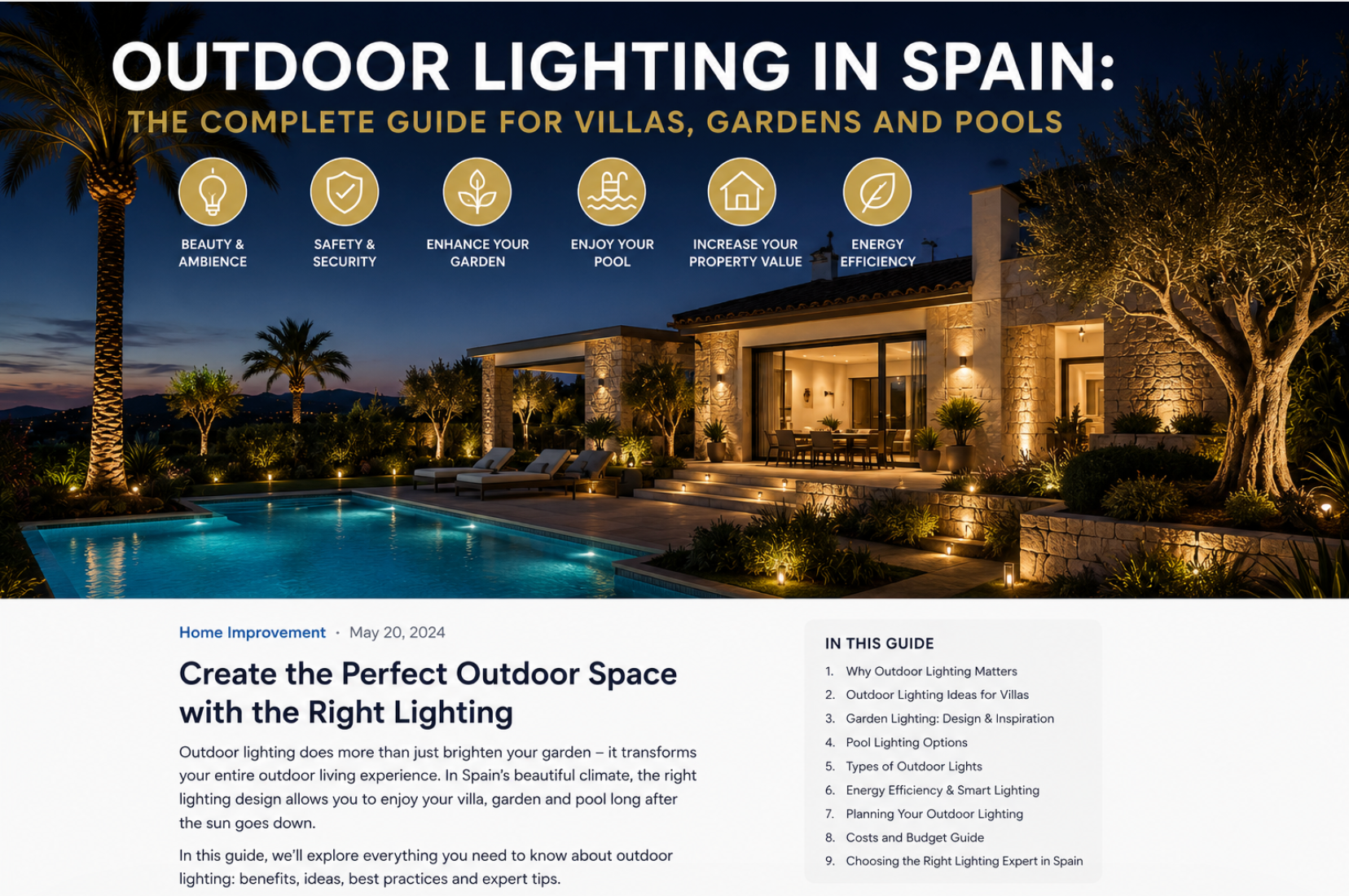
Outdoor Lighting in Spain: The Complete Guide for Villas, Gardens and Pools
Illuminating outdoor spaces in Spain demands a delicate balance of art, science, and local knowledge. Between the intense Mediterranean sun, the long, sociable evenings, the salt-laden coastal air and the diversity of architectural styles from Andalusian cortijos to sleek contemporary villas, the right lighting design elevates a property’s beauty and usability while upholding safety, efficiency, and compliance. This comprehensive guide has been developed to help villa owners, property managers, architects and landscaping teams plan, specify and execute exceptional outdoor lighting for villas, gardens and pools throughout Spain—irrespective of region or style. You will find practical specifications, climate-smart material guidance, design principles, regulatory considerations, energy strategies, and detailed instructions for long-term maintenance—everything needed to craft a refined, high-performing nightscape that complements life in Spain.
Understanding the Spanish Context: Climate, Lifestyle and Architectural Heritage
Spain’s outdoor lifestyle shapes how you should approach lighting. Long summer evenings, al fresco dining, late-night gatherings by the pool, and panoramic terraces that welcome sea breezes and mountain views all call for layered lighting schemes that enhance both ambience and functionality. Equally, Spain’s climates—from the humid Mediterranean coast and Balearic Islands to the drier central plateau and the subtropical Canary Islands—present technical challenges that directly affect fixture selection, control strategies, replacement cycles and maintenance regimes.
Architecturally, the spectrum is broad: whitewashed Ibizan villas with smooth stucco walls; Andalusian patios centred on a fountain with orange trees and geometric tiles; Catalan masías with stone façades; contemporary Costa Blanca residences with glass balustrades and floating staircases; rustic fincas nestled among olive groves; and dramatic coastal properties perched above the Mediterranean. Each typology benefits from nuanced lighting treatment—façade grazing to tease texture from stone, low-level planting accents to emphasise aromatic gardens, warm wall lighting to enliven an outdoor kitchen, and precisely controlled pool lighting for elegance and safety. The aim is to create a coherent night-time identity that respects local aesthetics, encourages social living and ensures easy circulation after dusk.
Core Design Principles: Layered Light, Human Comfort and Purpose
Start with purpose. Outdoor lighting is not merely decorative; it is an instrument for living well at night. A well-structured plan integrates four layers:
- Ambient lighting: Sets the overall mood for terraces, patios and garden rooms. Often achieved through warm wall lights, concealed cove lines in pergolas, or low-level bollards to create a soft base of light.
- Task lighting: Focused illumination for outdoor kitchens, bar counters, steps, and entry locks. Discrete, glare-free fittings with sufficient lux enable safe, efficient tasks.
- Accent lighting: Highlights features—sculptures, palms, stonework, water jets, or an antique door. These touches add depth and drama without overpowering the scene.
- Wayfinding and safety lighting: Ensures pathways, driveways, gates, ramps and pool surrounds are legible and safe, with controlled beams and anti-glare optics that do not dazzle.
Balance is everything. Too much light flattens a space; too little compromises safety. Consider perceived brightness: humans respond more to contrast than to absolute lux levels. Focus light where it’s needed, employ generous shadow to sculpt character and reduce energy consumption, and prioritise warm colour temperatures that support convivial evenings.
Recommended Lux Levels for Residential Exteriors
While residential standards are more flexible than commercial street lighting, the following targets are practical guidelines for Spain’s villas and gardens:
- Paths and walkways: 5–15 lx average (with good uniformity on steps and changes in level)
- Driveways and parking: 10–20 lx average
- Terraces and dining areas: 30–100 lx at table plane for comfortable dining and reading menus; allow lower background levels around 10–20 lx for ambience
- Outdoor kitchens and BBQs: 150–300 lx on worktops; ensure low glare and excellent colour rendering
- Pool surrounds (non-submerged deck): 10–30 lx with strong attention to glare control
- Feature lighting (plants, sculptures): No fixed lux; design by effect—ensure contrast without overexposure
Adopt a “just enough” mindset. Combine these guidelines with occupant preferences and on-site trials. Spain’s bright moonlit nights and luminous white façades often reflect more light than expected; always review your scheme in situ after dark.
Light Quality: Colour Temperature, Colour Rendering and Beam Control
Two attributes define the feel and fidelity of your lighting: colour temperature and colour rendering. In Spain, warm tones generally suit residential exteriors best, echoing the golden evening light and softening architectural lines.
Colour Temperature (CCT)
- 2200–2700 K: A candlelit to warm white range perfect for terraces, lounge seating, pergolas, and garden perimeters. It flatters skin tones, complements terracotta and timber, and reduces blue light content, which is kinder to the night sky and wildlife.
- 3000 K: A popular warm neutral for pathways, façades with crisp render, and contemporary spaces where a touch more clarity is desired without creating a cool ambience.
- 3500–4000 K: Use sparingly outdoors in residential contexts. Suitable for task-heavy areas like outdoor kitchens or for security lighting. Avoid mixing too many colour temperatures in small areas.
- Amber or narrowband sources: In ecologically sensitive or coastal turtle zones, amber and low-blue options can be advantageous. Consult local guidance and aim to shield light from the shoreline.
Colour Rendering (CRI)
A high CRI (≥90) ensures plant greens, timber tones, and stone textures appear rich and natural, and that food preparation looks appealing and safe. For façades and pathways, CRI 80–90 is usually sufficient, but in dining and cooking areas, CRI 90+ is transformational and worth the marginal cost increase.
Glare and Beam Shaping
Glare is the fastest way to ruin a beautiful garden at night. Select luminaires with:
- Integrated glare baffles and shielding to prevent direct view of the light source.
- Precise optics (narrow, medium, wide beams) matched to target sizes—narrow for tall palms, wide for low shrubs, elliptical beams for paths.
- Adjustability limits to avoid accidental mis-aiming during gardening or cleaning.
- Low mounting heights and indirect techniques (grazing, washing, bounce) to reduce physiological discomfort and neighbour disturbance.
For façades and trees, use grazing or off-axis uplighting, not brute-force floodlighting. For paths, prefer shielded bollards or directional in-ground washers over unshielded globe fittings. For pools, ensure submersibles are positioned to avoid shining towards seating or neighbouring properties.
Materials and Durability: Beating Salt, Sun and Storms
Spain’s climates are harsh on exterior fittings. The Mediterranean and Atlantic coasts subject metals to salt-laden air; Balearic and Canary Islands add persistent UV and wind; inland heat can bake seals; and calima or Saharan dust can abrade finishes. Specifying marine-suitable, UV-resistant, and well-sealed luminaires and accessories is not optional—it is essential.
Enclosure Ratings and Impact Resistance
- IP ratings: For exposed garden fittings, aim for IP65 minimum. For ground-recessed uplights and pool-side deck lights subject to jets or temporary puddles, specify IP67. Submerged pool lights must be IP68 and designed for continuous immersion at the specific depth.
- IK ratings: Where fittings are accessible or in high-traffic areas (driveways, sports courts), choose IK08–IK10 impact ratings to withstand knocks and occasional impacts from equipment or balls.
Corrosion Resistance and Finishes
- Marine-grade stainless steel (316): Excellent for coastal areas if properly maintained. Avoid lower grades. Periodic rinsing reduces tea staining.
- Bronze, brass and copper: Robust and develop attractive patina; excellent coastal performance. Watch for galvanic corrosion if mixed with other metals.
- Anodised aluminium: Choose high-quality, thick anodising. Polyester powder coating with a marine-grade pre-treatment can perform well; confirm salt-spray test performance and warranty.
- UV-stable polymers: When weight or thermal isolation is desired, specify UV-stabilised polycarbonate or acrylic engineered to resist yellowing; look for UV inhibitors and warranty against discolouration.
- Gaskets and seals: EPDM or silicone gaskets rated for high temperature swings preserve ingress protection over time. Consider replaceable gaskets for long-life luminaires.
Thermal Management and LED Longevity
High ambient temperatures (summer nights in southern Spain remain warm) can shorten LED lifespan. Ensure housings include sufficient heat sinking and that wattages are not driven to extremes. Look for thermal foldback protection and L80/B10 or better lifetime ratings. For enclosed architectural niches, account for heat build-up and allow ventilation.
Glass, Lenses and Diffusers
For in-ground and pool luminaires, opt for thick tempered glass and robust lens seals. Anti-slip glass textures can be valuable on walk-over fittings. Where hard water causes limescale, plan for periodic descaling to preserve optical clarity. Avoid low-quality plastics that haze or craze under UV.
Compliance, Safety and Local Regulations in Spain
Outdoor lighting must respect both electrical safety rules and environmental considerations. Spain’s regulatory landscape includes national frameworks and municipal ordinances. While homeowners do not typically require the same approvals as public lighting, installations must still be safe, efficient and compliant.
Electrical Regulations and Safety
- Authorised installers: Use an authorised electrician (instalador autorizado) for new circuits, pool zones, and any works involving the main distribution board. You may need a certificate of installation (CIE, commonly called “boletín”).
- Residual Current Devices (RCDs): Outdoor and pool circuits should be protected by 30 mA RCDs. Test regularly (monthly push-button test) and label circuits clearly.
- Wiring methods: Use cables rated for outdoor and underground use. In Spain, flexible rubber-sheathed cables (e.g., H07RN-F) and UV-stable conduits are commonly specified. Underground runs should be protected in conduits and buried at appropriate depths (often 60 cm for mains in gardens; consult local codes and conditions).
- Equipotential bonding and pools: All conductive parts in and around pools—ladders, handrails, nearby metal fittings—require equipotential bonding to minimise shock risk. Pool lights must be low voltage and comply with the strict “zones” around water.
- Protection zones: In and around pools and fountains, special regulations define volumes where only certain voltages and equipment are permitted. Submersible luminaires should be supplied by safety isolating transformers located outside restricted zones. Always follow the applicable Spanish low voltage regulations (REBT) and associated instructions (ITCs) on pools and fountains.
- Junctions and terminations: Use resin-filled or gel-filled IP68 junction kits for buried and wet locations. Do not bury standard junction boxes. Provide accessible but protected inspection chambers where necessary.
Light Pollution and Environmental Ordinances
Many Spanish municipalities have policies to reduce light pollution, glare and light trespass across property boundaries. Sensible measures include:
- Downward-directed light with full cut-off optics to reduce uplight and skyglow.
- Curfews for decorative lighting (e.g., automatic switch-off after midnight or when not in use).
- Warmer colour temperatures (≤3000 K, sometimes ≤2700 K) to minimise blue content that scatters and disturbs wildlife.
- Shielding and setbacks near boundaries to avoid spill into neighbours’ windows and sensitive habitats.
Before undertaking extensive landscape lighting, consult your local Ayuntamiento (town hall) for any specific ordinances. Historic districts may require approvals for façade alterations. Coastal zones may have special considerations for wildlife and public rights of way.
Façade and Architectural Lighting: From Texture to Silhouette
Well-composed façade lighting articulates your villa’s character and ties the night-time composition together. Whether rustic stone, crisp white render, or timber cladding, the technique should flatter the material while keeping glare and light spill under control.
Key Techniques
- Grazing: Place narrow-beam luminaires close to the wall (0.2–0.6 m) and aim upwards to emphasise surface texture, especially on stone or ribbed render. Control spill beyond the roofline to protect dark skies.
- Washing: For smoother façades, a wider beam at a modest offset creates gentle, even illumination without harsh highlights.
- Silhouetting and backlighting: Position a light source behind latticework, pergolas, or sculptural elements, letting them read as dark shapes against a softly lit background.
- Framing details: Accentuate arches, cornices and pilasters with short, shielded uplights or downlights. Avoid overemphasis—highlight selective features to avoid visual clutter.
- Perimeter downlighting: Recessed eaves lighting or small shielded downlights along façades bring vertical brightness close to the building, improving security and sense of enclosure without lighting the entire garden.
Colour and Control
For Mediterranean whites and creams, 2700–3000 K yields an inviting glow. For stone, 2700 K enriches warmth and ruggedness. Avoid overly cool tones that can appear stark. Where façades host art or intricate tiling, specify high CRI. Use dimming to adapt brightness as the night deepens and to accommodate neighbours. Consider astronomical timers for automated sunset/sunrise adjustment across seasons.
Garden and Planting Design: Sculpting Nature with Light
Spanish gardens range from fragrant courtyards of jasmine and orange blossom to terraced hillsides with pines and agaves. A planting-led lighting scheme celebrates structure, texture and seasonal change, sparingly and sensitively.
Tree and Shrub Strategies
- Palm trees: A narrow to medium beam uplight placed 1–1.5 times the trunk diameter from the base reveals trunk patterning and frond reach. Shield to avoid glare when viewed from seating.
- Olives: Use a warm, soft beam to caress the twisting form and silvery leaves. Backlighting can be magical, catching leaf edges and producing a shimmering halo.
- Pines and cypresses: Aim a narrow beam up the trunk for elegance. Consider two opposing lights at lower intensities rather than one strong light to reduce harsh contrasts.
- Agaves, aloes and succulents: Low grazing or side lighting brings out sculptural geometry and casts dramatic shadows on adjacent walls or gravel.
- Hedging and borders: Use linear grazing to create a continuous ribbon of soft light along pathways. Avoid over-brightness; the aim is legibility and texture, not daylight brightness.
Ground, Deck and In-Ground Fittings
In-ground uplights must combine performance with durability: IP67+, robust lenses, drainage provision and tilt-controlled gimbals. On timber decking, recess small marker lights at the perimeter rather than in central traffic lines to reduce glare and avoid trip hazards. In gravel or xeriscape zones, spike spots are versatile and easy to reposition as planting matures; ensure cable protection and discreet junctions.
Water-Wise and Wildlife-Conscious Planting
Spain’s water-scarcity concerns encourage drought-tolerant planting. Lower canopy density often makes individual plant accents more visible, enabling a few carefully positioned luminaires to achieve significant effect. Adopt warmer CCTs and curfews to reduce impact on pollinators and nocturnal fauna; keep light focused and low to the ground. In rural areas, guard against upward spill that disrupts stargazing and night ecology.
Paths, Steps, Driveways and Entrances: Wayfinding with Elegance
Movement areas demand clarity without compromise to ambience. The goal is to ensure secure, intuitive navigation with minimal visual intrusion.
Pathway Lighting
- Shielded bollards: Look for forward-throw optics and cut-off to keep light on the path, not in guests’ eyes or flowerbeds. Heights of 400–900 mm suit garden paths; closer spacing (3–6 m) improves uniformity.
- Low-level wall washers: In retaining walls and raised planters, integrated linear or porthole lights softly wash the adjacent walkway.
- Recessed steplights: Install at stair risers with asymmetrical beam to light the tread. Prioritise anti-glare louvers and precise alignment.
- In-ground edge markers: Use sparingly along driveways or curving paths for subtle guidance. Ensure anti-slip glazing, appropriate IK rating, and correct drainage detailing.
Entrances and Gateways
Front doors, garage entries and gates need a welcoming yet practical approach. Combine a warm wall light (or pair of sconces) at eye level with an overhead downlight positioned to avoid reflections in glossy doors. Integrate a discreet light by the intercom and key cylinder. For drive entrances, low-glare bollards or shielded lanterns define the boundary while respecting drivers’ night vision. Consider plate-reader or presence sensors only where necessary; keep illumination targeted and time-limited to avoid a constant “on” state.
Terraces, Pergolas and Outdoor Kitchens: The Social Heart
Spanish villas come alive on the terrace. From tapas at sunset to late-night conversations under a pergola, these areas benefit from a well-judged mix of ambient, task and decorative light that flatters faces, food and furnishings.
Dining and Lounge Zones
- Layered ambience: Combine dimmable wall lights and concealed linear lighting along rafters or beams to create a soft envelope of light. Add a focal pendant or cluster above the table (rated for exterior use and sheltered from rain) to anchor the setting.
- Table illumination: Target 30–100 lx horizontally. Portable, rechargeable table lamps can offer intimate pools of warm light; ensure IP ratings are adequate for outdoor use and storage.
- Glare control: Shield sources to avoid reflections on glass doors and windows. If your terrace faces the sea, consider baffles or louvers that block low-angle views from adjacent homes.
Outdoor Kitchens and Bars
Cooking demands high-quality, even illumination with strong colour rendering:
- Worktop task lights: 150–300 lx at counter height with CRI 90+. Opt for under-shelf or integrated downlights with precise beams to avoid shadows on the cutting area.
- Heat and grease considerations: Use luminaires with robust seals and finishes resistant to heat, steam and cleaning agents. Avoid fittings directly over grills where heat and soot concentrate; offset and cross-light instead.
- Switching and scenes: Separate controls for task and ambient circuits let you cook brightly then quickly return to a relaxed atmosphere.
Pergolas and Shade Structures
Linear LED concealed along beams, fairy-like low-intensity strings (rated for exterior), or tiny downlights set into rafters create an intimate canopy. Keep brightness subtle to preserve the starry sky feeling. In windy coastal regions, ensure pendants are mechanically restrained to avoid swaying. Use warm 2200–2700 K for a candlelit mood.
Pools, Spas and Water Features: Safety and Spectacle
Water is the centrepiece of many Spanish villas. Its lighting can be breathtaking, but it must be safe, durable and considerate of neighbours and wildlife. Aim for serene luminosity rather than a glaring beacon.
Safety and Electrical Zones
- Voltage and protection: Submerged luminaires should be low voltage via safety isolating transformers positioned outside defined pool zones. Circuits must be RCD-protected at 30 mA.
- Ingress protection: IP68 for submerged fittings with robust glands and potting. Use cable types rated for immersion.
- Equipotential bonding: Bond all metallic components: rails, ladders, nearby metal light fixtures, and pool reinforcement where applicable. This is essential for shock risk reduction.
- Junctions: Use pool-rated watertight junction boxes placed in accessible, dry niches. Avoid hidden, buried splices without approved sealing systems.
Designing the Pool Lighting Effect
- Positioning: Install pool wall lights opposite main viewpoints (terrace, lounge) and aim across the pool, not toward observers. This avoids glare and better reveals water clarity and movement.
- Colour temperature: For serenity, 3000 K or warm white works beautifully. Cooler whites can look crisp but risk a sterile feel. If colour change is desired, choose a system with excellent colour mixing and smooth dimming; use colour sparingly for events.
- Uniformity: Avoid bright hotspots; fewer, well-placed luminaires are better than many small, glaring points. Consider corner or end-wall positioning for even spread in rectangular pools.
- Wet decks and beach entries: Use low-level perimeter lighting or recessed step lights to define edges. Keep brightness modest and shielded to protect night vision.
- Fountains and rills: Narrow-beam submersible spots create jewel-like highlights on jets and cascades. For rills, concealed linear grazing can be mesmerising when viewed from above.
Spas and Wellness Zones
For hot tubs and spa pools, warm, dimmable light promotes relaxation. Tiny underwater points can sparkle like stars, but ensure controls are easy to reach without leaving the tub. If integrating aroma or steam features, choose corrosion-resistant fittings and sealed housings.
Sports, Courts and Activity Areas: Lighting for Play without Intrusion
Private tennis or padel courts and multi-use play spaces require higher light levels with robust optics and strict glare control to prevent disturbance to adjacent properties.
Design Considerations
- Illuminance: For recreational play, aim around 200–300 lx average with good uniformity for tennis, lower for padel or multi-use play depending on preference.
- Mast positions: Place luminaires outside the court enclosure with asymmetric optics to keep light on the playing surface and minimise spill. Use cowls and visors.
- Curfews and dimming: Program automatic switch-off at a reasonable hour and integrate scene controls for warm-up, play, and wind-down.
- Neighbours: Engage early with boundary shielding; consider planting and noise-absorbing landscaping along with careful aiming.
Smart Controls, Scenes and Automation
A sophisticated control strategy enhances experience, reduces energy, and assures compliance with curfews. The Spanish lifestyle benefits from scenes that adapt from sunset aperitifs to late-night swims.
Control Layers
- Astronomical timers: Automatically adjust on/off times to sunrise/sunset with seasonal drift accounted for. Ideal for façade and pathway circuits.
- Photocells: Ensure lights only come on when ambient light falls below a threshold; combine with timers to avoid unnecessary operation during early evenings.
- Presence/motion sensors: Use tactically for driveways, steps, and security, not as the primary control for social areas. Choose sensors with adjustable sensitivity and timeouts.
- Dimming and scenes: Group fittings into scenes—Arrival, Dinner, Pool, After Hours, and Off—so users can transform the atmosphere instantly.
- Integration: Where the villa has an automation system, integrate outdoor circuits for single-app control and remote management when away. Ensure robust, weatherproof enclosures for outdoor control gear and reliable networks for gardens of scale.
Power, Wiring and Installation: The Hidden Backbone
Behind every elegant nightscape is a meticulously planned electrical backbone. Outdoors, longevity depends on sound engineering: correct cable sizing, routes, protection, and accessible maintenance points.
Planning the Infrastructure
- Load calculation: Summate luminaire wattages and apply diversity where appropriate. Provide spare capacity for future additions—gardens evolve.
- Voltage drop: Long garden runs can suffer voltage drop. For low-voltage systems, keep cable runs short, use heavier gauge conductors, or locate transformers near loads.
- Segregation: Separate power and control/data cables to avoid interference. In conduits, respect fill ratios and bend radii.
- Distribution points: Create discreet service hubs (e.g., in planting beds or boundary walls) with IP-rated enclosures and drainage. Label everything clearly for future service.
Burial, Drainage and Junctions
- Depth and protection: Bury mains cables at a safe depth, typically around 60 cm in gardens, inside suitable conduits. Use marker tape above cable runs.
- Drainage: In-ground lights require sump and drainage layers—gravel beds or dedicated drainage conduits prevent standing water around housings.
- Resin and gel kits: Where splices are unavoidable in damp locations, use resin-filled IP68 kits approved for burial. Keep records of locations for maintenance.
Earthing and Bonding
Earth continuity and bonding are non-negotiable for metal luminaires, junction boxes and structural elements. Around pools and fountains, ensure equipotential bonding meshes all conductive parts. Validate with testing upon completion.
Energy Efficiency, Sustainability and Lifecycle Thinking
Energy costs and environmental stewardship are front of mind. Spain’s abundant sunshine doesn’t negate energy-conscious design; it invites intelligent control, efficient sources, and minimal waste.
LED Performance and Efficacy
- Efficacy: Choose luminaires with high lumens per watt while prioritising optics that put light where needed. Efficacy is meaningless if spill and glare waste energy.
- Driver quality: High-quality drivers extend lifespan and support smooth dimming and flicker-free operation. Specify surge protection, especially in storm-prone areas.
- Modularity: Prefer luminaires with replaceable drivers and LED modules to extend service life and reduce waste.
Controls and Curfews
Automated curfews reduce run hours dramatically. Scenes set at lower dim levels (e.g., 60–70 per cent for social ambience) often look better and save energy. Presence-based triggers for transient spaces like side paths keep lights off until needed.
Materials and Circularity
Metals such as aluminium, brass and copper are recyclable; choose products from manufacturers that support spare parts and end-of-life recycling. Opt for finishes with proven durability to extend service intervals. Avoid disposable fixtures with short warranties; lifecycle economics usually favour higher-quality fittings that last.
Security, Privacy and Good Neighbour Lighting
Thoughtful security lighting reassures occupants without creating a fortress ethos or intruding on neighbours.
Best Practice
- Targeted illumination: Light vulnerable points—gates, entrances, service yards—rather than flooding the entire plot.
- Colour temperature: Slightly cooler white (3000–3500 K) can improve camera clarity, but balance with the overall warm scheme. Many modern cameras perform excellently under warm light; test if possible.
- Triggering: Use motion sensors with short timeouts and soft-start dimming to avoid startling. Clearly distinguish security circuits from social lighting controls.
- Privacy: Angle luminaires to prevent spill into neighbours’ windows; shield and dim as needed. Avoid high masts unless absolutely necessary and permitted.
Coastal and Island Conditions: Special Measures for the Med, Atlantic and Islands
Coastal Spain and the islands require extra resilience. Salt, wind and intense sun punish inferior components. Marine-grade thinking is essential.
Recommendations
- Material selection: 316 stainless, brass/bronze, or marine-prepped powder-coated aluminium. Avoid untreated steels and low-grade fasteners.
- Sealing and vents: Pressure-equalising vents help manage condensation while preserving IP rating. Confirm that vents are designed for marine use.
- Maintenance: Rinse fittings near the sea monthly to remove salt crystals. Inspect gaskets annually; replace when compressed or brittle.
- Fasteners and accessories: Use 316 stainless screws and anchors. Isolate dissimilar metals to prevent galvanic corrosion.
Mountain and Inland Villas: Temperature Swings, Frost and Darkness
Inland and mountain areas can be cooler and darker at night, with crisp air and bigger diurnal swings. Approaches adapt accordingly.
Design Adjustments
- Warmth and hospitality: Lean towards 2200–2700 K to counter cooler ambient temperatures and create snug terraces.
- Snow and frost: Elevated fittings protect against snow cover; ensure walk-over fittings have textured, anti-slip glass.
- Dark-sky emphasis: Rural locales offer magnificent night skies. Emphasise fully shielded luminaires and curfews to preserve this asset.
Wildlife-Friendly and Dark-Sky Lighting
Spain’s biodiversity benefits when lighting is controlled and considerate. Wildlife-sensitive lighting is not only ethical; it often looks more beautiful and saves energy.
Practical Measures
- Warm CCT: Prefer ≤2700 K and consider amber sources in sensitive areas.
- Directional light: Aim down, shield sources, and avoid uplight.
- Curfews and dimming: Reduce brightness late at night; switch off purely decorative lights after use.
- Spectral management: Minimise blue-rich light that disrupts circadian rhythms for both humans and fauna.
Solar and Off-Grid Options: Harnessing Spain’s Sun
With generous solar irradiance across much of Spain, solar-powered lighting can be effective for pathways, remote garden features and boundary markers—when executed with quality components and realistic expectations.
When Solar Works Well
- Low to medium power needs: Path markers, gate post lights, and occasional-use areas with modest lux requirements suit solar.
- Unshaded locations: Position panels in full sun, ideally oriented for maximum daily exposure. Avoid shading from trees or pergolas.
- Integrated storage: Quality batteries (with suitable temperature tolerance) and charge controllers are crucial. Expect reduced output after several cloudy days; incorporate adaptive dimming.
Limitations and Solutions
- Brightness and autonomy: For brighter, all-night usage or for pool surrounds, hard-wired solutions are usually superior.
- Maintenance: Panels need occasional cleaning to remove dust and sea salt. Batteries have finite lifespans; plan for replacement.
- Hybrid strategies: Combine solar for remote markers with mains-powered circuits for primary social and safety zones.
Budgeting, Cost Planning and Return on Investment
High-end outdoor lighting is an investment in lifestyle and property value. Strategic budgeting ensures you allocate funds where they have the greatest impact and durability.
Where to Spend
- Fittings exposed to the harshest conditions: Pools, coastal zones, and in-ground fittings merit premium, marine-grade luminaires.
- Critical task zones: Outdoor kitchens and steps require reliable, glare-free luminaires with top-tier optics.
- Controls: Intelligent control saves energy, extends component life and greatly improves user experience.
Typical Cost Considerations
- Design and planning: Concept, night trials, and revisions are time investments that often reduce later changes.
- Infrastructure: Trenches, conduits, junction chambers and control enclosures represent a significant portion of cost but are essential for long-term reliability.
- Quality luminaires: Expect higher upfront cost but far lower replacement and maintenance over the lifecycle.
ROI Drivers
- Energy savings: LEDs and smart controls reduce consumption compared to legacy sources.
- Avoided maintenance: Durable materials and modular components prevent frequent replacements.
- Property value: A refined night-time appearance and extended usability of outdoor areas support valuation and desirability.
The Project Workflow: From Brief to Handover
A structured process ensures the final result meets both aesthetic and technical objectives.
1. Brief and Vision
- Define moods: relaxed, dramatic, minimal, or celebratory.
- Identify priority areas: entrances, terraces, pool, special trees, sculptures.
- Agree on curfews, colour temperatures and control preferences.
2. Survey and Night Walk
- Document existing services, plant species, materials and views.
- Conduct a dusk site visit to understand natural light, neighbour sightlines and reflective surfaces.
3. Concept and Mock-Ups
- Prepare zoning diagrams and preliminary luminaire selections.
- Carry out on-site mock-ups for key effects—trees, façade zones, pool corners—to calibrate beam angles and brightness.
4. Technical Design
- Specify luminaires, drivers, transformers, control hardware and wiring methods.
- Produce cable schedules, load calculations, protective device ratings, and control schematics.
- Detail mounting methods—sleeves, drainage, anchorages and corrosion isolation.
5. Installation and Commissioning
- Oversee trenching, conduit placement and junction hubs.
- Verify IP ratings after installation; test RCDs and earth continuity.
- Aim and focus luminaires at night with the client present to approve effects.
- Programme scenes and curfews; label all controls.
6. Handover and Documentation
- Provide as-built drawings, luminaire schedules, warranties and maintenance plans.
- Train occupants on scene selection, overrides and seasonal timer adjustments.
Maintenance and Troubleshooting: Keeping the Nightscape Pristine
Even the best installations need care. A gentle, regular routine prevents small issues from becoming costly failures.
Routine Care
- Cleaning: Wipe luminaires quarterly to remove dust, pollen, sea salt and limescale. Use non-abrasive cloths and pH-neutral cleaners. Rinse coastal fixtures with fresh water monthly.
- Gardening coordination: Inform gardeners of luminaire locations. Use protective guards during strimming to avoid lens scratches and cable damage.
- Seals and gaskets: Inspect annually. Replace when compressed, cracked or sticky to the touch.
- Drainage checks: Ensure sumps and gravel beds aren’t clogged with soil or mulch; clear as required.
- Control gear: Test RCDs monthly. Review timer programmes seasonally. Update automation scenes with owner feedback.
Troubleshooting Common Issues
- Condensation: Some breathability is normal; persistent fogging suggests compromised seals or thermal shock. Check vents and gaskets; ensure correct lamping and power levels.
- Corrosion spots: Early tea staining on stainless steel is cosmetic; rinse and apply protectant. For pitting, review material selection and galvanic isolation.
- Flicker or intermittent operation: Investigate driver health, loose terminations, or moisture ingress in junctions. Confirm voltage drop isn’t excessive on long runs.
- Glaring path lights: Re-aim heads, add louvres, lower output, or increase mounting offsets. Replace unshielded globes with cut-off luminaires.
- Algae in pool lights: Clean lens surrounds; check water chemistry. Ensure fixtures are properly sealed and seats are intact.
Common Design and Installation Mistakes to Avoid
- Over-lighting: Too many bright fittings wash out texture and disturb neighbours. Fewer, higher-quality luminaires placed with care are superior.
- Mismatched colour temperatures: Avoid mixing multiple CCTs in one view. Keep a consistent warm palette unless a task zone requires neutrality.
- Ignoring glare: Failure to shield or aim leads to discomfort and complaints. Always review at night and from seated positions.
- Neglecting drainage: In-ground fittings without drainage will fail prematurely. Always detail sumps and gravel surrounds.
- Inadequate corrosion protection: Coastal projects demand marine-grade components and maintenance. Do not cut corners here.
- Poor cable practices: Shallow burial, unprotected joints, and unlabeled circuits complicate maintenance and increase risk.
- No controls strategy: Lights that run at full power all night waste energy and reduce lifespan. Program scenes and curfews from the outset.
- Designing only on paper: Without night mock-ups and final aiming, outcomes disappoint. Always allocate time for on-site adjustments.
Inspiration: Five Spanish Villa Lighting Concepts
1) Ibiza Cliffside Minimalism
A white stucco villa steps down towards the sea. The night-time scheme is restrained: concealed linear light under bench edges, slim shielded downlights in the pergola, and two narrow uplights grazing a sculptural cactus garden. The pool glows softly with warm white light directed away from the terrace. Pathways are defined by low, forward-throw markers, and all decorative circuits curfew at midnight. The horizon remains dark—stars and sea dominate.
2) Andalusian Courtyard Romance
An interior patio with orange trees, a tiled fountain and archways comes alive with 2200 K. Niches host tiny accent lights to kiss the tilework; low-intensity uplights reveal citrus canopies. An arched gallery is lit with softened wall washers, and the fountain sparkles with a hidden submersible spot. The courtyard becomes an intimate salon, scented and glowing, perfect for evening guitar and conversation.
3) Costa del Sol Contemporary Entertainer
Clean-lined architecture, expansive terraces and an outdoor kitchen demand flexible scenes: Arrival subtly brightens the façade and drive; Dinner uplifts the table pendant and bar task lights; Pool shifts to tranquil low-level edge lighting; After Hours dims most circuits to 30 per cent while step markers maintain safety. Marine-prepped finishes and regular rinsing ensure longevity in salty breezes.
4) Valencia Orchard Finca
Rows of orange trees frame a rustic home. Gentle uplighting alternates through the orchard, leaving many trees unlit to retain mystery. A gravel path is guided by low, shielded bollards, and the outdoor dining area glows under a timber pergola with concealed linear light and a central, warmly dimmed lantern. The result is rural elegance, efficient and wildlife-friendly.
5) Pyrenees Mountain Retreat
Stone façades, slate roofs and cool air suggest a fireside mood carried outdoors. 2700 K wall washers create a soft halo against stone textures; steps and pathways are carefully defined with recessed riser lights and discreet bollards. A small spa pool is lit warmly, and the dark forest backdrop remains untouched, preserving the velvet night sky.
Specification Toolkit: Practical Numbers and Tips
- Pathways: 5–15 lx; forward-throw, shielded optics; 2700–3000 K; spacing 3–6 m depending on output.
- Steps: Riser lighting with asymmetrical beams; aim for uniform tread visibility; CRI 80+ (CRI 90 if colour discernment is important).
- Terraces: Ambient 10–20 lx; dining plane 30–100 lx; 2200–2700 K preferred.
- Outdoor kitchen: 150–300 lx at worktop; CRI 90+; avoid glare into seating.
- Façades: 2700–3000 K; grazing for texture; minimise spill above roofline.
- Pools: IP68 luminaires; low voltage via isolating transformer; light across to avoid glare; warm white preferred.
- Controls: Astronomical timers + dimming + motion where relevant; curfew decorative circuits at a set hour.
- Materials: 316 stainless, brass/bronze or marine-grade coated aluminium near the coast; UV-stable polymers where appropriate.
- Seals: IP65+ for exposed; IP67 for in-ground; pressure-equalising vents reduce condensation.
- Wiring: Outdoor-rated cables; conduits; resin-filled IP68 splices; label distribution points.
Regional Nuances Across Spain
Mediterranean Coast and Balearics
Expect salt, wind and high UV. Use marine materials, rinse schedule, and strong glare control facing the sea to respect neighbours and wildlife. Warm, low-level scenes complement late, social evenings.
Atlantic North
Wetter conditions with lush greenery. Ensure excellent sealing and drainage, anti-slip walk-over glass, and corrosion-resistant fixings. Moist air flatters warm whites; plant lighting benefits from careful shielding to avoid sparkle reflections on wet leaves.
Central Plateau and Inland South
Hot summers, cool winter nights, and strong sun. Prioritise UV stability, heat management and warm CCTs. Xeriscape planting with sculptural succulents shines with side lighting and grazing.
Canary Islands
Subtropical climate with volcanic landscapes, powerful sun and ocean winds. Choose robust materials and deep shields; reduce blue content for astronomy-sensitive areas. Lean into amber and 2200–2700 K for ecological sensitivity.
Process Checklists: From First Thought to Final Switch-On
Design Checklist
- Define use-cases: arrival, dining, lounging, swimming, entertaining, security.
- Select cohesive CCT palette (primarily 2200–3000 K).
- Prioritise glare control and dark-sky principles.
- Choose marine-grade or UV-stable materials per microclimate.
- Plan curfews, scenes and seasonal adjustments.
- Mock-up key effects at night before ordering all equipment.
Technical Checklist
- Calculate loads; specify protective devices and RCDs.
- Design cable routes, burial depths and drainage systems.
- Detail mounting hardware, isolating dissimilar metals where needed.
- Specify IP/IK ratings appropriate to each location.
- Provide accessible, labelled junction and control boxes.
Installation Checklist
- Confirm all components on-site match specification (CCT, beam, finish).
- Test IP integrity after installation; verify terminations and torque.
- Commission at night: aim, dim, and set scenes; document settings.
- Provide as-built drawings, manuals and warranties at handover.
Case Study Scenarios: Applying the Principles
Scenario A: Heritage Stone Villa near Girona
Objectives: Respect stone texture, provide safe access, and create a gentle evening glow. Solution: Narrow-beam grazers close to façades reveal stone. Recessed riser lights define uneven external stairs. A single olive tree receives a soft backlight. Terraces receive 2700 K wall lights dimmed for dining. Decorative circuits off at 00:30 by astronomical timer; path and security on motion-only thereafter. Materials: brass for uplights, marine-grade coated aluminium for wall lights. Outcome: Textural richness, no glare, minimal energy, neighbours delighted by the understated scheme.
Scenario B: Contemporary Villa in Alicante with Infinity Pool
Objectives: Seamless indoor-outdoor transition; avoid pool glare from main seating area; robust against sea air. Solution: Pool lights placed away from main terrace, angled across the water with warm white. Linear undercap lighting on the infinity edge accentuates the waterline without visible sources. Shielded bollards delineate the path to a lower chill-out deck. Outdoor kitchen uses high-CRI task lighting on separate circuit. Materials: 316 stainless for all pool-adjacent fittings; pressure-equalising vents for enclosed luminaires. Outcome: Relaxed glamour; maintenance plan includes monthly rinse-downs and annual gasket checks.
Scenario C: Rural Finca near Seville with Olive Groves
Objectives: Celebrate key olives, keep darkness intact for stargazing. Solution: Alternate olives are softly uplighted with 2200 K narrow beams; others left unlit. Low-level wall washers mark the courtyard perimeter. Push-button scene control shifts between Arrival (paths and façade), Dining (table and kitchen), and After Hours (only step markers and subtle tree accents). Outcome: Romance and restraint; power usage minimal; wildlife impact limited by warm spectrum and curfews.
Frequently Asked Questions
What colour temperature is best for a Spanish villa exterior?
Generally 2200–3000 K. Use 2200–2700 K for terraces and gardens to create a warm, convivial mood; 3000 K for paths or tasks if slightly crisper light is desired. Reserve cooler whites for specific security or activity needs.
How bright should my pathways be?
Aim for 5–15 lx average with good uniformity, higher at steps and level changes. Use shielded optics and avoid glare; brightness perceived is as much about contrast as lux.
Is solar lighting reliable enough for my garden?
It can be, for low- to medium-power applications like path markers and gate lights—if panels have full sun and components are high quality. For terraces, pools and social areas, mains power with smart controls usually delivers superior, consistent results.
What IP rating do I need?
IP65 minimum for exposed garden fittings; IP67 for in-ground or jet-exposed; IP68 for submerged pool lights. Also consider IK ratings for impact resistance where accessible.
How do I avoid glare?
Choose fittings with shielding and precise optics, place at low heights, and aim carefully. Review at night from seated positions and from neighbours’ viewpoints. Dim where possible.
What about wildlife and dark-sky concerns?
Use warm CCTs (≤2700 K), shield light downward, dim or switch off late, and avoid excessive blue-rich light. This approach also looks more refined and uses less energy.
Can I retrofit my existing halogen or discharge fittings to LED?
Yes, but do so thoughtfully. Ensure thermal management, compatible drivers and optics. In many cases, replacing whole luminaires with purpose-built LED models provides better performance, sealing and longevity.
How often should I maintain outdoor lights near the sea?
Rinse fixtures monthly to remove salt deposits, wipe lenses quarterly, and inspect gaskets annually. Use marine-grade materials from the outset to reduce effort.
Are coloured pool lights a good idea?
Colour can be fun for events, but warm white is usually most elegant for nightly use. If you include colour, ensure faithful mixing, smooth dimming and intuitive controls, and default scenes in white.
Do I need permits for outdoor lighting?
Regulations vary by municipality. For standard residential garden lighting, formal permits may not be required, but electrical work must comply with national regulations and may require certification by an authorised installer. Historic or coastal zones may have additional requirements—check with your Ayuntamiento.
Bringing It All Together: A Philosophy for Spanish Outdoor Lighting
Spain invites living outdoors—long meals, unhurried evenings, the soft rush of the sea or the quiet rustle of pines. Lighting should respect and elevate this rhythm. Warm, layered, and discreet; precise where safety or cooking demands, veiled and poetic where relaxation calls; rigorous in materials and sealing to withstand salt and sun; thoughtful in controls to minimise cost and impact; and always mindful of neighbours and night skies. With these principles, your villa, garden and pool can glow with character and calm, beautifully attuned to the Spanish way of life.
How IMMO ABROAD Can Support Your Project
Outdoor lighting is both creative and technical. From initial vision and night-time mock-ups to microclimate-savvy specifications and commissioning, it benefits from seasoned guidance. IMMO ABROAD can help you define a cohesive lighting strategy for your villa, coordinate with authorised installers, align design with Spanish regulations and local ordinances, and craft scene-based controls that fit your lifestyle. Whether you need a sensitive enhancement to a historic courtyard or a fully integrated scheme for a contemporary coastal home, our team will ensure the result is elegant, robust and effortless to live with.
Action Plan: Start Today
- Walk your garden at dusk and list the areas you use most.
- Choose a warm CCT palette and decide on curfews that respect neighbours and nature.
- Prioritise safety lighting for steps and paths; add ambience on terraces; accent only a few key features.
- Specify marine-grade or UV-stable materials based on your location.
- Design for maintenance: accessible junctions, clear labels, and drainable in-ground details.
- Commission with care: aim lights at night, set scenes, and keep records.
- Engage IMMO ABROAD to refine the concept and coordinate a professional, enduring installation.
Conclusion
A Spanish villa at night should feel effortless—secure yet soft, functional yet atmospheric, distinctive yet restrained. Achieving this balance calls for clarity of purpose, sensitivity to climate and context, robust engineering, and a light touch in both design and operation. By embracing warm spectra, precise optics, layered scenes, and materials made for Spain’s diverse conditions, you will create an outdoor realm that you, your guests and your neighbours will love—season after season. With IMMO ABROAD at your side, the journey from first sketch to final switch-on is clear, confident and rewarding, ensuring your villa, garden and pool shine with enduring elegance.