





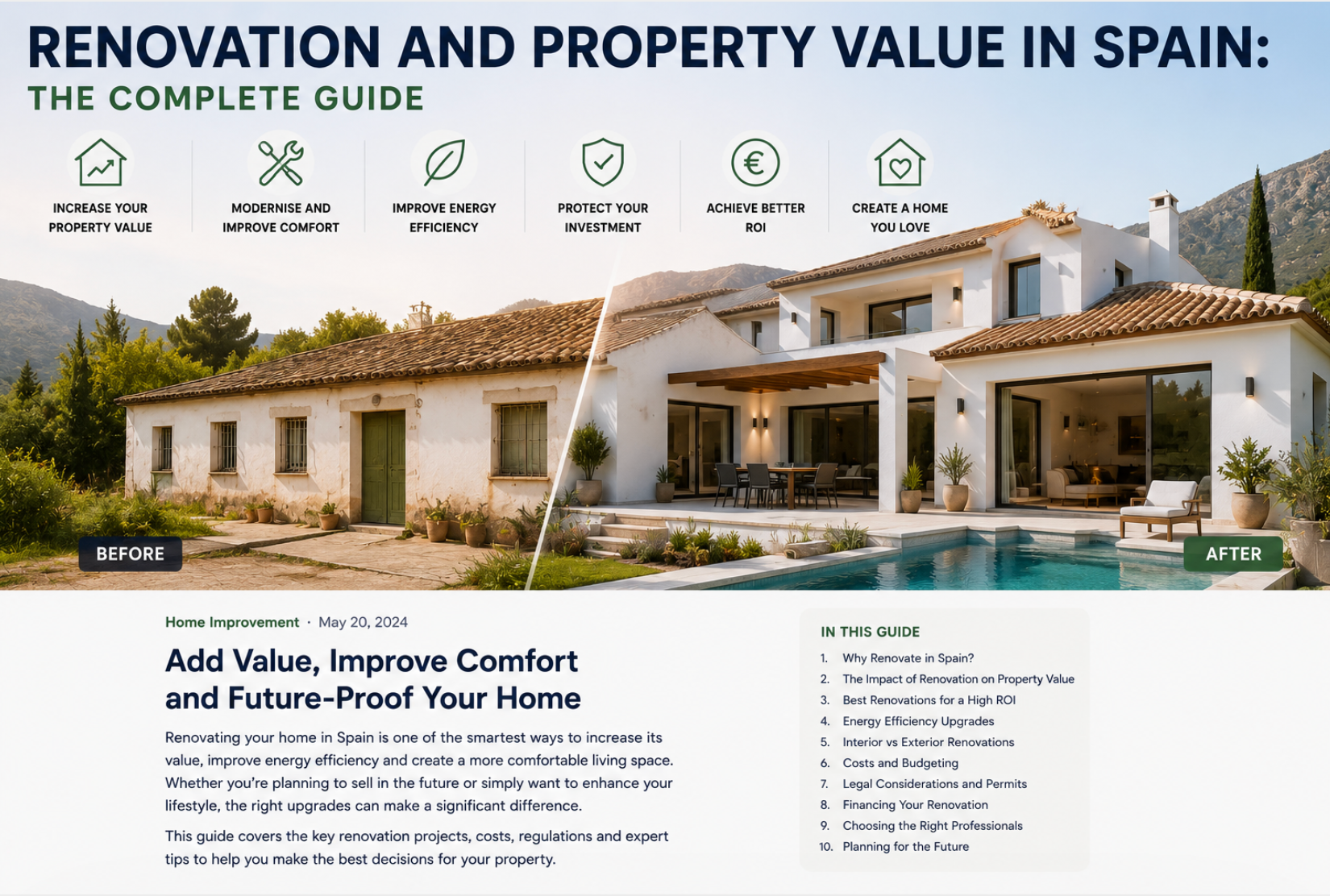
Why Renovation Matters to Property Value in Spain
Renovating a property in Spain is one of the most effective ways to unlock hidden value, differentiate your asset in a competitive market, and create a home that embodies Mediterranean living. From city apartments in Madrid and Barcelona to villas along the Costa del Sol or fincas in the Valencian hinterland, strategic improvements can elevate both sale price and rental performance. Yet the Spanish legal and planning environment is nuanced. Permits, community approvals, structural guarantees, and tax documentation all play decisive roles in whether the value you create is recognised by appraisers, mortgage lenders, and ultimately, buyers.
This complete guide explores how to plan, permit, budget, and execute a renovation in Spain that measurably increases property value. It explains how valuers capture quality and legality, why certain works offer a higher return on investment than others, and what practical steps protect your timeline, budget, and eventual exit. Whether you are modernising a pied-à-terre in a historic barrio, transforming a coastal townhouse for holiday rentals, or undertaking a comprehensive villa refurbishment with energy upgrades, you will find clear, actionable insight grounded in Spanish practice.
Throughout, you will also find detail on documents, approvals, and taxes, plus region-specific considerations that influence feasibility and costs. The aim is not simply to refresh interiors, but to create a compliant, efficient, and commercially compelling property that commands a premium when sold or rented. With expertise and care, the right renovation strategy in Spain can deliver strong financial returns and an exceptional lifestyle outcome.
Understanding the Spanish Property Landscape
Spain’s property market is a mosaic of local regulations, architectural styles, and buyer expectations. A renovation that adds tremendous value in one region or property type may be less effective elsewhere. Before scoping works, it is vital to understand where your asset sits in the broader landscape and how its context shapes both potential and constraints.
Common Property Types and Their Renovation Profiles
Across Spain, property types typically fall into the following categories, each with distinctive renovation patterns:
- Urban flats (pisos): Located in multi-storey blocks governed by a community of owners, these range from period apartments with tall ceilings to mid-century blocks and modern developments. Renovations often focus on layout reconfiguration (open-plan living), kitchen/bathroom upgrades, windows with thermal/acoustic improvements, and building services. Structural changes may require community approvals and careful coordination.
- Townhouses (casas adosadas): Terraced or semi-detached homes in towns and resorts. These offer more autonomy than flats yet may sit within a community with shared facilities. Popular works include adding or legalising roof terraces, reworking internal staircases, and improving outdoor spaces.
- Detached villas: Common on the coasts and peripheries of Spanish cities. Renovations often involve façade refreshes, pool modernisation, landscaping, energy upgrades, and, where feasible, extending living space or reorienting interiors towards outdoor living.
- Country houses (fincas, cortijos, masías): Rural properties carrying unique planning considerations (e.g., restrictions on non-urban land). Renovations must respect local bylaws, heritage elements, and infrastructure realities (septic tanks, wells, access roads). Authentic materials and sympathetic upgrades secure value while avoiding overcapitalisation.
- Lofts and attics (áticos, buhardillas): Top-floor properties prized for terraces and light. Works frequently focus on optimising roof insulation, shading, and creating indoor-outdoor continuity. Approvals can be sensitive where communal roofs or façades are affected.
Regional Variations Influencing Value
Spain’s autonomous communities apply zoning, licensing, and rental rules differently. A renovation’s value potential depends as much on location-specific regulation as on design quality. Illustrative variations include:
- Major cities: In Madrid and Barcelona, high buyer demand and strong rental markets support comprehensive refurbishments that enhance energy performance, acoustics, and premium finishes. Heritage controls and community approvals are decisive. In central districts, soundproofing and air-conditioning can be as value-enhancing as marble worktops.
- Mediterranean coasts (Costa del Sol, Costa Blanca, Costa Brava): Outdoor living drives value; terraces, pools, shade structures, and drought-resilient landscaping matter. Tourist rental licensing frameworks vary by municipality, affecting ROI for holiday-let driven projects.
- Balearic and Canary Islands: Heightened environmental and water considerations, increased scrutiny of rental licences, and a premium for authenticity. Logistics, transport, and island labour availability influence budgets and programming.
- Northern Spain (Basque Country, Asturias, Galicia): Weatherproofing, insulation, and rain management are critical. Traditional materials and craftsmanship add value, but energy retrofits deliver particularly strong returns due to climate.
Overall, value in Spain is both universal and local: universal in that modern services, quality finishes, and natural light appeal everywhere; local in how regulatory permissions, climate, and lifestyle nuance the renovation brief. Thorough due diligence on regional rules and micro-market buyer tastes is the foundation of a value-led plan.
How Renovations Translate into Appraised and Market Value
Spanish valuers and buyers recognise quality and legality. Your renovation should aim to improve three dimensions simultaneously: functional performance, perceived desirability, and documentary compliance. Understanding how value is captured helps you prioritise works that move the needle.
How Appraisers Assess Refurbished Property
Mortgage valuations in Spain follow accepted standards that triangulate between comparable sales, cost, and, where relevant, income approaches. Key takeaways:
- Condition and quality: Valuers adjust for the property’s state of conservation and finish level. A comprehensive, documented refurbishment typically uplifts the condition rating from “average” to “good” or “excellent”, supporting higher comparables and reduced obsolescence deductions.
- Legality: Works completed under the correct licence and reflected in municipal files (and, where required, post-work occupancy/habitation certificates) are recognised in value. Unlicensed extensions or terraces may be excluded from the measured area or yield a lower value due to regularisation risk.
- Energy performance: Demonstrable improvements to the energy rating (certificado de eficiencia energética) increasingly influence appraisals, especially for lending and institutional investors. Upgrades to windows, insulation, and efficient HVAC systems are tangible signals.
- Usable space and layout: Intelligent reconfiguration to create an additional bedroom, enhance circulation, or introduce dual-aspect lighting typically improves both valuation and absorption in the resale market.
Buyer Psychology: Lifestyle, Light, and Liveability
Beyond technical appraisal, buyers in Spain respond to lifestyle. Renovations that amplify the Mediterranean living experience command premiums:
- Indoor-outdoor flow: Level thresholds to terraces, large sliding doors, pergolas, and outdoor kitchens convert balconies and gardens into true living areas. In coastal and island markets, this is often the single biggest emotional driver.
- Natural light: Strategic glazing, internal windows, and light wells uplift perceived space. In traditional apartments, redistributing service cores can bring daylight deeper into the plan.
- Quiet and comfort: Acoustic insulation, quality windows, and zoned air-conditioning win buyers in dense urban settings.
- Low running costs: Solar PV, heat pumps, and insulation lead to lower bills—important for both residents and investors focused on net yields.
Income Approach: Holiday and Long-Term Rentals
Where properties are oriented to rental income, value often derives from gross and net yields. Renovations can drive higher nightly rates or stable long-term occupancy if they deliver:
- Durable finishes that withstand changeovers.
- Flexible sleeping arrangements and optimised storage.
- Energy-efficient systems that reduce consumption borne by either landlord or tenant.
- Compliance with tourist rental licensing where applicable, since unlicensed properties may not legally operate as short-stays in many municipalities.
Ultimately, the works that add the most value are those fully permitted, professionally executed, and clearly documented, so lenders and buyers can confidently underwrite the uplift you have created.
Legal and Planning Framework: Licences and Compliance
Spain’s legal framework prioritises safety, habitability, and urban order. Securing the correct authorisations before building is non-negotiable for value creation. A complete file allows your improvements to be recognised at appraisal and avoids costly regularisation later.
Licencia de Obra: Minor vs Major Works
Most municipalities distinguish between:
- Licencia de obra menor (minor works): Typically for non-structural interventions such as kitchen and bathroom refits, flooring, internal finishes, and sometimes window replacements not altering openings. Usually requires a simple application, scope description, and fee. Timeframes are shorter.
- Licencia de obra mayor (major works): Required for structural alterations, façade changes, extensions, roof modifications, new openings, or changes affecting the building envelope or communal elements. These generally demand a technical project signed by an architect, technical architect involvement during works, and a fuller review by the town hall.
The dividing line between minor and major can vary by municipality, and some non-structural items (such as external joinery changes) can trigger stricter review in historic centres or protected buildings. When in doubt, consult an architect early.
Building Regulations: Código Técnico de la Edificación (CTE)
The CTE is Spain’s national building code, establishing performance requirements for structure, fire, noise, energy efficiency, and health. Major works must comply with the relevant CTE sections, and even minor upgrades benefit from aligning with energy and acoustic standards where feasible. Notable parts include:
- DB HE (Energy Saving): Thermal envelope, HVAC efficiency, and renewable contributions.
- DB HR (Acoustic): Sound insulation between dwellings and within the home.
- DB HS (Healthiness): Ventilation and moisture control.
- DB SI (Fire Safety) and DB SE (Structural Safety): Critical for major works.
Occupancy and Habitability Certificates
Post-works, you may need to obtain or update a certificate of occupancy/habitability (often called Licencia de Primera Ocupación, Cédula de Habitabilidad, or similar terminology depending on the region). This is especially important where there has been a change of use, significant alterations, or legalisation of previously unapproved space. Without it, some utilities or rental registrations may be unavailable, and buyers/lenders may take a cautious view.
Heritage and Protected Zones
In historic districts or formally protected buildings, additional approvals are typical. Façades, shutters, joinery, and rooflines may be tightly controlled. Expect to provide detailed drawings and material specifications. Internal works that affect protected elements (staircases, beams, tiles) may require specialist interventions and supervision.
Coastal and Rural Land Considerations
For properties near the shore, coastal protection rules can limit extensions or external interventions. On rural land (suelo rústico/no urbanizable), new residential developments are typically prohibited, and only certain agricultural or infrastructure-related works may be permitted. Some existing rural homes may be in situations akin to “fuera de ordenación” or classified under municipal regimes for assimilated properties. Always obtain a municipal urban planning report clarifying permitted works before committing to significant investment.
Tourist Rental Licences
If your renovation objective includes holiday-letting, research local tourist rental licensing thoroughly. Some municipalities have freezes, quotas, or strict zoning that limit new registrations. Requirements often include minimum standards for habitability, safety equipment, and noise management. Renovating to meet these standards early saves time and duplication later.
Due Diligence Before You Renovate
Strong due diligence transforms a renovation from a design exercise into a strategic investment. Assemble a complete legal and technical picture to avoid surprises and cost overruns.
Title, Registry, and Cadastral Consistency
Confirm that the registered description at the Property Registry aligns with the Cadastre and physical reality. Discrepancies in built area, terraces, or outbuildings are common in older homes. Where differences exist, your architect can help prepare the technical documents needed for regularisation in parallel with the renovation project, ensuring your investment is recognised at sale time.
Nota Simple and Urban Planning Reports
Obtain a recent Nota Simple from the Property Registry to confirm ownership, charges, and easements. Request a municipal urban planning report or equivalent to verify land classification, permitted uses, building parameters (height, setbacks, occupancy rates), and any heritage or environmental constraints. This document informs what is legally feasible, saving you from designing unpermittable schemes.
Comunidad de Propietarios Rules and Approvals
In buildings with a community of owners, the Horizontal Property Law and community statutes govern alterations affecting common elements (façades, structural walls, roofs, terraces classed as common with exclusive use). Many interventions require prior approval by the community at an owners’ meeting. For example, installing external air-conditioning units, modifying windows, enclosing balconies, or creating new roof access often need community consent in addition to municipal licences. Secure this early to avoid rework.
Technical Survey and Structural Assessment
Commission a detailed technical survey. A Spanish architect or technical architect will inspect structure, damp, roof condition, services, and compliance risks. Where major works are contemplated, consider opening up selected areas for inspection and commissioning a structural engineer’s input. If you plan to extend or modify load-bearing elements, a geotechnical study may be required for foundations and project design.
Services and Infrastructure
Map out the existing electrical capacity, water pressure, drainage runs, and any septic or well systems. Upgrading to modern kitchen appliances, air-conditioning, or induction hobs frequently requires higher electrical power contracts, panel upgrades, and earthing improvements. In rural areas, septic tanks must meet local standards; upgrading can be mandatory when undertaking major works.
Budgeting: Costs, Contingencies, and Realistic Benchmarks
Accurate budgeting underpins ROI. Spanish construction costs vary by region, contractor capacity, and specification. The following ranges are indicative and should be refined through detailed design and competitive tendering.
Cost per Square Metre Benchmarks
- Light refurbishment (paint, basic kitchen/bath updates, minor carpentry): approximately €300–€700/m².
- Mid-range refurbishment (new kitchen and bathrooms with quality finishes, flooring, internal doors, upgraded electrics and plumbing as needed): approximately €700–€1,200/m².
- Comprehensive “gut” renovation (full reconfiguration, services overhaul, windows, insulation, HVAC): approximately €1,200–€2,200/m², potentially higher in premium urban cores or islands.
- Extensions/new-build elements: construction costs generally €1,400–€2,800/m² depending on structure, envelope, and finish, plus design fees and permits.
Specialised items are budgeted separately:
- Windows/doors with thermal break and double/triple glazing: €500–€1,200/m² of opening, depending on system and glazing.
- Air-conditioning/heat pumps: €2,500–€8,000+ for a typical flat; villas with multi-zone systems may exceed €15,000.
- Underfloor heating: €40–€80/m² supply and install, plus plant.
- Solar PV: €1,000–€1,600 per kWp installed, before subsidies.
- Pool refurbishment: €8,000–€40,000 depending on size, lining, and equipment.
- Roof replacement/insulation: €80–€250/m² depending on system and access.
Soft Costs: Fees, Permits, and Taxes
Beyond construction, allow for:
- Architect and technical architect: fees vary with scope and complexity; for comprehensive refurbishments, combined professional fees often range between 8% and 15% of construction cost, including design, licensing documentation, site supervision, and health and safety coordination where required.
- Municipal taxes and fees: the construction tax (ICIO) is typically a percentage of construction budget (often 2%–4%, varying by municipality). There may be licence application fees and waste-container permits.
- VAT (IVA): residential renovation services are generally subject to VAT (commonly 10% for certain qualifying home renovations under specific conditions, otherwise 21%; verify the applicable rate for your case). Materials and services invoiced properly can be capitalised to increase acquisition value for future sale tax calculations.
- Surveys and testing: geotechnical studies for extensions, asbestos surveys in older structures, and additional specialist reports.
- Insurance: builder’s all-risk during works, contractor liability, and, for structural new-build elements, consideration of decennial structural insurance depending on circumstances.
Contingency and Escalation
Allocate a prudent contingency. For light refurbishments in well-understood buildings, 7%–10% may suffice. For period apartments, structural interfaces, or rural homes with uncertain services, 12%–20% is safer. Market conditions can drive material cost volatility, so plan procurement with price locks where possible.
Illustrative Budget Scenarios
Examples help frame feasibility. Consider the following simplified scenarios:
- Urban apartment, 85 m², mid-range refurbishment: new kitchen and 2 bathrooms, flooring, AC, windows, rewiring, partial replumbing, decoration. Construction €75,000–€110,000; professional fees €8,000–€15,000; permits and taxes €3,000–€6,000; contingency €8,000–€12,000. Total €94,000–€143,000.
- Coastal villa, 180 m², comprehensive upgrade: envelope insulation, new windows, AC/heat pump, pool refurbishment, landscaping, new kitchen and 3 bathrooms. Construction €220,000–€360,000; professional fees €25,000–€50,000; permits/taxes €7,000–€15,000; contingency €25,000–€50,000. Total €277,000–€475,000.
- Townhouse extension, 25 m² addition + internal reconfiguration: structural works, envelope, services. Construction €55,000–€85,000; professional fees €8,000–€15,000; permits/taxes €3,000–€6,000; contingency €6,000–€10,000. Total €72,000–€116,000.
These figures are for orientation only and should be adjusted for local pricing, specification, and site complexity.
Choosing Your Team: Architects, Contractors, and Project Managers
The calibre of your professional team determines build quality, compliance, and risk management. Spain differentiates clearly between design and site supervision roles, and good coordination between them keeps programmes and budgets on track.
Core Roles
- Architect (arquitecto): Designs the project, prepares licensing documentation, coordinates engineering inputs, and often acts as lead consultant.
- Technical architect (aparejador/arquitecto técnico): Manages site control, measurements, health and safety coordination where applicable, and quality oversight during construction.
- Contractor (constructor): Executes works under a detailed contract, programme, and payment schedule. Subcontractors deliver trades (carpentry, MEP, tiling, roofing).
- Project manager (optional): Provides client-side cost control, tendering, and reporting, particularly useful for overseas owners or more complex schemes.
Tendering and Contracts
Competitive tendering with a clear specification reduces risk. Consider inviting 3–5 vetted contractors to price a complete set of drawings, schedules, and finishes lists. Typical contract structures include:
- Lump sum (precio cerrado): Fixed price for a defined scope; variations priced via change orders.
- Measurement-based (por medición): Quantities priced per unit; final cost reflects actual measured quantities, suitable where scope is well-quantified.
- Cost-plus: Contractor is reimbursed for costs plus a fee. Requires strong oversight; less common for residential unless scope is evolving.
Include key protections: defined milestones, retention (e.g., 5%–10% held until practical completion and defects rectification), performance timelines, and requirements for insurances. Insist on invoices with VAT for all works to ensure legality and future tax recognition.
Insurance and Guarantees
- Contractor liability insurance is standard; request certificates.
- Builder’s all-risk (worksite insurance) can be arranged to cover accidental damage during construction.
- Decennial structural insurance may apply to structural new-build elements. Requirements vary depending on whether you are a self-promoter for own use and future sale plans; seek professional advice early to avoid later constraints on selling.
- Defects liability period: Contracts usually specify a period for rectifying snags post-completion; also, statutory guarantees apply for specific elements (structure, installations, finishes) for certain durations under Spanish law.
Financing, Valuation, and Grants
Financing renovation sensibly can magnify returns, while public incentives for energy improvements can reduce net costs. Understanding lender criteria and grant schemes helps you structure your project for approval and savings.
Renovation Mortgages and Drawdowns
Many banks in Spain finance renovations through mortgage top-ups or specific refurbishment loans, often released in tranches against certified progress. Appraisers may issue an as-is and an as-completed value; lenders size the facility accordingly. To support valuation, provide:
- Detailed project description and drawings.
- Contractor quotations and programme.
- Evidence of planning permission or licence application, as required.
- Proof of own funds for contingencies.
Public Incentives for Energy Efficiency
Spain has implemented programmes, often co-funded at regional level, to support energy retrofits, including subsidies for insulation, windows, heat pumps, and solar PV. Municipalities may offer tax reliefs such as temporary reductions in property tax for installing renewable energy and rebates on construction taxes for energy upgrades. Programme details and eligibility criteria differ by autonomous community and can change; your architect or project manager can advise on currently available schemes and the documentation needed (energy certificates before and after works, invoices, and proof of payment).
Tax Considerations for Investors
For owners renting long-term, certain repair and maintenance expenses may be deductible against rental income. Capital improvements can increase the acquisition value for future capital gains tax calculations if properly invoiced and paid through traceable means. Detailed tax planning is case-specific; maintain meticulous records for all works and consult a qualified adviser to optimise your position within the prevailing rules.
Energy Efficiency and Sustainability: High-Impact Upgrades
Energy retrofits can elevate comfort, reduce costs, and meaningfully increase value. Buyers, lenders, and tenants increasingly prize properties with strong thermal performance and efficient systems, particularly in climates with cooling needs for much of the year.
Thermal Envelope: Insulation and Windows
- External insulation (SATE or ventilated façades): Where permitted, adding external insulation provides continuous thermal protection and can dramatically reduce heat gain/loss. Check heritage and façade regulations in urban settings.
- Internal insulation: In apartments where external works are restricted, insulated plasterboard or mineral wool within stud partitions can improve performance, with careful detailing at junctions and around windows to minimise thermal bridges.
- High-performance glazing: Double or triple glazing with low-emissivity coatings, argon filling, and thermally broken frames reduces heat transfer and noise. In cities, acoustic-laminated glass significantly improves comfort.
- Shading: External louvres, pergolas, or blinds control solar gain in hot months, reducing cooling loads.
Heating, Cooling, and Hot Water
- Air-to-air heat pumps (modern split or multi-split systems) efficiently heat and cool. Choose inverter units with zoning and quiet operation.
- Air-to-water heat pumps can feed underfloor heating/cooling and domestic hot water, offering excellent efficiency when combined with a well-insulated envelope.
- Mechanical ventilation with heat recovery improves air quality and reduces energy waste, particularly in tighter envelopes.
Renewables and Smart Integration
- Solar PV: Rooftop arrays reduce electricity bills and, combined with smart inverters and possible storage, increase self-consumption. Energy communities and netting schemes vary locally; investigate grid requirements early.
- Solar thermal for hot water can be effective in villas and townhouses with adequate roof area and orientation.
- Smart controls integrate thermostats, blind motors, lighting, and leak detection, enabling efficient operation and remote management for holiday rentals.
Water Stewardship and Landscaping
- Low-flow fixtures reduce consumption without compromising comfort.
- Greywater reuse systems can irrigate gardens where permitted.
- Drought-tolerant planting and efficient drip irrigation create sustainable, beautiful landscapes with modest maintenance.
- Pool efficiency: Variable-speed pumps, LED lights, and high-quality covers lower running costs and water loss.
Design That Sells: Kitchens, Bathrooms, and Interiors
In almost every Spanish market segment, kitchens and bathrooms carry outsized impact on perceived value. Durable materials, ergonomic layouts, and a calm, coherent aesthetic signal quality to both buyers and tenants.
Kitchens: Heart of the Home
- Layout: Favour open or semi-open arrangements that connect to living areas and, where possible, terraces. Islands double as prep space and casual dining.
- Materials: Porcelain or engineered stone worktops, robust cabinetry with soft-close hardware, and high-spec hinges stand up to wear. Consider integrated handles or minimalist pulls for a refined look.
- Appliances: Energy-efficient induction hobs, quiet dishwashers, and extraction suitable for Spanish cooking needs. In rentals, standardised appliances simplify maintenance.
- Lighting: Layer task, ambient, and accent lighting. Under-cabinet LEDs are a must for usability.
Bathrooms: Spa-Level Functionality
- Layouts that optimise space: walk-in showers with linear drains, wall-hung WCs, and recessed shelving.
- Surfaces: Large-format porcelain tiles reduce grout lines and maintenance. Anti-slip floors add safety.
- Fixtures: Thermostatic mixers and rain showers provide tactile quality; concealed cisterns and floating vanities create an elegant, easy-to-clean aesthetic.
Living Spaces and Bedrooms
- Flooring: Engineered wood, high-quality porcelain, or microcement can unify spaces. In coastal homes, moisture-resistant options are sensible.
- Storage: Built-in wardrobes with internal lighting, shoe drawers, and adjustable shelving are both luxurious and practical.
- Acoustics: Soft furnishings and targeted acoustic panels can dramatically improve comfort in urban apartments.
Lighting and Controls
Integrated lighting design—downlights, wall washers, and decorative fixtures on dimmers—enhances perceived quality. Smart switches and scenes cater to different moods and reduce energy waste.
Outdoor Living: Terraces, Gardens, and Pools
Spain’s climate invites outdoor life. Thoughtful exterior upgrades often yield disproportionate value, especially on the coasts and islands.
Terraces and Balconies
- Seamless thresholds between interior and exterior floors promote flow. Ensure correct waterproofing and drainage.
- Shade: Pergolas, retractable awnings, or fixed brise-soleil create usable space much of the year.
- Outdoor kitchens with durable worktops and fixtures elevate entertainment potential.
- Privacy screens, planters, and acoustic elements create sanctuary in urban settings.
Gardens and Landscaping
- Planting palettes matched to region reduce water and maintenance while providing seasonal interest.
- Lighting for paths, trees, and façades adds security and drama; use low-glare, warm-temperature LEDs.
- Hardscapes in natural stone or quality porcelain age gracefully and complement Spanish vernaculars.
Pools and Wellness
- Refinishing: High-quality liners or tiles refresh dated pools. Saltwater systems are popular for reduced maintenance.
- Heating and covers extend the season; safety features and automation are attractive to families and rental operators.
- Spas/saunas can differentiate luxury villas but should be balanced against maintenance complexity.
Structural Works, Extensions, and Change of Use
Structural interventions and additions can transform liveability and value—when done legally and with proper engineering. These works typically require a major works licence and a full technical project.
Reconfiguring Structural Walls
Removing or altering load-bearing elements demands structural analysis and reinforcement (beams, columns, or lintels) designed and certified by a qualified professional. Expect increased review time and cost but potentially large layout gains.
Roof and Attic Conversions
Adding roof windows, dormers, or converting an attic to habitable space may be possible under local planning parameters. Fire safety, acoustic separation, insulation, and stair design are vital; in flat buildings, community and municipal approvals are determinative.
Basement and Semi-Basement Upgrades
Improving waterproofing, ventilation, and natural light via lightwells can turn marginal spaces into value-adding areas. Ensure habitability standards (ceiling height, light, ventilation) are met if seeking recognition as habitable area.
Change of Use
Converting premises (e.g., commercial to residential) is sometimes viable, particularly in urban areas adapting to shifting demand. Such changes require explicit planning permission, compliance with habitability standards, and, in many cases, community approvals. When possible, this approach can unlock substantial value by aligning use with market demand.
Heritage, Character, and Compliance
Restoring character features—hydraulic tiles, timber beams, stone walls—creates narrative and premium appeal. However, protected-status properties involve specific constraints and processes.
Working with Protected Buildings
If your property is on a heritage register or within a protected zone, anticipate additional documentation, more frequent municipal consultation, and possibly oversight by heritage specialists. Internal rearrangements may be limited, and craftsmanship standards rigorously enforced. Early alignment of your design vision with regulatory expectations is essential.
Blending Old and New
Contemporary insertions can coexist beautifully with heritage elements when materials are thoughtfully chosen—e.g., pairing lime plasters and oak joinery with discreet modern glazing. The key is reversibility of interventions and respect for original proportions. Such projects are often publication-worthy and can command notable premiums.
Community of Owners: Governance and Strategy
For flats and some townhouse complexes, the community of owners (comunidad) is a central stakeholder. A renovation that aligns with community standards and long-term building improvement plans proceeds more smoothly and can even benefit from cost-sharing in certain shared upgrades.
Statutes, Bylaws, and Meeting Approvals
Review community statutes for restrictions on façades, colours, external units, and terraces. Secure agenda items and resolutions at owners’ meetings for any works affecting common elements. Provide clear visuals and contractor credentials to win support; good neighbour relations often hinge on transparency and noise/dust mitigation plans.
Shared Services and Collective Upgrades
Buildings sometimes undertake collective projects (façade insulation, roof replacements, lift installations). Coordinating your apartment works with community projects can save cost and complexity, and improve building-wide performance—benefiting your unit’s value indirectly.
Timelines: From Concept to Completion
Spanish renovation programmes vary widely by scope and location. Clear sequencing reduces risk and keeps stakeholders aligned.
Typical Programme Milestones
- Feasibility and due diligence (2–6 weeks): Surveys, planning checks, community statutes, budget ranges.
- Concept and developed design (4–10 weeks): Options, cost plan, finishes direction, client sign-off.
- Permitting (4–16+ weeks): Application for obra menor or mayor; heritage or complex cases take longer.
- Tendering and contract award (3–6 weeks): Competitive bids, clarifications, and contract finalisation.
- Construction (8–40+ weeks): Duration depends on scope: light refits may finish in 2–3 months; comprehensive villa upgrades can span 8–12 months or more.
- Commissioning and handover (1–3 weeks): Snagging, certifications, as-built documentation, and occupancy certificate where necessary.
Phasing Strategies
If you occupy the home during works, careful phasing can maintain partial functionality, though overall costs and duration may rise. For rentals, schedule works in low season to minimise lost income. Where possible, decant during invasive phases (services replacement, wet trades) to avoid rework and delays.
Risk Management: Avoiding Pitfalls
Renovations can go off-course when legal, technical, or financial risks are underestimated. Robust early planning and disciplined execution help maintain value.
Common Traps
- Unlicensed works: Attempting to save time by skipping permits often leads to fines, forced reversals, and reduced value recognition at sale. Always licence what is required.
- Incomplete documentation: Missing invoices with VAT, absent completion certificates, or unregistered extensions impede appraisal and buyer confidence.
- Scope creep: Changes during construction inflate cost. A thorough design and specification before tendering limits surprises.
- Cash payments: Beyond legal restrictions on cash transactions, paying “off the books” forfeits invoices that could add to capitalised acquisition value for tax purposes and jeopardises consumer protections.
- Poor contractor vetting: Lowest price is not best value if coordination and quality suffer. Check references and recent work.
Quality Control and Site Management
Schedule regular site meetings with minutes. Agree mock-ups for critical finishes. Test and commission systems properly before handover. Retain a percentage of payments until all defects are resolved. Keep a project log with key decisions and approvals.
Selling a Renovated Property: Capturing the Premium
A successful renovation culminates in a sale that reflects the investment and design you have created. Documentation, marketing, and timing are central to realising the uplift.
Essential Documentation for Buyers and Lenders
- Permits and final certificates for all licensed works.
- Updated occupancy/habitability certificate if applicable.
- Energy performance certificates before and after to showcase improvement.
- As-built drawings and equipment manuals.
- Invoices with VAT for significant improvements that support value and tax positioning.
Marketing the Story
High-end buyers in Spain respond to narrative and provenance. Showcase the design intent, material choices, energy savings, and the lifestyle your renovation enables—indoor-outdoor flow, light, views, and quiet. Professional photography and carefully staged spaces are essential, as is a detailed features list clarifying what is new and under warranty.
Taxes on Sale: Planning Ahead
When selling, be prepared for capital gains tax calculations and municipal taxes on land value increases. Properly documented capital improvements can reduce taxable gains. Keep all records organised, and seek tailored advice in advance of listing to avoid surprises at completion.
Holiday Let Optimisation: Designing for Occupancy and Reviews
If your business case revolves around short-term rentals, design for durability, easy turnover, and guest delight within the licensing framework of your municipality.
Durable and Maintainable Finishes
- Stain-resistant surfaces and removable, washable covers.
- Scratch-resistant flooring and tiled splash zones in high-traffic areas.
- Matt paint with high scrub ratings for quick touch-ups.
Guest-Centric Amenities
- Fast, reliable connectivity and smart TVs.
- Blackout blinds in bedrooms and acoustic insulation to ensure restful sleep.
- Efficient cooling/heating with intuitive controls and clear instructions.
- Well-equipped kitchens and thoughtful storage, including luggage stowage.
Operational Efficiency
- Owner’s cupboard lock-offs for supplies.
- Smart locks and remote access for late arrivals.
- Hard-wearing outdoor furniture suited to local climate.
Regional Spotlights: Costs, Approvals, and Buyer Priorities
While every property is unique, regional market dynamics and regulatory nuances shape the renovation equation. The following spotlights offer directional guidance.
Madrid
In Madrid, strong demand for tastefully renovated flats endures across central districts and well-connected neighbourhoods. Buyers reward acoustic performance, air-conditioning, and elegant interiors with a nod to period elements. Community approvals can be sensitive regarding façades and external units. Building-wide improvements (lifts, façades) are common, and aligning your works with these can be efficient. Expect permitting times for major works to be moderate; minor works often process more quickly.
Barcelona and Catalonia
Barcelona’s heritage architecture and planning protections require rigorous compliance. Restoring mosaic tiles, woodwork, and decorative ceilings wins favour if executed with care. Energy upgrades are increasingly important. Tourist rental licences are tightly regulated; value for investors focuses on long-term letting or primary residence appeal. Outside Barcelona, in coastal Catalonia, outdoor space and views weigh heavily, and modern insulation is vital due to coastal winds and hot summers.
Valencia and the Costa Blanca
Valencia offers compelling value with a growing appetite for quality refurbishments. Terraces and cross-ventilation are prized. Along the Costa Blanca, villas benefit from pool and landscaping upgrades, along with window and shading improvements to manage sun exposure. In some municipalities, regularising past unlicensed works is a core step in value creation; do not skip the legal audit.
Andalusia and the Costa del Sol
From Málaga to Marbella and Estepona, the market values light, views, and outdoor living. Energy-efficient cooling, high-performance glazing, and thoughtful shade dramatically improve comfort. In mature resorts, community approvals for uniform external aesthetics can be strict. Inland, cortijos and fincas require respectful restorations; modern services discreetly integrated are well received.
Balearic Islands
Mallorca, Ibiza, Menorca, and Formentera command premium prices and exacting standards. Water and energy stewardship are critical; authentic materials matter. Logistics can extend programmes and increase costs. Holiday rental licensing is tightly controlled; ensure your business case stands on permitted uses. Buyers often pay notable premiums for turnkey, tasteful refurbishments with documented permits.
Canary Islands
Subtropical conditions change priorities: passive cooling, corrosion-resistant materials, and wind protection are important. Tourist infrastructure is strong; check municipal licensing on rentals. Outdoor amenities and sea-view optimisation are potent value drivers.
Basque Country and Northern Coasts
In Bilbao, San Sebastián, and coastal towns, insulation, airtightness, and rain management are top priorities. Preserving architectural character while delivering modern comfort is a winning combination. Rental markets are robust for quality stock near transport and amenities.
Return on Investment: What Typically Pays in Spain
ROI depends on location, property type, and entry price. However, Spanish market experience points to recurring high-yield works:
- Legalisation and regularisation: Bringing a property into full compliance (licences, habitability, area regularisation) often yields immediate valuation recognition and buyer confidence, even before heavy cosmetic upgrades.
- Kitchen and bathroom upgrades: Professional, timeless design typically recovers a substantial portion of cost in both sale and rental performance.
- Windows and acoustic insulation: In cities, this is among the most appreciated upgrades, visibly and audibly improving quality of life.
- Outdoor living: Terraces, pergolas, and landscaping are powerful differentiators in coastal markets.
- Energy retrofits: With rising energy awareness, efficient HVAC and insulation enhance saleability and rentability while reducing operating costs.
- Optimised layouts: Adding a bedroom or improving circulation to create functional space is a classic value enhancer.
Step-by-Step: From Vision to Value
To turn intent into uplift, follow a disciplined path:
- Define objectives: Resale uplift, rental yield, lifestyle? Prioritise accordingly.
- Audit constraints: Title, planning, community statutes, structure, services.
- Assemble your team: Architect first; then determine whether a project manager is needed; begin contractor prequalification.
- Concept design and budget: Align scope to budget with early cost checks; refine specification to hit ROI targets.
- Secure approvals: Community where needed; apply for the correct municipal licence.
- Detail and tender: Drawings, schedules, and a comprehensive finishes list. Tender to multiple contractors.
- Contract and programme: Fix milestones, retentions, and payment terms; lock key material lead times.
- Execute: Regular site meetings, quality control, and swift decision-making.
- Commission and document: Complete snagging, secure final certificates, update habitability if required, and compile the completion file.
- Market strategically: If selling or renting, present documentation and lifestyle improvements effectively.
Compliance, Documentation, and Valuation Recognition
To ensure your renovation is fully recognised by appraisers and buyers, curate a rigorous documentation set:
- Licence copies and stamped technical project, where applicable.
- Completion certificates from the architect/technical architect for major works.
- Energy certificates demonstrating improvement.
- Invoice dossier with VAT and proof of payment.
- As-builts and equipment specifications for long-term maintenance and warranties.
This level of documentation reduces risk perceptions, accelerates due diligence for prospective buyers, and supports favourable mortgage valuations.
Special Cases: Rural Homes, Wells, and Septic Systems
Rural properties in Spain have immense charm but require careful handling. Infrastructure realities dictate both feasibility and value outcomes.
Water and Wastewater
Where mains connections are absent, verify the legal status of wells and boreholes, including any extraction permits. Septic systems must meet standards; upgrading tanks and drainage fields can be a condition of major works approval. Plan power for pumps and consider backup arrangements if frequent outages occur.
Access and Fire Safety
Track widths, turning circles, and fire appliance access can affect approvals and insurance. Survey access routes and consider upgrades if necessary, especially for larger projects or rental uses. Ensure your design includes adequate fire detection and escape provisions.
Working with Existing Communities and Neighbours
Goodwill is an asset. Engaging constructively with neighbours and the community ensures smoother execution and a better reception at sale or rental.
Communication, Noise, and Cleanliness
Provide the community with a clear programme, working hours, and site contact. Protect common areas; install dust control and ensure tidy access routes. Responsive issue resolution builds trust and reduces complaints that can slow progress.
Shared Infrastructure
Where scaffolding, lifts, or roofs are shared, coordinate usage windows and safety measures. If your works bring building-wide benefits (e.g., façade insulation in line with a future community project), explore cost-sharing mechanisms.
Acoustic Comfort: A Premium Urban Upgrade
In Spanish cities, noise is part of the urban character, but buyers increasingly seek quiet sanctuaries. Acoustic comfort improvements deliver discernible value:
- Floating floors with resilient layers to reduce impact noise to neighbours.
- Acoustic-laminated glazing to mitigate traffic and street noise.
- Insulated partitions and decoupled plasterboard systems between rooms and adjacent units.
- Quiet mechanical systems and vibration isolation mounts.
Healthy Homes: Ventilation, Light, and Materials
Well-being features move properties upmarket. Spanish buyers, particularly in premium segments, respond to design that promotes health:
- Balanced ventilation with heat recovery for fresh air and controlled humidity.
- Abundant daylight, glare control, and circadian-friendly lighting schemes.
- Low-VOC paints and adhesives for better indoor air quality.
- Mould control through thoughtful detailing at thermal bridges and adequate extraction in wet rooms.
Accessibility and Multigenerational Design
As Spain’s population ages and multigenerational living remains common, accessibility adds both humanity and marketability. Consider:
- Step-free thresholds and wider internal doors where feasible.
- Reinforcements in bathrooms to allow future grab bar installation.
- Shower access with flush floors and non-slip finishes.
- Lift installations in communities contemplating upgrades—properties with lift access enjoy a pricing advantage.
Smart Home and Security
While smart technology should never overshadow fundamentals, it can meaningfully improve perceived quality and operational efficiency, especially in secondary homes and rentals:
- Security with monitored systems, smart locks, and discreet cameras for exterior areas, respecting privacy rules.
- Lighting control and scenes to enhance living and reduce energy use.
- Leak detection and automatic shut-offs protect finishes and avoid costly incidents while away.
- Energy monitoring to optimise consumption and identify faults proactively.
Materials and Craft: Spanish Traditions, Modern Execution
Spain’s material heritage—from terracotta to encaustic tiles and lime plasters—invites refined reinterpretation. Employing traditional materials with modern detailing creates homes that feel rooted yet current.
Stone, Tile, and Plaster
Natural stone and high-quality porcelain suit floors and terraces. Traditional hydraulic tiles, restored or newly produced in classic patterns, can punctuate kitchens and entry halls. Lime-based plasters regulate humidity and offer a tactile warmth well-suited to Mediterranean climates.
Timber and Metalwork
Oak and chestnut complement white-walled interiors. Blackened steel accents and minimalist balustrades add contemporary edge without overwhelming. In coastal zones, specify corrosion-resistant finishes and appropriate fasteners to endure saline air.
Procurement, Lead Times, and Logistics
Current market conditions can stretch delivery times for specialist items. Plan procurement proactively:
- Order long-lead items early: windows, HVAC equipment, bespoke joinery, and stone.
- Confirm storage solutions if materials arrive before installation, ensuring protection and insurance coverage.
- Coordinate deliveries in urban settings with community and municipal guidelines for loading and access.
Documenting and Showcasing Energy Savings
Buyers and lenders value quantifiable performance:
- Before-and-after energy certificates display rating improvements.
- Consumption data (where available) supports claims of reduced operating costs.
- Commissioning reports verify systems are tuned to design performance.
Case Studies: Fictionalised Examples to Illustrate ROI
These composite examples show how strategy, compliance, and design can produce measurable value in Spanish contexts. Figures are indicative.
Case 1: Madrid Centro Apartment, 92 m²
Scope: Full interior reconfiguration to create 2 bedrooms + study, new kitchen and 2 bathrooms, acoustic glazing, ducted AC, restored period ceilings and doors, LED lighting, and improved insulation where feasible. Licencia de obra mayor obtained due to structural lintel works and window changes facing an internal courtyard; community approval secured for AC external unit placement.
Cost: €140,000 construction; €18,000 professional fees; €5,500 permits and taxes; €14,000 contingency. Total €177,500.
Outcome: Energy rating improved from E to C. Valuation uplift vs as-is: €220,000. Time on market reduced by 40% vs comparable unrenovated units; multiple offers at asking.
Case 2: Costa del Sol Villa, 210 m²
Scope: Envelope insulation upgrades, high-performance windows, pergola and outdoor kitchen, pool refurbishment with new liner and variable-speed pump, air-to-water heat pump with underfloor heating in living areas, kitchen and 3 bathrooms upgraded, landscaping with drought-tolerant species, and PV installation. Licencia de obra mayor for envelope and structural pergola posts; minor works licence for interior finishes.
Cost: €310,000 construction; €36,000 professional fees; €10,000 permits/taxes; €31,000 contingency. Total €387,000.
Outcome: Peak-season rental rates increased by 30%; off-season bookings improved due to year-round comfort. On resale appraisal, the energy and outdoor improvements commanded a premium over nearby comparables without these features.
Case 3: Valencia Townhouse with 28 m² Extension
Scope: Ground-floor extension to enlarge kitchen-living area, lightwell for natural illumination, new bathroom, and terrace upgrade with shading. Structural works designed with geotechnical inputs; full compliance with CTE. Community approvals obtained for façade-facing window adjustments.
Cost: €98,000 construction; €14,000 professional fees; €4,000 permits; €10,000 contingency. Total €126,000.
Outcome: Additional usable space transformed livability; appraisal recognised increased habitable area and quality, rising above the upper quartile of market range for the street.
Checklist: Your Renovation Value Playbook
- Define investment goals and target exit (sell, rent, or hold).
- Obtain Nota Simple, planning report, and review community statutes.
- Commission a thorough technical survey; probe suspected risks early.
- Engage an architect; outline options and costs aligned to ROI.
- Confirm licence pathway (minor/major) and heritage constraints.
- Coordinate with community for required approvals.
- Produce detailed drawings and specifications; tender competitively.
- Inspect insurances, references, and past projects of contractors.
- Set a robust contract with milestones, retention, and change control.
- Order long-lead items early; secure storage and delivery windows.
- Monitor site with regular reviews; maintain a decisions log.
- Commission systems; secure completion certificates and updated habitability if applicable.
- Compile a complete dossier of invoices, manuals, and as-builts.
- Market the narrative: lifestyle, efficiency, and compliance.
Glossary of Key Spanish Renovation Terms
- Licencia de obra menor: Minor works licence for non-structural, smaller-scale works.
- Licencia de obra mayor: Major works licence for structural, façade, or significant alterations.
- CTE (Código Técnico de la Edificación): National building code setting performance standards.
- Cédula de Habitabilidad/Licencia de Primera Ocupación: Certificates of habitability/first occupancy issued by local authorities.
- Comunidad de Propietarios: Community of owners governing shared buildings.
- Aparejador/Arquitecto Técnico: Technical architect overseeing site management and quality control.
- ICIO: Municipal construction tax based on project cost.
- EPC (Certificado de Eficiencia Energética): Energy performance certificate grading property efficiency.
- Fuera de ordenación/AFO-type situations: Properties not fully aligned with planning parameters and subject to special regimes; terminology and processes vary by region.
- Decennial insurance: Ten-year structural insurance relevant to certain new-build/structural works.
Frequently Asked Questions
Do I always need a licence for interior works?
Most municipalities require at least a minor works licence for interior refurbishments, even if non-structural. Structural changes, façade works, or extensions require a major works licence and a technical project. Confirm with your architect and local town hall before starting.
How can I be sure my renovation increases appraised value?
Focus on legal compliance, quality documentation, and improvements with clear functional or energy benefits. Appraisers respond to condition, legality, energy performance, and layout enhancements. Provide permits, completion certificates, invoices, and energy certificates as part of the valuation package.
What community approvals are commonly needed?
Changes to façades or common elements (windows, shutters, external AC units, balcony enclosures, roof access) typically require community approval under the Horizontal Property Law and community statutes, in addition to municipal licences.
Can I legalise a past unlicensed extension during my renovation?
In many cases, yes—subject to planning parameters and municipal procedures. Your architect can assess feasibility and include regularisation in the new project. Full success depends on compliance with building and urban rules at the time of regularisation.
How do energy upgrades affect value?
Energy improvements reduce running costs and improve comfort, positively influencing valuations and buyer demand. A demonstrable uplift in the energy rating and evidence of efficient systems are increasingly prized features across Spain.
What contingency should I carry?
For well-understood, light refurbishments, 7%–10% may be enough. For period buildings or complex works, 12%–20% is prudent to absorb unforeseen conditions.
Are short-term rental licences easy to obtain?
Licensing varies by municipality and can be restricted or paused in certain zones. Investigate early and design to meet requirements where permitted. If licensing is unavailable, consider a business plan based on long-term letting or private use.
When do I need decennial insurance?
For structural new-build works, decennial insurance is generally required. Specific exemptions may apply in limited self-promoter scenarios, particularly when the property is for your own use and not sold within ten years; seek professional advice tailored to your case to avoid constraints on future sale.
What documentation should I keep for future sale?
Keep copies of all permits and licences, completion certificates, as-built drawings, energy certificates, invoices with VAT, manuals, and warranties. This dossier substantiates value and speeds buyer due diligence.
A Note on Taxes and Transaction Costs
When acquiring a property to renovate, consider purchase taxes (transfer tax on resales or VAT and stamp duty on new builds), notary and registry fees, and legal advice. During renovation, account for municipal construction taxes, licence fees, and VAT on services and materials. On sale, understand potential capital gains tax and municipal land value taxes. Detailed tax positions depend on personal circumstances and evolving rules; maintain complete records and seek advice early in the project.
Sustainability as a Selling Point
Spanish buyers’ environmental awareness is rising. Renovations that credibly reduce carbon and water footprints, documented through energy certificates and specifications, command attention. Enhance sustainability without compromising aesthetics by focusing on envelope performance, efficient systems, and region-appropriate landscaping. Tangible proof—bills, monitoring data, and post-works certificates—helps translate green features into price.
The Luxury Segment: What Distinguishes a Top-Tier Renovation
In Spain’s prime markets, the bar is higher. To achieve best-in-class outcomes:
- Deliver silence: superior acoustic insulation and quiet plant rooms.
- Perfect the details: alignment of joints, shadow gaps, and bespoke joinery.
- Feature natural materials: stone, timber, and artisan finishes executed flawlessly.
- Offer wellness: air quality, water purification, and spa-grade bathrooms.
- Provide documentation: full manuals, service schedules, and a comprehensive finishes book reassure discerning buyers.
Aligning Renovation with Exit Strategy
Define your exit early. A home for personal use prioritises lifestyle and comfort within budget; an investment sale demands rigorous ROI focus and documentation; a holiday-let strategy emphasises durability and guest-centric amenities. Each exit path has distinct specification and budget implications—design to the brief.
Leveraging Market Timing
Planning and procurement cycles mean completion may coincide with different market conditions than at project start. Build flexibility into your exit plan. If the market softens, a move to premium rentals can provide carry while awaiting optimal sale conditions. High-quality, efficient, and compliant homes remain more resilient across cycles.
How IMMO ABROAD Supports Value-Driven Renovations
For property owners and investors who want certainty and performance, IMMO ABROAD provides guidance rooted in Spanish market realities. From identifying opportunities with strong renovation upside to coordinating due diligence, aligning design with target buyers, and curating the documentation that appraisers and purchasers expect, IMMO ABROAD helps you translate vision into verifiable value. The objective is simple: an elegant, compliant, and comfortable property that sells or rents swiftly at a premium.
Conclusion: Renovate with Purpose, Document for Value
Spain rewards thoughtful, compliant renovation. The most successful projects start with rigorous due diligence, pair timeless design with modern comforts, and prioritise legality and documentation at every step. Kitchens and bathrooms, energy upgrades, acoustic comfort, and outdoor living consistently resonate with buyers and tenants. In flats, community approvals and acoustic performance distinguish quality; in villas and townhouses, indoor-outdoor flow and efficient climate control are paramount; in rural homes, authenticity and infrastructure compliance underpin long-term value.
Advancing through concept, permitting, tendering, and construction with a disciplined process keeps time and cost under control. Upon completion, a meticulous dossier—licences, certificates, invoices with VAT, and as-builts—turns design excellence into recognised market value. Whether your goal is to sell, rent, or simply enjoy life under the Spanish sun, a strategic, well-documented renovation is one of the most reliable paths to unlocking the full potential of your property in Spain.