





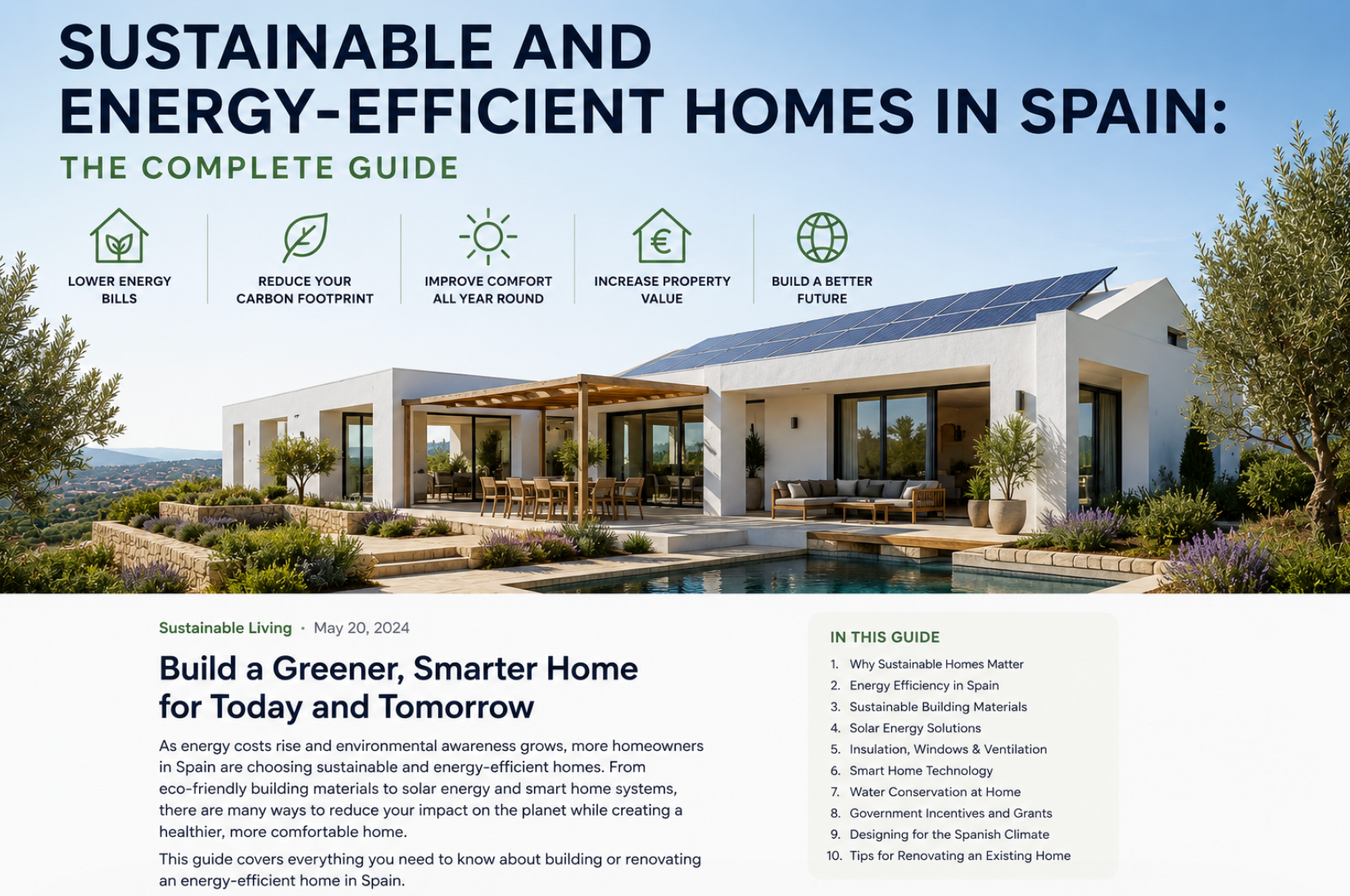
The vision of sustainable, energy‑efficient living in Spain
Spain is uniquely positioned to lead the Mediterranean in sustainable, energy‑efficient housing. With abundant sunshine, a rich tradition of climate‑sensitive architecture, and a national push towards decarbonisation, the country offers buyers and homeowners a compelling opportunity: beautifully designed homes that are healthier, cheaper to run, and more resilient to rising energy costs and climate change. This complete guide explores how to buy, design, renovate, and live in a sustainable and energy‑efficient home in Spain—whether you are seeking a minimalist city apartment, a coastal villa, or a serene rural finca.
As the property market evolves, energy performance is becoming a central factor in value. High‑efficiency homes attract stronger demand, sell faster, and command a premium, while legislative changes and shifting consumer expectations are favouring properties that meet higher environmental standards. In Spain, this change is also supported by reforms to the electricity market, new building codes that prioritise energy savings, and incentives that reward sustainable upgrades. For discerning buyers and homeowners, embracing efficiency is no longer simply a good idea; it is a strategic choice that pays dividends in comfort, wellbeing, and long‑term financial performance.
In the pages that follow, you will find an in‑depth roadmap covering Spanish regulations and climate zones, passive design strategies, high‑performance systems, water and landscape efficiency, material choices, retrofitting strategies, financing and incentives, permitting and delivery, operations and maintenance, regional best practices, and realistic case studies. It is a practical resource crafted for those who want the polished, professional insight of a high‑end advisory—so you can confidently take your next step towards a low‑carbon, high‑comfort home in Spain.
Why Spain is a leader in Mediterranean sustainable housing
Climate advantage: more comfort from less energy
Spain’s varied but largely mild climate gives it a structural advantage in the journey to energy efficiency. In Mediterranean and island regions, winters are comparatively short and heating loads are modest. Coastal breezes, clear skies, and high solar incidence enable passive strategies—like shading, optimised orientation, and natural ventilation—to reduce mechanical cooling demand dramatically. Even in the continental interior and the Atlantic north, where winters are cooler and summers can be hot, the number of extreme‑temperature days is limited relative to many northern European climates. This means that well‑designed envelopes, windows with selective coatings, and targeted airtightness can achieve excellent year‑round comfort with smaller, more efficient HVAC systems.
Historic Spanish design already demonstrates climate wisdom: deep balconies, arcades, courtyards, high thermal mass walls, and adjustable shading elements (such as persianas) are time‑tested responses to solar gain and diurnal temperature swings. Modern green building in Spain builds on this heritage with engineered envelopes, high‑performance glazing, mechanical ventilation with heat recovery, and intelligent controls. The result is higher comfort and lower energy bills—especially when paired with solar energy.
Renewables and grid reforms: a favourable landscape for self‑consumption
Spain has one of Europe’s best solar resources. Across the mainland and islands, photovoltaic (PV) systems deliver high yields, often exceeding 1,300–1,800 kWh per installed kilowatt annually depending on location. This reduces payback periods and accelerates the path to net‑zero operational energy, particularly when combined with efficient heat pumps and smart load management.
Reforms to self‑consumption rules have simplified the process for homeowners to generate and use their own power. Regulations allow individual and collective self‑consumption, simplified compensation for surplus export, and increasingly streamlined permitting in many municipalities. Batteries are becoming more cost‑effective, but in Spain’s context, many households already achieve substantial bill reductions using PV alone, leveraging daytime production to run heat pumps, pool systems, and domestic hot water production.
Consumer demand and property value
Buyers in Spain and from abroad are prioritising comfort, air quality, low running costs, and year‑round liveability. Energy‑efficient homes deliver precisely this. The market is rewarding properties with strong Energy Performance Certificates (EPCs), good insulation, modern glazing, heat pumps, and solar. Investors and second‑home buyers also recognise that sustainable features help secure bookings and better reviews for tourist rentals in regions where regulations permit it. For long‑term owners, the durability and risk reduction (against energy price volatility and climate stress) are compelling. In short, sustainability is not a niche preference in Spain—it is mainstream, rational, and increasingly fundamental to property value.
Key regulations, standards and certifications in Spain
The Spanish Technical Building Code (CTE) and DB‑HE: energy saving
Spain’s Código Técnico de la Edificación (CTE) is the backbone of building regulation. Within CTE, the DB‑HE (Documento Básico de Ahorro de Energía) sets out requirements for limiting energy demand, improving envelope performance, boosting system efficiency, and integrating renewables in new builds and major renovations. Updates in recent years have tightened U‑value limits, advanced airtightness expectations, and expanded the role of renewable energy in domestic hot water and electricity production.
Key implications for homeowners and developers include:
- Better insulation standards for roofs, walls, and floors, adapted to local climatic zones.
- High‑performance glazing with appropriate solar control for overheating mitigation.
- Minimum contributions from renewables for domestic hot water, and in many cases, electricity via PV.
- Verification of building energy demand and primary energy consumption through recognised calculation methodologies.
For buyers, a home built to the latest CTE standards is likely to be more comfortable and cheaper to run than earlier stock. For renovators, the DB‑HE framework offers technical targets that, while not always mandatory for partial works, provide valuable benchmarks for optimal performance.
Energy Performance Certificates (EPCs)
Energy Performance Certificates are mandatory when selling or renting a property in Spain, with certain exceptions. The EPC rates the property from A (most efficient) to G (least efficient), estimating annual energy consumption and associated emissions under standardised conditions. While EPCs are not a substitute for a detailed technical survey, they are a useful screening tool and a transparent baseline for comparing options.
When reviewing an EPC:
- Examine the rating band and the calculated annual kWh/m² consumption; both matter.
- Look for recommended improvement measures and their indicative savings.
- Check the validity period and whether the certificate reflects recent renovations.
Prospective buyers should treat the EPC as the first chapter of a due diligence story, not the entire book. Follow with an on‑site inspection and, if warranted, a building physics assessment to confirm air leakage, thermal bridge risks, and window performance.
Self‑consumption and surplus compensation
Spain recognises several self‑consumption modalities, allowing homeowners to generate electricity for their own use and, in many cases, receive compensation for surplus energy exported to the grid. This simplified compensation model credits exported energy against consumption on a monthly basis, up to certain limits and subject to contract terms with the energy retailer. Collective self‑consumption has opened opportunities for communities of owners to share PV systems, allocating production across multiple dwellings based on agreed distribution coefficients.
For a homeowner, the practical message is straightforward: pairing an efficient envelope with a modestly sized PV array and a right‑sized heat pump can substantially reduce bills and emissions, often without needing a large battery. Batteries add resilience and self‑consumption but should be evaluated case by case.
Nearly zero‑energy buildings (nZEB) and European alignment
Spain’s trajectory aligns with European ambitions for nearly zero‑energy buildings. New constructions are expected to achieve very low energy demand and high renewable contributions. For private buyers, that translates into homes that maintain stable comfort with small, efficient systems and have future‑proof compliance trajectories. As regulatory baselines rise, homes that far exceed minimums—through rigorous passive design and on‑site renewables—will differentiate strongly in the market.
Voluntary sustainability certifications
In addition to statutory compliance, Spain hosts a mature ecosystem of voluntary sustainability standards. Examples include passive‑house‑inspired approaches that emphasise airtightness, superior insulation, and heat‑recovery ventilation; holistic building certifications that assess energy, water, materials, site ecology, and health; and national rating tools focused on Spanish conditions. While certification is not essential to achieving outstanding performance, it provides measurable targets, third‑party verification, and marketing value for premium properties. If you choose to certify, assemble a project team with proven experience to streamline the process.
Understanding Spain’s climate zones and how they shape design
Designing or selecting an efficient home in Spain begins with climate literacy. Spain comprises several climatic regions with distinct design priorities. Get the climate right, and everything else—envelope specifications, window selection, shading strategy, and mechanical systems—falls into place.
Mediterranean coastal zones: Valencia, Costa Blanca, Costa del Sol, Catalonia coasts
Characteristics: Mild winters, hot summers, abundant sun, and sea breezes. Overheating risk is the dominant design challenge, with shoulder seasons where natural ventilation excels. Humidity can be moderate to high in some locales, influencing material selection and ventilation strategies.
Design priorities:
- Solar control is critical: deep overhangs, pergolas, adjustable exterior shading, and selective glazing reduce summer gains while admitting low winter sun where useful.
- Airtight but ventilated: combine robust airtightness with mechanical ventilation with heat recovery (MVHR) or demand‑controlled ventilation to maintain fresh air and manage humidity.
- Thermal mass moderates swings: concrete or stone floors, internal masonry walls, and shaded courtyards help buffer hot days and cool nights, especially when night‑purge ventilation is used.
- Efficient cooling: high‑SEER air‑to‑air heat pumps, ceiling fans, and zoning; hydronic radiant cooling with dehumidification can be superb where design budgets allow.
- PV is highly productive; domestic hot water can be covered by heat pump heaters or solar thermal.
Continental interior: Madrid, Castilla y León, Castilla‑La Mancha, Aragón
Characteristics: Hot summers with significant diurnal ranges, cold winters, and low humidity. Both heating and cooling loads are material. Clear skies and dry air favour radiative heat loss at night, which can be harnessed via night ventilation strategies in shoulder seasons.
Design priorities:
- High insulation standards for roofs and façades to reduce winter demand; excellent airtightness to limit infiltration.
- High‑performance glazing (low‑e, selective coatings) with appropriate solar gain control—more winter gain on south façades, stronger shading on west.
- MVHR for winter efficiency and summer by‑pass mode for cool‑night ventilation.
- Right‑sized air‑to‑water or air‑to‑air heat pumps, with underfloor radiant heating often delivering superior comfort.
- PV with possible battery to shift summer production into evening peaks; thermal storage (buffer tanks) can increase flexibility.
Atlantic north: Galicia, Asturias, Cantabria, Basque Country
Characteristics: Mild summers, cool damp winters, frequent rainfall, and overcast conditions. Heating is the primary load, while summer overheating is less common but not absent. Moisture management is crucial for durability, comfort, and indoor air quality.
Design priorities:
- Build tight and ventilate right: robust airtightness and MVHR are central to comfort and preventing condensation risk.
- Insulation continuity and thermal bridge‑free detailing to avoid winter discomfort.
- Moisture‑tolerant assemblies and rain‑screen façades; careful flashing and drainage.
- Efficient heating via air‑to‑water heat pumps, often combined with low‑temperature radiators or underfloor heating.
- PV yields are lower than in the south but still attractive; solar hot water can be supplemented by heat pumps.
Island climates: Balearic and Canary Islands
Balearic Islands: Mediterranean patterns with strong solar exposure and sea breezes; overheating and salt‑air durability shape design choices. Canary Islands: subtropical mildness with narrow temperature ranges; dehumidification and solar control are more important than heavy heating.
Design priorities:
- Emphasise shading, cross‑ventilation, and salt‑resistant materials and finishes.
- Prioritise corrosion‑resistant hardware and fixtures for coastal durability.
- Leverage PV; in the Canaries, year‑round production boosts returns.
- Optimise dehumidification strategies to maintain comfort with minimal energy input.
Passive design fundamentals for Spanish homes
Passive design reduces energy demand before you add technology. It is where sustainable homes earn their strongest returns—in comfort that does not depend on constantly running machines. In Spain, the five pillars of passive performance are orientation, envelope, glazing and shading, airtightness, and ventilation.
Orientation and massing
Optimal orientation maximises winter sun and minimises summer gains. In most of Spain, a south‑facing orientation allows precise control: admit low winter sun with limited shading, and block high summer sun with overhangs. East and west façades are trickier due to low‑angle sun; minimise glazing, or provide robust external shading. Massing should favour compact forms to reduce exposed surface area while allowing daylight penetration and cross‑ventilation. Courtyard typologies can create microclimates that decouple interior comfort from external extremes.
For renovations where orientation is fixed, refine solar control on east/west façades with adjustable external blinds, vertical fins, and selective glazing. Consider pergolas with deciduous planting for seasonal adaptability. Even small massing changes—like extending roof overhangs or adding a loggia—deliver outsized benefits for thermal comfort.
High‑performance envelopes: insulation and thermal continuity
Insulation in Spain must be tailored to climate and construction type. Aim for continuous thermal layers that wrap the building without gaps or thermal bridges at junctions. Exterior insulation systems (e.g., insulated render or ventilated façades) are particularly powerful in retrofits, allowing you to maintain interior space while addressing junctions comprehensively. Roofs and attic decks are the most cost‑effective insulation opportunities; flat roofs can be upgraded with inverted insulation above waterproofing or with warm‑roof assemblies during reroofing.
Material choices include mineral wool, PIR/PUR, wood fibre, cellulose, and EPS/XPS, each with trade‑offs in thermal performance, moisture behaviour, and embodied carbon. In humid coastal or northern climates, vapour‑open, moisture‑tolerant systems reduce condensation risks; in hot–dry interiors, lightweight assemblies with reflective barriers can be effective in attics. Always pair insulation with airtightness detailing and ensure that dew‑point calculations validate the assembly for local conditions.
Windows and glazing: the fine balance
Windows are the “thermal valves” of a home—sources of light, view, and gain—but also potential weak points. In Spain, high‑performance double glazing is often sufficient when paired with shading; triple glazing can be warranted in colder northern or high‑altitude areas, or where acoustic comfort is a priority. Focus on:
- Low‑e coatings tuned to climate; solar factor (g‑value) selected to balance winter gains with summer control.
- Thermally broken frames in aluminium, or high‑quality timber or uPVC frames rated for airtightness.
- Installation quality: perimeter air seals, sill pan flashings, and insulated window reveals to eliminate cold bridges.
For retrofits, replacing old single glazing with modern units frequently halves heat loss and significantly improves acoustic comfort. If replacement is not feasible, consider secondary glazing or interior storm panels. Always combine glazing upgrades with shading solutions to control solar gains.
Shading strategies: design that thinks like the sun
External, adjustable shading is the gold standard for controlling solar heat gain in Spain. Options include:
- Fixed overhangs sized to local solar geometry, blocking high summer sun while admitting winter light.
- Operable louvres, shutters, and persianas that occupants can modulate throughout the day.
- Pergolas with retractable sails or deciduous vines for seasonal adaptability.
- Vertical fins or sliding screens for low‑angle east–west sun.
Interior blinds reduce glare but are far less effective for heat control, as energy enters the building before being blocked. Prioritise external shading for thermal performance and complement with interior shading for visual comfort and style.
Airtightness and thermal bridges: invisible comfort
Airtightness is essential for controlling heat loss, heat gain, moisture, and indoor air quality. Aim for robust detailing at junctions—around windows and doors, at roof–wall interfaces, and through service penetrations. In renovations, an interior air barrier using membranes or continuous plaster often offers the best value. Thermal bridges—points where heat bypasses insulation—are addressed with continuous exterior insulation and careful detailing at balconies, slab edges, and lintels. Blower door tests verify performance and guide targeted improvements before finishes conceal issues.
Ventilation: fresh air without energy waste
Mechanical ventilation with heat recovery (MVHR) consistently elevates comfort and health in efficient Spanish homes. MVHR supplies filtered, fresh air, recovers heat from outgoing air in winter, and often provides a summer by‑pass for night cooling. In humid climates, hybrid approaches with demand‑controlled ventilation manage moisture efficiently. Duct layout matters: short, smooth runs reduce noise and pressure drops; supply to living rooms and bedrooms, extract from kitchens and bathrooms. Keep systems balanced and maintain filters to ensure healthful air and low energy use.
Natural ventilation still has a place. Cross‑ventilation strategies and stack effects can quickly purge heat in shoulder seasons and evenings, especially near the coast. Combine operable windows with secure insect screening and consider trickle vents in specific contexts. The best homes use both: mechanical ventilation for baseline health and natural ventilation for delight and seasonal efficiency.
Daylighting and glare control
Daylight reduces artificial lighting needs and enhances wellbeing. In Spain’s bright light, the challenge is often glare rather than quantity. Use architectural shading, light‑coloured external surfaces, and matte interior finishes to diffuse light evenly. High window head heights and clerestories bring light deep into spaces without overheating lower zones. Consider tubular daylight devices for internal bathrooms or corridors, and select lighting controls and LEDs with high efficacy for evenings.
High‑performance systems that lower bills and carbon
Once demand is minimised through passive design, efficient systems deliver the required comfort with minimal energy. The Spanish home of the future runs on heat pumps, smart controls, and solar electricity, with steady gains from domestic hot water innovations and, where appropriate, battery storage.
Heat pumps: the heart of efficient comfort
Air‑to‑air heat pumps (high‑efficiency inverter air conditioners) are a proven, cost‑effective solution for Spain’s climates. They heat and cool with excellent seasonal performance, especially in coastal and Mediterranean regions. Air‑to‑water heat pumps paired with underfloor heating/cooling or low‑temperature radiators deliver superior comfort and stability, particularly in the north and interior.
Design considerations:
- Right‑size based on calculated loads; oversizing leads to short cycling and inefficiency.
- Plan zoning carefully—day and night areas often need different set‑points.
- Combine with PV to power daytime operation; adjust schedules to match solar production.
- Allow for low‑noise external unit placement and vibration isolation; coastal installations need corrosion‑resistant units.
Distribution: radiant, fan coils, and beyond
Underfloor radiant systems offer luxurious comfort at low water temperatures, ideal for heat pumps. In cooling mode, integrate humidity control to avoid condensation, typically via a dedicated dehumidifier or air‑handling unit. Fan coils and high‑wall indoor units provide flexibility for retrofits. Ceiling fans are an elegant, low‑energy complement to any system, extending the comfort range by increasing perceived cooling.
Domestic hot water: heat pump water heaters and solar thermal
Domestic hot water (DHW) can be a surprising share of total energy use in efficient homes. Heat pump water heaters dramatically reduce energy consumption, especially when scheduled to operate during solar‑rich hours. Solar thermal remains viable, though many homeowners now favour PV plus heat pump DHW for system simplicity and integration. Pipe insulation, smart recirculation with occupancy sensors, and efficient fixtures further cut use.
Photovoltaics and batteries: harnessing Spain’s sun
Photovoltaic systems are central to Spain’s residential decarbonisation. Key points:
- Array sizing: balance roof area, consumption patterns, and tariff structures; many homes find 3–6 kWp an optimal range, with villas often installing 6–10 kWp.
- Orientation: south is ideal, but east–west arrays capture broader production windows, aligning better with household use.
- Batteries: add self‑consumption and resilience; evaluate economics based on tariffs, consumption profile, and potential for backup power in rural areas.
- Inverters and monitoring: choose quality inverters with reliable data platforms; monitoring underpins optimisation and early fault detection.
For apartments, shared PV via collective self‑consumption can allocate energy to individual meters; roof rights, community agreements, and structural assessments are key due diligence steps.
Smart controls, tariffs, and load management
Spain’s time‑of‑use tariffs and smart meters reward flexible consumption. With simple automation, households can align DHW heating, EV charging, pool pumps, and laundry with solar peaks or lower tariff periods. Smart thermostats, occupancy sensors, and zoning prevent waste. In high‑performance homes, fine control also protects comfort—careful humidity set‑points, gentle ramp rates for radiant systems, and seasonal logic for shading devices contribute to a calm, consistent indoor climate.
Water efficiency, landscaping and biodiversity
Energy efficiency pairs naturally with water stewardship in Spain, where drought cycles and heatwaves are intensifying. A sustainable home reduces potable water use, harvests and reuses non‑potable sources where permitted, and nurtures resilient landscapes that cool and regenerate the site.
Rainwater harvesting and greywater reuse
Rainwater harvesting is ideal for irrigation and, with treatment, toilet flushing or laundry in some jurisdictions. Storage tanks can be concealed under terraces or integrated into landscaping. Greywater—lightly used water from showers and basins—can be filtered and reused for irrigation or flushing subject to local rules. Systems should be designed with simple maintenance: accessible filters, clear labelling, and safe bypasses. In multi‑dwelling buildings, shared rainwater systems can deliver scale benefits.
Efficient fixtures and appliances
Water‑saving taps, dual‑flush WCs, low‑flow showers with quality aeration, and efficient dishwashers and washing machines reduce consumption without sacrificing experience. Temperature regulators protect against scalding and allow precise control. Leak detection systems with automatic shut‑off provide security for holiday homes or pied‑à‑terres left vacant for periods.
Drought‑resilient gardens and microclimate design
Xeriscaping with native or climate‑appropriate species minimises irrigation while creating lush, habitat‑rich spaces. Drip irrigation with soil moisture sensors reduces waste; mulch retains moisture and enriches soil. Deciduous trees placed strategically provide summer shade and winter sun, lowering cooling demand. Permeable paving reduces runoff and replenishes groundwater, and green roofs can moderate heat gain on flat roofs, benefiting both energy performance and biodiversity.
Pools: comfort with conscience
Pools are common in Spanish villas. Efficiency upgrades include variable‑speed pumps, high‑efficiency filters, automatic covers to curb evaporation and heat loss, and heat pump pool heaters paired with PV. Saltwater chlorination reduces chemical handling. Timers and smart controls align pump operation with solar production to keep running costs low.
Materials, embodied carbon and healthy interiors
A sustainably designed Spanish home considers not only operational energy but also the carbon embodied in materials and the health of interior environments. Choices at the specification stage can substantially cut lifetime impacts while elevating comfort, acoustics, and wellbeing.
Low‑carbon materials and assemblies
Prioritise materials with documented environmental product declarations (EPDs), recycled content, and low transport impacts. Options include:
- High‑supplementary cementitious materials in concrete (e.g., fly ash, slag) to reduce cement content.
- Recycled steel and reinforcement with verified content.
- Insulation with lower embodied carbon—wood fibre, cellulose, or mineral wool—balanced against moisture and fire performance needs.
- Locally sourced stone and ceramics where appropriate for durability and thermal mass.
Design for disassembly where possible: screwed, clipped, and lime‑based assemblies can be adapted and repaired more easily than heavily bonded layers.
Timber and engineered wood
Modern Spanish homes increasingly feature cross‑laminated timber (CLT) and glulam for structure and interiors. Timber stores carbon, speeds construction, and provides warm aesthetics. In moist climates, ensure robust detailing—rain‑screen façades, ventilated cavities, capillary breaks, and protective overhangs—to safeguard durability. Interior timber finishes should use low‑VOC oils or water‑based varnishes to preserve indoor air quality.
Recycled and reclaimed content
Reclaimed timber, tiles, and architectural elements integrate beautifully in Spanish homes, especially in renovations that celebrate heritage while upgrading performance. Recycled aggregates for sub‑bases, reclaimed roof tiles, and reuse of structural elements (where certified) can cut embodied carbon and imbue spaces with character. Factor in testing and certification costs when salvaging load‑bearing components.
Low‑VOC finishes and indoor air quality
Healthy interiors use low‑VOC paints, adhesives, sealants, and cabinetry free of added formaldehyde. MVHR with high‑quality filters improves air cleanliness, reducing pollen and fine particulates—valuable in urban centres and during Saharan dust episodes affecting parts of Spain. Maintain positive hygiene in wet rooms with vapour‑open yet water‑resistant finishes and continuous extraction with humidity sensors.
Acoustic and thermal comfort metrics
Beyond kilowatt‑hours, comfort is what occupants feel. Aim for steady indoor temperatures (typically 20–22°C in winter, 24–26°C in summer, adjusted for humidity and personal preference) and low radiant asymmetry to avoid cold drafts or overheated glazing. Acoustic comfort involves façade sound insulation in cities, impact noise isolation between floors in apartments, and calm mechanical systems—select quiet fans, isolate pumps, and design ductwork for low velocities. Spanish masonry construction often has good mass for sound control, but junctions and penetrations can undermine performance if not detailed carefully.
New‑build versus retrofit in Spain
Spain’s existing building stock offers enormous potential for energy savings. Whether you build new or renovate, the path to sustainability is clear—but the strategies differ.
Property types and typical retrofit opportunities
Urban apartments (1960s–1990s): Commonly feature single glazing, minimal wall insulation, and centralised but inefficient systems. Upgrades include window replacement, internal wall insulation or insulated ventilated façades at the building scale, MVHR or demand‑controlled ventilation, and heat pump retrofits. In community buildings, shared PV and roof insulation deliver collective benefits.
Coastal villas (1980s–2000s): Often generous glazing without effective shading, hollow brick walls with limited insulation, and older air‑conditioning units. Best gains come from external shading, roof insulation, air‑to‑air or air‑to‑water heat pumps, pool system optimisation, and PV. Airtightness improvements and sealing of service penetrations are high‑value, low‑cost measures.
Historic townhouses and fincas: Thick masonry provides thermal mass but may lack damp management and insulation. Lime‑based renders, capillary‑active interior insulation, and careful ventilation strategies are essential. Prioritise moisture safety and breathability. Replace or refurbish windows with heritage‑appropriate, high‑performance glazing. Add discreet shading and, where allowed, PV integrated sympathetically.
Contemporary new builds: If recent but pre‑update CTE, target incremental upgrades—improved controls, additional PV, better shading, and ventilation enhancements. Commissioning and tuning often unlock surprising performance gains.
Phased retrofit planning
Deep retrofits can be staged to match budgets and minimise disruption. A typical sequence:
- Audit and plan: energy assessment, blower door test, thermography, moisture diagnostics, and a costed roadmap prioritising quick wins and synergy.
- Envelope first: roof insulation, window upgrades, external shading, and airtightness repairs. Address water ingress and damp before adding insulation.
- Ventilation: integrate MVHR or improved extraction with supply air, ensuring balanced fresh air and humidity control.
- Systems: replace boilers or resistive heaters with heat pumps; upgrade distribution; install heat pump water heater.
- Renewables: add PV sized to reduced loads; consider batteries based on usage profile.
- Finishes and fine‑tuning: low‑VOC finishes, lighting upgrades, and smart controls with monitoring to verify performance.
Costs and returns: indicative ranges
Costs vary by region, specification, and contractor. Indicative residential ranges in Spain (subject to detailed design):
- Window replacement to high‑performance double/triple glazing: €400–€900 per m² of window area installed.
- External insulation and render (ETICS): €80–€150 per m² of façade, depending on thickness and finish.
- Roof insulation upgrades: €40–€120 per m²; more for complex flat roof assemblies.
- MVHR system retrofit: €4,000–€12,000 depending on size and ducting complexity.
- Air‑to‑air heat pumps (multi‑split): €2,500–€8,000+ depending on zones and capacity.
- Air‑to‑water heat pump with underfloor heating (new‑build or major refurb): €12,000–€30,000+.
- PV systems: €900–€1,600 per kWp installed; inverters and scaffolding influence totals.
- Heat pump water heater: €1,800–€3,500 installed.
Savings depend on baseline, climate, and occupant behaviour. Well‑planned packages often achieve 40–70% reductions in energy bills, with paybacks shortened by grants and rising energy prices. Comfort, health, and resilience benefits compound the financial case, as do appreciation and improved saleability.
Common pitfalls and how to avoid them
- Partial measures without strategy: avoid installing a new heat pump before reducing loads with shading and insulation.
- Ignoring moisture: in humid or historic buildings, vapour‑closed interior insulation can trap moisture—use capillary‑active systems and ventilated façades where appropriate.
- Poor detailing: thermal bridges, leaky window perimeters, and unsealed penetrations undermine performance.
- Overlooking ventilation: airtight homes without balanced ventilation risk condensation and poor air quality.
- Under‑commissioning: systems not tuned to real‑world use perform worse; insist on commissioning and user training.
Financing, incentives and insurance
Spain supports energy efficiency through grants, fiscal measures, and favourable finance, often co‑funded by European instruments. Availability evolves, so confirm current programmes and eligibility during planning.
Grants and programmes
Spain has implemented building rehabilitation programmes aimed at improving energy performance, with particular support for envelope upgrades, heat pump installations, and renewable integration. Some initiatives prioritise smaller municipalities or focus on deep retrofits achieving specified percentage savings. Regional governments frequently administer funds, layering local incentives on top of national frameworks. For multi‑dwelling buildings, collective projects may qualify for higher support rates, especially where accessibility or envelope improvements benefit the entire community.
Key takeaways for homeowners:
- Grants often require pre‑approval; do not start works until your application is accepted.
- Energy savings must typically be demonstrated; an audit by a qualified professional is valuable.
- Eligible measures and maximum amounts per dwelling vary; packages targeting at least 30% demand reduction generally receive stronger support.
Tax deductions and local rebates
Spain has offered personal income tax deductions for energy‑efficiency improvements achieving defined savings thresholds, alongside occasional property tax (IBI) reductions in certain municipalities for solar installations or energy upgrades. As tax measures are time‑limited and subject to extension or modification, obtain current advice and plan upgrades to meet thresholds within qualifying periods. Keep invoices, professional certificates, and energy calculations to substantiate claims.
Green mortgages and private finance
Financial institutions in Spain increasingly offer green mortgages or preferential rates for energy‑efficient homes and renovations. Favourable terms may apply to properties with high EPC ratings or to borrowers committing to upgrades that achieve substantial savings. Combining a green mortgage with grants can materially improve project feasibility. For holiday or investment properties, factor in improved rental performance and reduced running costs when sizing finance.
Insurance, warranties and risk management
For new builds and major structural works, Spain’s decennial structural warranty regime protects against major defects. Ensure proper policies are in place and that contractors provide guarantees for building services, PV components, and waterproofing. Commissioning reports, pressure tests, and photographic records of concealed assemblies help evidence quality and support any future claims. For coastal properties, verify that corrosion‑prone elements (outdoor units, fixings) are specified appropriately; insurers will look favourably on durable detail.
Buying an energy‑efficient home in Spain: due diligence
Purchasing a sustainable property in Spain blends standard legal diligence with technical assessments. Approach the process methodically to ensure performance aligns with expectations.
Interpreting the EPC and beyond
Use the EPC as a starting point to understand the property’s baseline. Compare the rating and estimated energy consumption to similar properties. Review recommended measures and ask whether any have been completed. However, be aware that EPCs reflect standardised assumptions and may not capture issues like air leakage or poor controls. For properties marketed as “eco” or “highly efficient,” request detailed documentation: insulation specifications, window performance (U‑values and g‑values), heating and ventilation system details, and PV system data.
Technical surveys and performance testing
Commission a building surveyor or architect with energy expertise to inspect the property. Priority checks include:
- Envelope integrity: insulation continuity, signs of damp, thermal bridges at balconies or lintels.
- Windows and doors: glazing type, frame quality, seals, and installation details.
- Ventilation: presence and condition of MVHR or extraction systems; airflow balancing records.
- Systems: age, capacity, and efficiency ratings of heat pumps; maintenance records; controls and zoning.
- Renewables: PV size, inverter model, production history, roof condition, and structural adequacy.
Where practical, request a blower door test to quantify airtightness and a thermographic survey to identify hidden defects. These are small investments that provide clarity and negotiating leverage.
Legal checks: permits, licences, and community rules
Verify that any extensions, structural renovations, PV arrays, or significant systems have the requisite municipal permits and, where relevant, community of owners’ approvals. Confirm habitability certificates and, for investment properties, whether local regulations allow tourist rentals and what energy or sustainability conditions apply. In protected areas or heritage buildings, sustainability improvements must be reconciled with conservation requirements—planning ahead avoids delay.
Community of owners considerations
In apartment buildings, the community of owners can be a powerful ally for sustainability. Collective roof insulation, façade upgrades, shared PV, and centralised heat pump systems spread costs and amplify benefits. Review community statutes for provisions enabling energy works, examine reserve funds and planned capital works, and gauge support for sustainability upgrades among neighbours. Properties in proactive communities often achieve better long‑term value.
Building or renovating in Spain: permits, teams and delivery
A successful sustainable project in Spain hinges on an integrated team and a disciplined process. Align architect, engineer, energy modeller, contractor, and commissioning agent early. Clear goals, rigorous details, and quality control are non‑negotiable.
Permits and approvals
Municipal permits vary by scope, from minor works licences for interior upgrades to full building permits for structural changes, extensions, and façade modifications. PV installations often follow simplified procedures but still require registration and utility notifications for self‑consumption. Early engagement with the local planning office helps clarify requirements, especially in coastal, rural, or heritage zones where additional constraints may apply.
Assembling the right professionals
Core team members include:
- Architect: leads design, planning, and often energy concept integration.
- Quantity surveyor or technical architect: cost control, technical detailing, and site oversight.
- MEP engineer: designs HVAC, ventilation, hot water, and controls with an efficiency focus.
- Energy modeller: quantifies design choices, optimises envelope and systems, and supports grant applications.
- Specialist contractors: experienced installers for MVHR, heat pumps, and PV are essential for performance.
- Commissioning agent: verifies installation and performance; conducts blower door tests and system balancing.
Choose teams with proven experience delivering efficient homes in Spain’s climates. References and site visits to completed projects are invaluable.
Procurement and contracts
Performance‑based specifications keep everyone aligned: define target airtightness (e.g., air changes per hour at 50 Pa), U‑values, shading factors, and system efficiencies. Include commissioning requirements and documentation deliverables (as‑built drawings, manuals, and maintenance plans). Fixed‑price or guaranteed maximum price contracts with clear scopes reduce variation risk; provisional sums can be used judiciously for unknowns in complex retrofits.
Quality control, commissioning, and handover
Quality control should be visible and continuous. Hold pre‑installation workshops for airtightness detailing, window installation, and MVHR ductwork. Conduct interim blower door tests while details remain accessible. Commissioning at the end verifies that systems meet design intent—airflow balancing, control sequences, heat pump performance, and safety systems all receive documented checks. Handover includes user training and a seasonal tuning plan to adjust settings after occupants move in.
Operations, maintenance and living well
Efficient homes stay efficient when operated and maintained with intention. The good news: with a strong design, day‑to‑day living is simple—comfortable temperatures, clean air, and low bills come naturally. A few habits and occasional checks keep everything at its best.
Seasonal maintenance checklists
- Spring: clean PV modules if safe access is available; check shading devices; service MVHR (filters and fans); inspect exterior seals.
- Summer: verify cooling set‑points and humidity control; ensure shading schedules are correct; confirm pool covers and pumps are optimised.
- Autumn: test heating operation; flush condensate drains; inspect roof and gutters; review hot water schedules for cooler months.
- Winter: check for drafts indicating seal degradation; monitor energy use against expectations; schedule any essential servicing for shoulder seasons.
Monitoring and optimisation
Use your inverter app, heat pump dashboard, and smart meter to understand patterns. If PV export is high at midday, consider shifting loads—DHW heating, laundry, or EV charging—to those hours. If humidity regularly exceeds comfort targets, adjust ventilation rates or enable dehumidification schedules. Monitoring is not about micromanaging; it is about making a handful of smart tweaks with big payoffs.
Behavioural tips for comfort and savings
- Let the building work: keep windows closed during peak heat; open strategically in the evening for night‑purge cooling in shoulder seasons.
- Use shading proactively: external blinds down before rooms heat up, especially on east and west façades.
- Set realistic temperatures: each degree of cooling consumes materially more energy; fans extend comfort.
- Maintain filters: MVHR and heat pump filters are inexpensive and vital for efficiency and air quality.
Waste management and circularity
Designate well‑organised recycling and composting areas. During renovations, prioritise deconstruction over demolition to salvage reusable materials. Choose modular, repairable fixtures and appliances. Select durable finishes that age gracefully, reducing the need for replacement. Circular thinking strengthens sustainability beyond energy, delivering homes that respect resources throughout their life cycles.
Regional spotlights: best practices across Spain
Andalusia and the Costa del Sol
Overheating control defines success along the sun‑drenched southern coast. Homes that pair deep, architecturally expressive shading with selective glazing, ceiling fans, and zoned air‑to‑air heat pumps provide year‑round comfort. PV thrives; many villas offset a large share of electricity including pool systems. Salt‑air durability is non‑negotiable near the sea: specify marine‑grade finishes and protect outdoor units. In Seville and inland Andalusia, the diurnal swing makes night cooling powerful—combine with high thermal mass and careful window management.
Valencia and the Costa Blanca
Mediterranean breezes and bright skies invite cross‑ventilation and verandas. Sliding screens, pergolas, and deciduous planting soften solar exposure and extend outdoor living seasons. Apartment retrofits commonly focus on glazing, shading, and efficient splits; building‑scale PV and roof insulation can be game changers. Villas benefit from air‑to‑water heat pumps for radiant floors—pleasant in winter—plus PV for domestic loads. Water stewardship is important during dry periods; drip irrigation and drought‑tolerant landscaping are appreciated by buyers and guests alike.
Catalonia and Barcelona
Dense urban contexts elevate the value of acoustic comfort, shading on façades with complex exposures, and high‑quality ventilation and filtration. Heritage façades require sensitive interventions: interior insulation must be vapour‑open and thermally bridge‑aware. Smart controls and metering support city dwellers’ variable schedules. In the Costa Brava, combine shading, cool roofs, and careful detailing to resist salt air. Collective PV on apartment buildings is increasingly viable—leadership within communities accelerates adoption.
Madrid and the central plateau
Madrid’s hot summers and chilly winters reward serious envelopes: insulated façades and roofs, low‑e glazing, and very good airtightness. MVHR enhances winter comfort and health during pollution peaks. Air‑to‑water heat pumps feeding underfloor heating/cooling balance the seasons elegantly, with dehumidification in summer to avoid condensation. PV productivity is solid; east–west arrays broaden generation to better match daily life. Urban apartments gain much from acoustic upgrades and careful shading on west façades.
Galicia, Asturias, Cantabria, and the Basque Country
Moisture management comes first in the green north. Rain‑screen façades, vapour‑open insulation, and rigorous airtightness support comfort and durability. MVHR with high‑performance filters enhances health through pollen seasons. Heating loads are higher than the Mediterranean; air‑to‑water heat pumps and low‑temperature radiators are steadfast choices. PV yields are lower but attractive with self‑consumption; consider higher tilt angles to favour winter and shoulder‑season production. Landscaping celebrates lushness while minimising maintenance and avoiding waterlogging near foundations.
Balearic and Canary Islands
In the Balearics, manage heat and humidity while cherishing island light and materials. Stone, lime plasters, and timber blend tradition with performance when paired with shading and ventilation. In the Canaries, narrow temperature ranges mean modest heating or cooling loads; efficient dehumidification and solar control can achieve comfort with minimal energy. PV is exceptionally productive in many island locations, making near‑net‑zero operation feasible for homes that embrace efficient systems.
Case studies and costed scenarios (illustrative)
Retrofit: 1970s Valencia apartment (85 m²)
Baseline: single glazing, no wall insulation, old AC units, electric resistance water heater. Summer overheating and winter drafts; EPC F.
Measures:
- High‑performance double glazing with thermally broken frames; external roller shutters.
- Internal wall insulation on north and west walls (vapour‑open), airtightness improvements at junctions.
- MVHR with compact ducting above corridor ceilings.
- Multi‑split inverter heat pumps for living and bedrooms; ceiling fans.
- Heat pump water heater scheduled midday; LED lighting and smart controls.
- Participation in building‑scale PV (3 kWp share allocated) via collective self‑consumption.
Indicative cost: €22,000–€35,000 depending on finishes and PV allocation. Outcome: EPC B/C, 55–65% energy bill reduction, markedly improved comfort and acoustics.
New‑build net‑zero villa: Marbella (240 m²)
Design: south‑facing living zones, deep overhangs, ventilated façade, high‑performance envelope, and airtightness target of 1.0 ACH50. MVHR with summer by‑pass; air‑to‑water heat pump with underfloor heating/cooling and dedicated dehumidification. 10 kWp PV with 10 kWh battery; pool with variable‑speed pump and cover; drought‑resilient landscaping.
Indicative premium over conventional build: 6–12%, with operating costs near zero on an annualised basis; excellent resilience and comfort. Market value uplift supported by demand for low‑running‑cost villas and robust year‑round liveability.
Deep retrofit: Seville townhouse (160 m²)
Context: historic façade retained; interior reconfiguration around a shaded patio. Lime plasters; capillary‑active interior insulation; new timber windows with selective glazing and external shutters. MVHR; ceiling fans; multi‑split heat pumps; PV integrated on rear roof hidden from street view. Rainwater tank for irrigation; microclimate planting.
Outcome: bright, cool interiors in summer without excessive mechanical cooling; warm in winter with modest heat input. Heritage character celebrated with contemporary performance. EPC moves from E/F to B.
Rural finca: Mallorca off‑grid‑ready (180 m²)
Approach: maximise passive cooling with cross‑ventilation and thermal mass; large pergola with deciduous vines; MVHR for filtration and winter efficiency. PV 8 kWp with battery sized for evening loads and modest backup generator for extended cloudy periods. Heat pump water heater, efficient appliances, and water harvesting with drip irrigation. Materials prioritise local stone and timber with low‑VOC finishes.
Result: resilient lifestyle with minimal grid reliance; comfortable through heatwaves with shading, fans, and occasional targeted cooling. Running costs and environmental footprint greatly reduced.
Investment perspective: resale, rental and long‑term value
Premiums for green features
In Spain’s prime and lifestyle markets, energy‑efficient homes increasingly command price premiums. Buyers value tangible features—EPC ratings, PV production history, heat pump specifications, and measured airtightness—alongside intangible qualities like silence, stable temperatures, and beautifully managed light. In competitive markets, these features help properties stand out and sell faster.
Tourist rentals and efficiency
Where short‑term rentals are permitted, efficient homes perform well. Reduced running costs support net yields, while comfort translates to positive reviews even during peak summer periods. Smart meters and sub‑metering, along with clear user guides for shading and cooling, minimise energy waste. Ensure that any rental activity complies with local licensing and building standards, including safety and habitability criteria.
Corporate relocation and expat appeal
International tenants and relocating professionals often prioritise quality of life—air quality, acoustics, connectivity, and low operating costs. Sustainable features align with corporate net‑zero goals and personal values, widening your tenant pool and strengthening occupancy prospects. For furnished rentals, efficient appliances and good ventilation are visible differentiators.
Checklists and step‑by‑step roadmaps
Buyer’s quick checklist for energy‑efficient homes
- Review the EPC: rating, kWh/m², and recommendations.
- Request documentation: insulation specs, glazing details, HVAC and MVHR data, PV system information.
- Inspect shading: external devices on east/west façades; overhangs on south.
- Assess airtightness indicators: modern seals, quality window installation, minimal drafts.
- Confirm permits and warranties for energy works.
- Consider a blower door and thermographic survey.
- Evaluate roof for PV potential; check community rules (apartments).
Retrofit roadmap: from audit to optimisation
- Set goals: comfort targets, EPC band, emissions reduction, budget.
- Audit: energy modelling, moisture assessment, and on‑site diagnostics.
- Envelope phase: roof and façade insulation, high‑performance windows, airtightness, shading.
- Ventilation: MVHR or balanced systems with filtration and humidity control.
- Systems: heat pumps for space conditioning and DHW; controls and zoning.
- Renewables: PV sized to reduced loads; evaluate batteries.
- Water: efficient fixtures, rainwater/greywater where allowed, drought‑tolerant landscaping.
- Commissioning and handover: testing, documentation, and user training.
- Monitor and tune: use data to refine schedules and set‑points.
New‑build roadmap: integrated from day one
- Brief: define sustainability targets, certifications (if any), and comfort criteria.
- Concept: orientation, massing, and climate‑specific passive strategies.
- Design development: envelope specs, shading, glazing, airtightness detailing, and MVHR layout.
- Systems integration: heat pumps, DHW strategy, PV and electrical planning, smart controls.
- Documentation: performance‑based specs; draw details for critical junctions.
- Procurement: select experienced contractors; align contracts with performance goals.
- Construction: quality control, interim blower door tests, and site coordination.
- Commissioning: verify performance; adjust controls seasonally.
- Aftercare: monitor, maintain, and refine.
How IMMO ABROAD helps you succeed sustainably
From sourcing to handover, sustainable property decisions benefit from expert guidance grounded in Spain’s diverse climates, regulations, and market dynamics. With a clear focus on energy performance and long‑term value, IMMO ABROAD supports you at every step.
Advisory for buyers and owners
IMMO ABROAD helps define your sustainability brief, assess EPCs and technical documentation, and coordinate building surveys with energy specialists. Whether you seek a turnkey efficient home or a value‑add renovation opportunity, you receive insight into climate‑specific strategies, running‑cost modelling, and resale considerations.
Property sourcing, due diligence, and project coordination
For purchases, IMMO ABROAD identifies properties with strong fundamentals—orientation, structural integrity, and upgrade potential. During due diligence, you benefit from coordinated technical inspections, review of permits and community rules, and feasibility studies for PV, heat pumps, and envelope upgrades. If you proceed to build or renovate, IMMO ABROAD can help assemble the right professional team, structure performance‑based scopes, and maintain quality oversight through commissioning and handover.
A commitment to sustainability and client success
IMMO ABROAD understands that a sustainable home in Spain is more than a checklist—it is a refined living experience that blends architecture, technology, and place. You gain a partner focused on delivering comfort, health, efficiency, and enduring market appeal, all while respecting local character and environmental stewardship.
Frequently asked questions
Will an energy‑efficient home in Spain cost more to build?
Expect a modest premium compared to a standard build, often in the 5–12% range for high‑performance envelopes, quality systems, and PV. However, operating costs fall sharply, comfort improves, and marketability increases—factors that offset initial investment. Strategic design and competitive procurement can keep premiums tight without compromising outcomes.
Is triple glazing necessary in Spain?
Not always. In many Mediterranean locations, high‑quality double glazing with selective coatings performs very well when paired with external shading. Triple glazing is advantageous in colder northern regions, high altitudes, or where acoustic attenuation is a priority. The decision should follow climate, orientation, and acoustic context.
How large should my PV system be?
Size PV to match your consumption profile after efficiency measures. Many detached homes settle between 3–10 kWp depending on loads (HVAC, pool, EV). East–west arrays may be preferable to a pure south orientation if you value broader production over midday peaks. Batteries add flexibility but evaluate economics relative to your tariff and usage.
What is the single best first step in a retrofit?
Start with a professional audit to build a sequenced roadmap. In practice, roof insulation, airtightness repairs, external shading, and window upgrades often deliver the best early returns. Replacing old resistive heating or ageing AC with heat pumps is also highly impactful—ideally after reducing loads.
Do I need MVHR in a Spanish home?
For high‑performance, airtight homes, MVHR is strongly recommended. It delivers continuous fresh air, filters particulates, and recovers heat in winter. In hot, humid zones, hybrid ventilation or dehumidification strategies may complement MVHR for summer comfort. In leaky, older homes, upgrading airtightness and adding balanced ventilation can transform comfort and health.
Can I install PV in an apartment?
Yes, through collective self‑consumption with your community of owners, subject to roof rights and structural capacity. Energy is allocated to individual meters based on agreed distribution. Alternatively, some apartments with exclusive roof terraces can install private arrays with community approval. Engage early with the community to align interests.
How do I protect systems near the coast?
Choose corrosion‑resistant outdoor units and fixings, specify protective coatings, and locate equipment away from direct salt spray when possible. Plan for regular rinsing and maintenance. Quality components and careful placement extend service life and preserve efficiency.
What EPC rating should I aim for?
In most contexts, a B or better signals strong performance; many new builds and deep retrofits achieve A ratings. Focus on both the letter grade and the underlying kWh/m² figure, as well as qualitative comfort factors (noise, temperature stability, air quality).
Are batteries worth it in Spain?
Batteries increase self‑consumption and provide backup in rural areas. Their value depends on your tariff, daily consumption pattern, and tolerance for export compensation. Start with efficiency and PV; add batteries when the data suggests clear benefits for your household.
Will a heat pump keep me warm in the northern regions?
Yes. Modern air‑to‑water heat pumps perform well in Spain’s northern climates when properly sized and paired with low‑temperature emitters. Good envelope performance and airtightness are key. Underfloor heating or upgraded radiators ensure comfort at efficient water temperatures.
Conclusion: a future‑proof home in Spain
Sustainable and energy‑efficient homes in Spain are no longer aspirational concepts; they are the new benchmark for comfort, resilience, and enduring value. The country’s exceptional solar resource, climate‑smart traditions, and evolving regulatory support make high performance both attainable and desirable. Whether you are renovating a coastal villa, reimagining a historic townhouse, or commissioning a new‑build retreat, the path is clear: start with passive design, invest in a quality envelope, ventilate with care, choose efficient systems, and harness the sun.
As energy costs fluctuate and climate pressures intensify, your home should stand calm and comfortable—cool when the heat rises, warm through crisp winters, and quietly efficient all year round. With thoughtful design, skilled delivery, and the right guidance, you can achieve a refined living experience that respects Spain’s landscapes and secures long‑term value. When you are ready to take the next step, align with expertise that understands the subtleties of Spanish climates, regulations, and markets. IMMO ABROAD is committed to helping you realise a sustainable, energy‑efficient home in Spain that you will be proud to own and delighted to live in.